
-
Size
Up to 18 inches (46 cm) -
Diet
Crustaceans, bivalves and small fishes -
Range
Western Atlantic -
Habitat
Coral and rocky reefs and drop-offs
Physical Characteristics
- Reaches a maximum length of about 18 inches (46 cm). The maximum published weight is 1.7 lbs. (771 g).
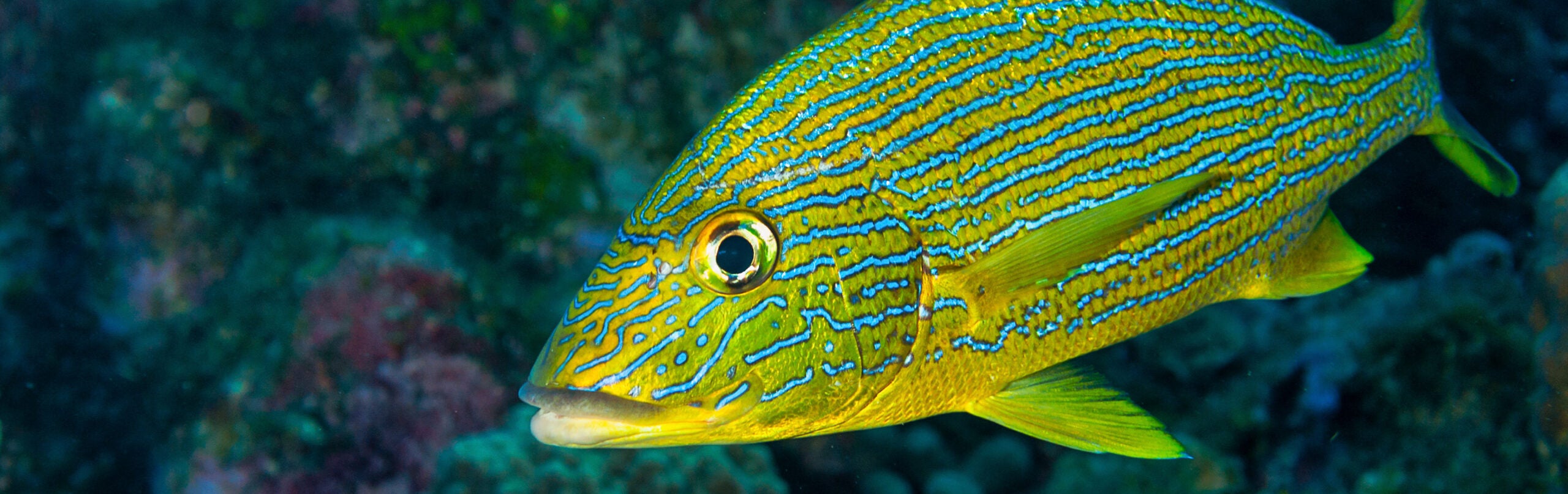
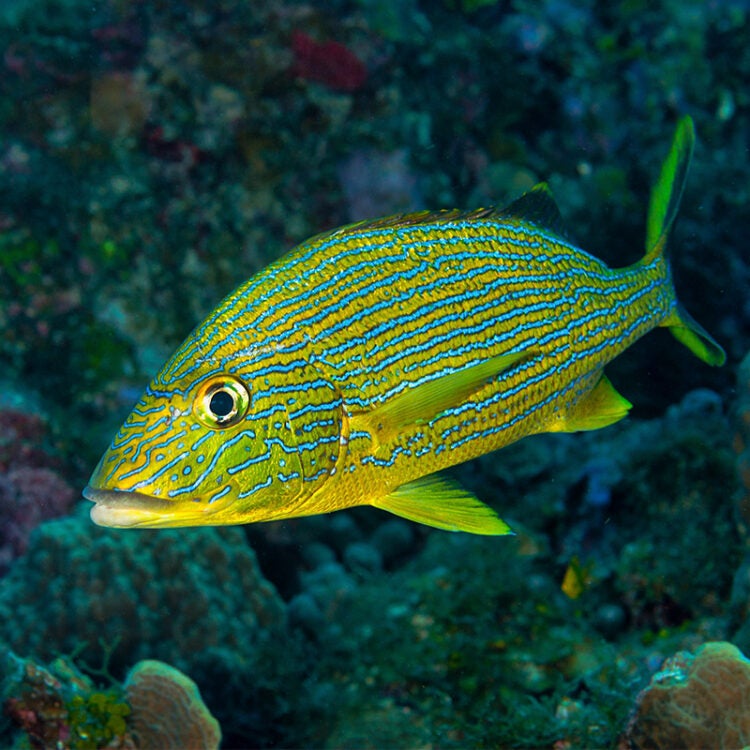
- Has a yellow head and body with narrow horizontal blue stripes along the head and length of its body. It has a blue stripe under the eye that has a distinctive arch. Its dorsal fin is spiny and yellow.
- The caudal, or tail, fin is black, which easily distinguishes it from the similar-appearing French grunt, whose tail is yellow.
Diet / Feeding
- Diet consists of crustaceans, bivalves and occasionally on small fishes.
Range / Habitat
- Occurs in the Western Atlantic from Florida to Brazil, including the Gulf of Mexico and the Caribbean Sea.
- Found over coral and rocky reefs and drop-offs.
- Juveniles are abundant in Thalassia, or turtle grass, sea grass beds, with subadults preferring mangrove habitats.
- Depth range of about 100 feet (30 m), with adults living in the deepest parts of the range, sub-adults in the moderate depths, and juveniles in the shallowest depths.
Reproduction & Growth
- Oviparous, or egg-laying, with distinct pairing during breeding.
Conservation Status
- “Least Concern” on the IUCN Red List.
Additional Information
- Congregates in small to mid-sized schools that are usually found near drop-offs and reefs, which provide structural protection.
- Schooling behavior is believed to confuse predators, protecting as many fish as possible within the school.
- Inactive schools seen during the day are taking a rest from the long nights of searching for food.
- Will hover in mid-water at cleaning stations. Observed opening its mouth to be cleaned by juvenile porkfish.
Sources
- Reef Fish Behavior. Human, P. and Deloach, N., pgs. 44, 106, 107, 202
- Reef Fish Identification. Human, P. and Deloach, N., pg. 92