


Education
Sea Scholars
Bring Georgia Aquarium to your Classroom
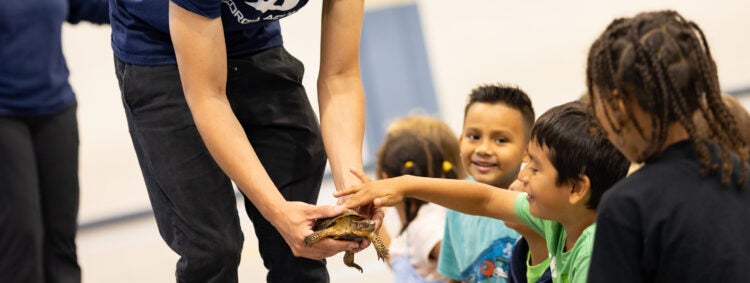
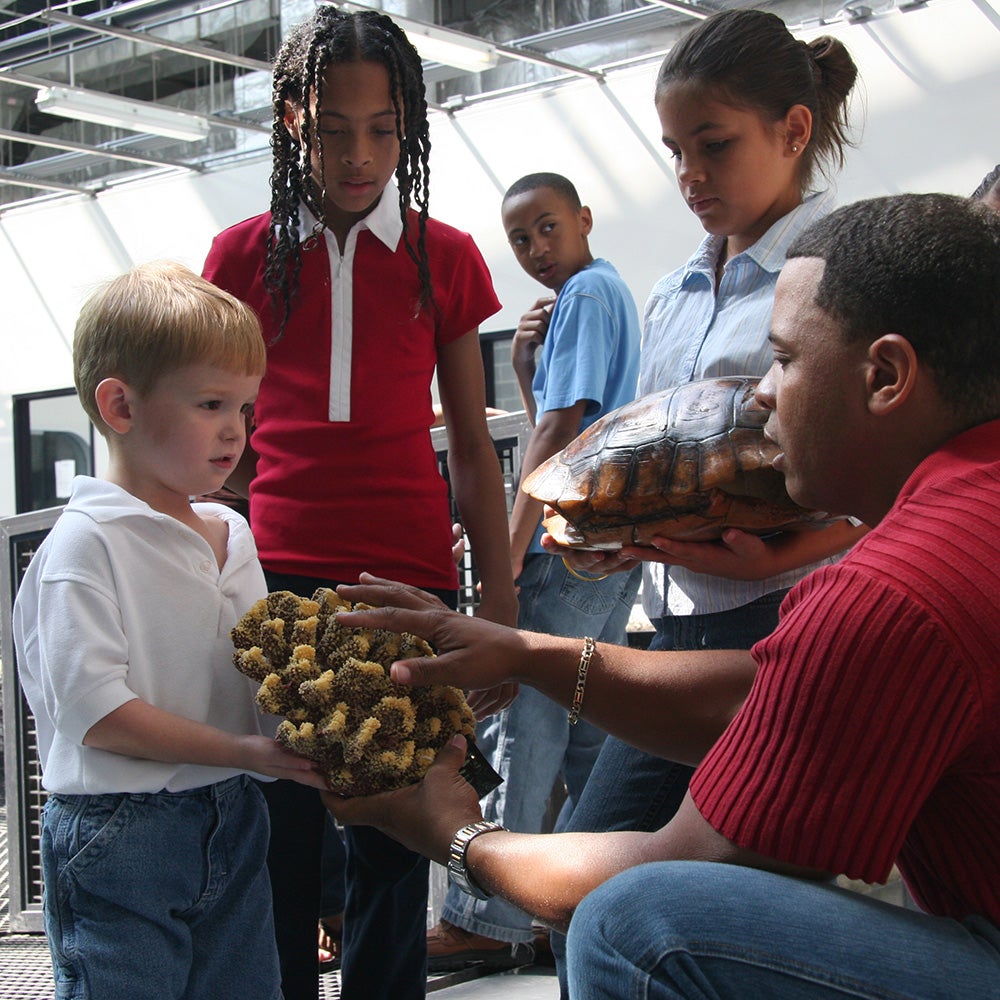
Bring the wonders of the ocean directly to your classroom with our classroom outreach program, Sea Scholars. Our expert educators transport a piece of the marine world to you, with interactive presentations, live animal encounters, and hands-on activities. Students embark on a journey through diverse aquatic ecosystems, learning about marine biology, conservation challenges, and the importance of ocean preservation. It’s an immersive experience that sparks curiosity and enhances understanding, inspiring the next generation of marine enthusiasts and environmental stewards right in your own school.
All of our programs are aligned with Georgia Standards of Excellence and are structured for the appropriate grade level of your students. Find the best program for your class below.
Sea Scholars is available year-round, Monday through Friday. Please note, blackout dates apply.
Available Programs
-
Primary - Grades K-5
Do the Locomotion
Have you ever wanted to swim as fast as a sea lion, or jump as high as a dolphin? Animals have all kinds of interesting adaptations that allow them to get from one place to another, from penguins that waddle on two feet to snakes that slither without any feet at all! Come along as we learn about the different ways that animals move their bodies, and discover how animals in many different ecosystems are able to navigate their habitats.
Georgia Standards of Excellence:
SKP2. Obtain, evaluate, and communicate information to compare and describe different types of motion
b. Construct an argument as to the best way to move an object based on its physical attributes.
S2P2. Obtain, evaluate, and communicate information to explain the effect of a force (a push or a pull) in the movement of an object (changes in speed and direction).
a. Plan and carry out an investigation to demonstrate how pushing and pulling on an object affects the motion of the object.
NGSS:
2-PS1-1. Plan and conduct an investigation to describe and classify different kinds of materials by their observable properties.
CD-SC3 The child will demonstrate knowledge related to living things and their environments.
CD-SC3.1b Explores characteristics of living things.
Turtle-y Awesome
Do you know the differences between turtles and tortoises? There are actually quite a few ways to tell! Each species has unique characteristics and diets that allow them to survive in their habitats. Swim on over (or walk on down!) to discover the distinct and turtle-y awesome ways that these animals differ, and what we can do to protect these amazing creatures!
Georgia Standards of Excellence:
SKL2. Obtain, evaluate, and communicate information to compare the similarities and differences in groups of organisms.
a. Construct an argument supported by evidence for how animals can be grouped according to their features.
S3L1: Obtain, evaluate, and communicate information about the similarities and differences between plants, animals, and habitats found within geographic regions (Blue Ridge Mountains, Piedmont, Coastal Plains, Valley and Ridge, and Appalachian Plateau) of Georgia.
b. Construct an explanation of how external features and adaptations (camouflage, hibernation, migration, mimicry) of animals allow them to survive in their habitat.
Next Generation Science Standard:
K-ESS3-3. Communicate solutions that will reduce the impact of humans on the land, water, air, and/or other living things in the local environment.*
Ribbit or Reptile?
From our backyards to the deepest jungles, the world is full of fascinating creatures! Even among millions of vertebrates, reptiles and amphibians abound in plenty with their slithery, scaly, slimy, and smooth characteristics. While they might share some traits, there’s more to each than meets the eye! By understanding their distinctions, we can build a deeper understanding and appreciation for some nocturnal neighbors. Dig in deep to discern the truth of each of these groups from their tails to their teeth!
Georgia Standards of Excellence:
S2L1 Obtain, evaluate, and communicate information about the life cycles of different living organisms.
a. Ask questions to determine the sequence of the life cycle of common animals in your area: a mammal such as a cat, dog or classroom pet, a bird such as a chicken, an amphibian such as a frog, and an insect such as a butterfly.
S5L1. Obtain, evaluate, and communicate information to group organisms using scientific classification procedures.
a. Develop a model that illustrates how animals are sorted into groups (vertebrate and invertebrate) and how vertebrates are sorted into groups (fish, amphibian, reptile, bird, and mammal) using data from multiple sources.
Next Generation Science Standard:
4-LS1-1. Construct an argument that plants and animals have internal and external structures that function to support survival, growth, behavior, and reproduction.
Survival of the Fittest
Dive into the deep and discover what it takes to survive beneath the waves! From tiny plankton to mighty whales, all aquatic life depends on a few key things to stay alive. These basic needs help us explore how creatures thrive in their habitats. Once we understand what plants and animals need to survive, we can follow the flow of energy through aquatic food chains and food webs and uncover the amazing ways everything is connected below the surface. Join us as we explore the foundations of aquatic ecosystems and the fascinating relationships that keep marine life in motion!
Georgia Standards of Excellence:
S1L1. Obtain, evaluate, and communicate information about the basic needs of plants and animals.
b. Ask questions to compare and contrast the basic needs of plants (air, water, light, and nutrients) and animals (air, water, food, and shelter).”
S4L1. Obtain, evaluate, and communicate information about the roles of organisms and the flow of energy within an ecosystem.
b. Develop simple models to illustrate the flow of energy through a food web/food chain beginning with sunlight and including producers, consumers, and decomposers.
Next Generation Science Standard:
K-LS1-1: Use observations to describe patterns of what plants and animals (including humans) need to survive.
5-PS3-1: Use models to describe that energy in animals’ food (used for body repair, growth, motion, and to maintain body warmth) was once energy from the sun.
Stepping into STEM
Enter into a world of possibilities as we explore the four pillars of STEM – Science, Technology, Engineering, and Mathematics! Become a scientist, engineer, or inventor for a day while you use each discipline to investigate the natural world and be inspired by its wonder. Put your STEM skills to the test by analyzing sea turtles, building a reef, and even bringing nature into everyday designs! Today we’ll take a single step, but your STEM journey can last a lifetime!
-
Secondary - Grades 6-12
Evolving Oceans
Since evolving from a volcanic wasteland into a watery oasis roughly 3.8 billion years ago, Earth’s ocean has seen countless significant changes. The birth of our ocean brought on the origin of all animals on Earth, where ancient ancestors ruled the seas. The modern day descendants of these animals came to be through eons of evolutionary phenomena. Venture into Earth’s ancient depths, as we take a peek at how modern ocean animals have changed from their prehistoric relatives over time!
Georgia Standards of Excellence: S7L5.c, SB6.b, SEV2.c
S7L5. Obtain, evaluate, and communicate information from multiple sources to explain the theory of evolution of living organisms through inherited characteristics.
c. Analyze and interpret data for patterns in the fossil record that document the existence, diversity, and extinction of organisms and their relationships to modern organisms.
SB6. Obtain, evaluate, and communicate information to assess the theory of evolution.
b. Analyze and interpret data to explain patterns in biodiversity that result from speciation.
SEV2. Obtain, evaluate, and communicate information to construct explanations of stability and change in Earth’s ecosystems.
c. Construct an argument to predict changes in biomass, biodiversity, and complexity within ecosystems, in terms of ecological succession.
Next Generation Science Standard:
HS-LS4-5. Evaluate the evidence supporting claims that changes in environmental conditions may result in (1) increases in the number of individuals of some species, (2) the emergence of new species over time, and (3) the extinction of other species.
MS-LS4-1 Analyze and interpret data for patterns in the fossil record that document the existence, diversity, extinction, and change of life forms throughout the history of life on Earth under the assumption that natural laws operate today as in the past.
All SySTEMs Go
Once mysterious and unknown, humans have harnessed STEM to explore once impossible depths using remotely operated vehicles (aka ROVs). Explore how science, technology, engineering, and mathematics all work together to combat the challenges of the deep sea. From finding neutral buoyancy to building multifunctional attachments, experience what it takes to get all sySTEMs online in the amazing world of ROVs!
ABC (Animal Behavior and Care)
It takes more than providing basic needs to maintain a clean bill of health and happiness for the animals that call Georgia Aquarium home. Through specialized behavioral training and husbandry, animals are empowered to take an active role in their own healthcare. These efforts not only strengthen their well-being, but also increase the trust they share with their trainers. Discover how innovative training methods and enrichment experiences support healthy behaviors, enhance daily care, and help every animal, big and small, thrive at Georgia Aquarium.
Georgia Standards of Excellence: SZ5.a, S7L4.a
SZ5. Obtain, evaluate, and communicate information to analyze the relationship between humans and animals within various phyla.
a. Ask questions and define problems identifying the cause and effect of human activities on the biodiversity of organisms (including habitat destruction, overharvesting, water consumption, and pollution).
S7L4. Obtain, evaluate, and communicate information to examine the interdependence of organisms with one another and their environments.
a. Construct an explanation for the patterns of interactions observed in different ecosystems in terms of the relationships among and between organisms and abiotic components of the ecosystem.
Next Generation Science Standard:
HS-LS2-8 Evaluate the evidence for the role of group behavior on individual and species’ chances to survive and reproduce.
CTAE Career Pathway Standards:
AFNR-VS-8 Critique the various regions of an animal’s body and the signs of illness that may be present.
AFNR-VS-11 Analyze animal nutrition required to maintain a healthy animal.
Aquatic Attributes
Water isn’t just something you drink, it’s a superhero substance that animals have learned to use to their advantage! In this splashy program, students will become scientists as they experiment with water’s strangest notions, from buoyancy to density to the magic of staying afloat. Along the way, they’ll uncover how aquatic creatures have evolved to survive in a world where everything is constantly sinking, floating, drifting, or swirling. Dive into the wild world of water with us as we experience this wonder together!
Georgia Standards of Excellence: SEC1.a, SEV4.b
SEC1. Obtain, evaluate, and communicate information on how biotic and abiotic factors interact to influence the distribution of species and the diversity of life on Earth.
a. Develop a model describing the organizational structure of a habitat within an ecosystem.
SEV4. Obtain, evaluate, and communicate information to analyze human impact on natural resources.
b. Design, evaluate, and refine solutions to reduce human impact on the environment including, but not limited to, smog, ozone depletion, urbanization, and ocean acidification.
Next Generation Science Standard:
HS-LS2-6. Evaluate claims, evidence, and reasoning that the complex interactions in ecosystems maintain relatively consistent numbers and types of organisms in stable conditions, but changing conditions may result in a new ecosystem.
The Great Squid Race
When it comes to speed and motion, aquatic animals aren’t squidding around! Powered by Newton’s ink-redible laws of motion, these slippery cephalopods zoom through the ocean using jet-propulsion. A squid at rest will remain at rest and the more water a squid expels from its body, the faster it will blast forward! With every jet of water, they’ll swiftly zoom in the opposite direction. Buckle up as we investigate how biology, physics, and squids collide!
Georgia Standards of Excellence: S8P3.c, SZ4.a
S8P3. Obtain, evaluate, and communicate information about cause and effect relationships between force, mass, and the motion of objects.
c. Construct an argument from evidence to support the claim that the amount of force needed to accelerate an object is proportional to its mass (inertia).
SZ4. Obtain, evaluate, and communicate information to assess how animals interact with their environment and one another.
a. Construct explanations to relate structure and function of animals to ecological roles, including morphological, physiological, and behavioral adaptations
Next Generation Science Standard:
MS-PS2-2. Plan an investigation to provide evidence that the change in an object’s motion depends on the sum of the forces on the object and the mass of the object.
HS-PS2-1. Analyze data to support the claim that Newton’s second law of motion describes the mathematical relationship among the net force on a macroscopic object, its mass, and its acceleration.
Wild Waves
Ocean animals interact with waves all the time, but we’re not just talking about ocean waves! From sound to light to electromagnetism, many animals rely on the physics of waves to master the art of survival in their environment. If you’ve ever wondered how whales hunt with sound or how octopuses can change their appearance in an instant, you’re in the right place. These incredible abilities all come down to how animals sense, send, and interpret different kinds of waves. Explore the fascinating properties of the swells that shape our oceans and the world around us!
Georgia Standards of Excellence: SP4.d, S8P4.a
SP4. Obtain, evaluate, and communicate information about the properties and applications of waves.
d. Plan and carry out investigations to characterize the properties and behavior of electromagnetic waves.
S8P4. Obtain, evaluate, and communicate information to support the claim that electromagnetic (light) waves behave differently than mechanical (sound) waves.
a. Ask questions to develop explanations about the similarities and differences between electromagnetic and mechanical waves.
Next Generation Science Standard:
MS-PS4-2 Develop and use a model to describe that waves are reflected, absorbed, or transmitted through various materials.
HS-PS4-1 Use mathematical representations to support a claim regarding relationships among the frequency, wavelength, and speed of waves traveling in various media.
Overboard for Oceanography
What secrets are hiding in our ocean? There’s only one way to find out! Oceanographers study the chemical, physical, geological, and biological features of the ocean in an attempt to uncover answers to the ocean’s mysteries. Scientists and explorers alike have studied the ocean’s bathymetry for centuries in order to properly navigate the seascape and discover new worlds. Step into the shoes of an oceanographer and investigate the wonders of the sea!
Georgia Standards of Excellence: S6E3.c, S8P1.c, SB5.c
S6E3: Obtain, evaluate, and communicate information to recognize the significant role of water in Earth processes.
c. Ask questions to identify and communicate, using graphs and maps, the composition, location, and subsurface topography of the world’s oceans.
S8P1: Obtain, evaluate, and communicate information about the structure and properties of matter.
f. Construct an explanation based on evidence to describe conservation of matter in a chemical reaction including the resulting differences between products and reactants
SB5: Obtain, evaluate, and communicate information to assess the interdependence of all organisms on one another and their environment.
e. Construct explanations that predict an organism’s ability to survive within changing environmental limits (e.g., temperature, pH, drought, fire).
Next Generation Science Standard:
HS-ESS2-4: Use a model to describe how variations in the flow of energy into and out of Earth’s systems result in changes in climate.
MS-ESS 3-5: Ask questions to clarify evidence of the factors that have caused the rise in global temperatures over the past century.
Deep Sea “Aliens”
Have you ever wondered why some animals glow? Or why some fish have such large eyes? As you descend deeper into the ocean, the environments become more extreme and the creatures become more alien. Dive deep to explore how animals use their fascinating adaptations in order to survive the deep sea’s drastic changes in pressure, temperature, and sunlight.
Georgia Standards of Excellence: SB5.e, S7L1.a, S8P2.d
SB5 Obtain, evaluate, and communicate information to assess the interdependence of all organisms on one another and their environment.
e. Construct explanations that predict an organism’s ability to survive within changing environmental limits (e.g., temperature, pH, drought, fire).
S7L1. Obtain, evaluate, and communicate information to investigate the diversity of living organisms and how they can be compared scientifically.
a. Develop and defend a model that categorizes organisms based on common characteristics.
S8P2. Obtain, evaluate, and communicate information about the law of conservation of energy to develop arguments that energy can transform from one form to another within a system.
d. Plan and carry out investigations on the effects of heat transfer on molecular motion as it relates to the collision of atoms (conduction), through space (radiation), or in currents in a liquid or a gas (convection).
Next Generation Science Standard:
MS-LS2-2. Construct an explanation that predicts patterns of interactions among organisms across multiple ecosystems.
Request Group Ticket Information
Thanks for your interest in bringing a school group to Georgia Aquarium!
To get started, complete the request form below and click Submit. After submitting, keep an eye on your email inbox for a message from your Group Sales Manager. They’ll provide group rates and instructions on how to complete your reservation.
Please note: Submitting this request form does not secure your reservation. Bookings are only confirmed once an order form and deposit have been submitted.
If you have any questions about the information required on this form, please contact our Group Sales Office at (404) 581-4121 or email us at groupsales@georgiaaquarium.org