
-
Size
6.5 to 10 feet (2-3 m) -
Diet
Fishes, crustaceans, birds, small mammals -
Range
North America -
Habitat
Backwaters of large rivers, swamps, bayous, and lakes
Physical Characteristics
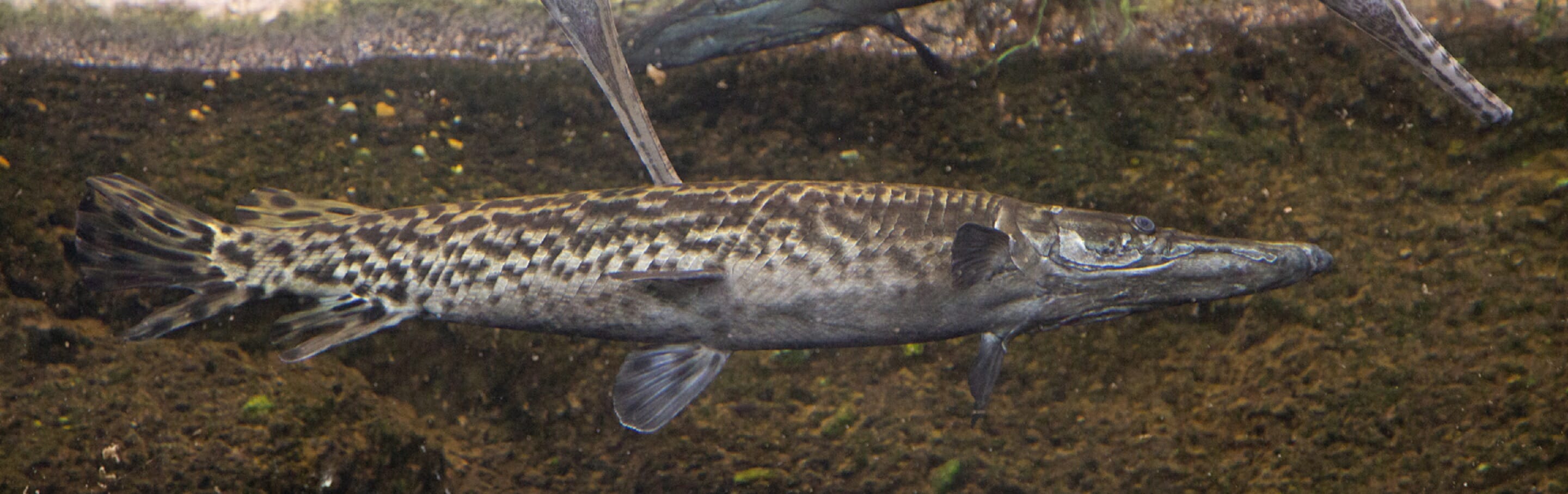
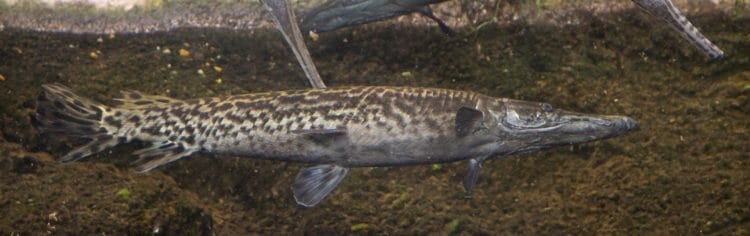
- Short, broad snout with upper jaw shorter than the lower. Its head resembles that of an alligator, hence its name.
- Body covered with non-overlapping, armor-like scales consisting of bony plates. /li>
- Coloration is dark olive-brown on back, white to yellow below, and sometimes spotted on the sides.
- Juvenile has a light stripe along its back from tip of the snout to the upper base of the caudal (tail) fin.
- Common length of close to 6.6 feet (2 m), with a maximum length of 10 feet (3 m) and a maximum weight of more than 100 lbs. (45 kg).
- Unlike most gars, it possesses two rows of teeth on upper jaw.
Animal Fun Fact
Alligator gar have a lung-like air bladder that is connected to their throat. This allows them to gulp air and survive in oxygen-poor water
Diet / Feeding
- Diet consists of fishes, crustaceans, birds, and small mammals as well as reptiles. Turtles and blue crabs are common prey.
Range / Habitat
- Occurs in the Mississippi River basin from southwest Ohio and southern Illinois to the Gulf of Mexico, as well in the Gulf Coastal Plain from Florida to Northern Mexico.
- Prefers sluggish pools and backwaters of large rivers, swamps, bayous and lakes in the south.
- Occasionally enters brackish water along the Gulf of Mexico coast and may enter the Gulf itself.
Reproduction & Growth
- Female alligator gar lay eggs that attach to rocks or vegetation.
- These eggs contain ichthyotoxin and are poisonous if ingested.
Conservation Status
- “Least Concern” on the IUCN Red List.
Additional Information
- Alligator gar has a lung-like air bladder that is connected to its throat. It can gulp air which enables it to survive in oxygen-poor water.
- Known as the “Giant of the Gars” because of its size.
- Eggs are bright red and poisonous if eaten.
Sources
- www.fishbase.org
- animaldiversity.org
- iucnredlist.org
- McClane’s Field Guide to Freshwater Fishes of North America. McClane, A.J.,
pg. 179 - Peterson’s Field Guides – Freshwater Fishes. Page, L.M. and Brooks, M., pgs. 29-30
- Fishes of the Gulf of Mexico. Hoese, H.D. and Moore, R.H., pg. 144