
-
Size
4-6 feet (1.2-1.8 m), 20-50 lbs. (9.1-22.7 kg) -
Diet
Fruit -
Range
South and Southeast Asia -
Habitat
Arboreal, living in dense forest trees
Physical Characteristics
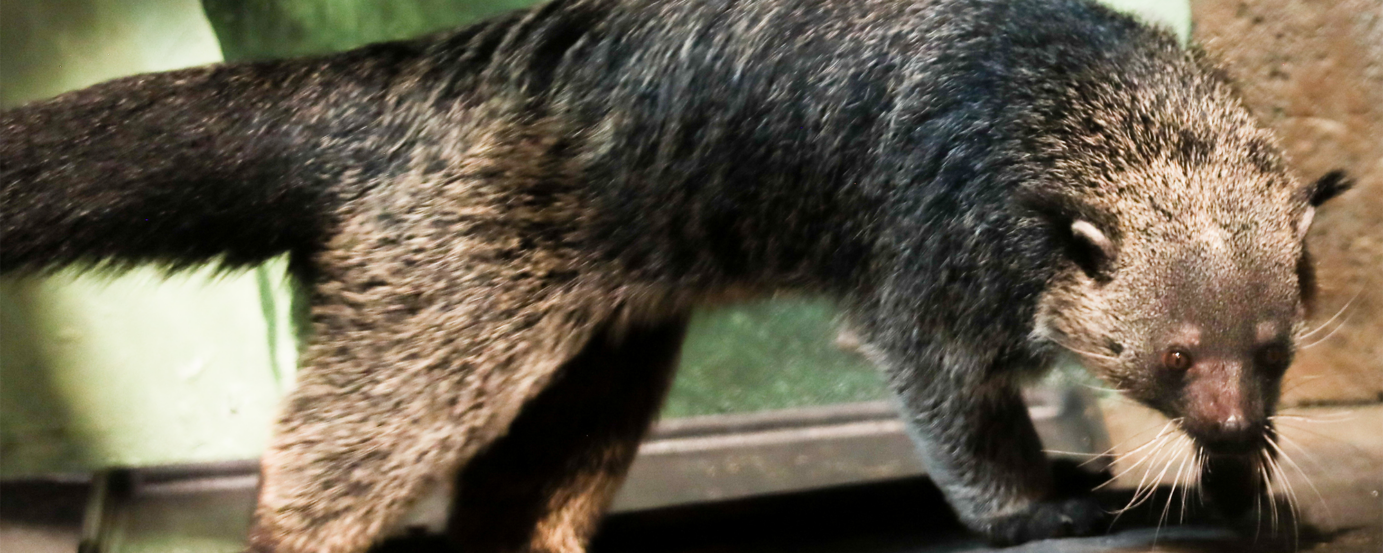
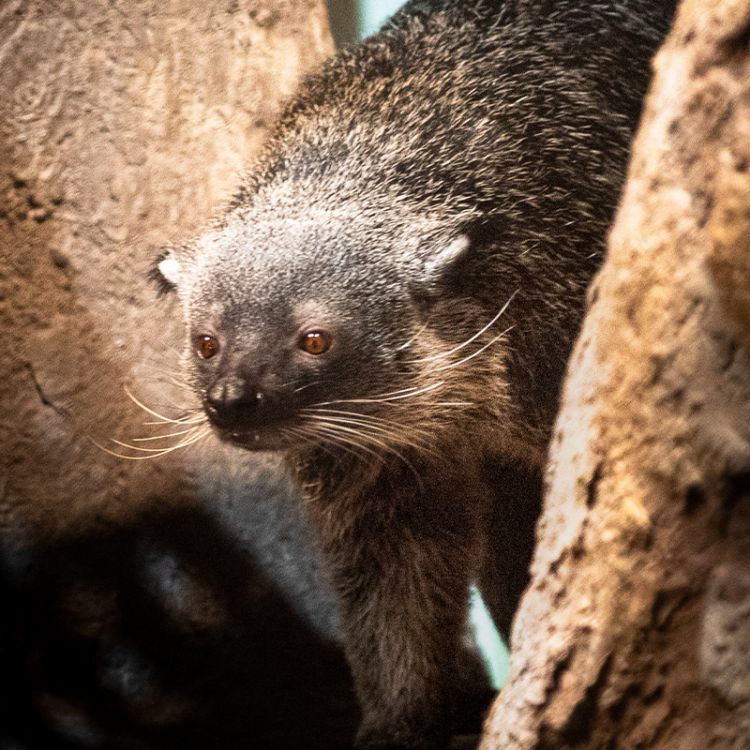
- Binturongs are dark brown to black in color with grey around their faces and ears and long, stiff, white whiskers.
- A binturong’s total body length is between 4-6 feet (1.2-1.8 m).
- The length of the tail is nearly equivalent to the length of the rest of the body (2-3 feet or 0.6-0.9 m). This long prehensile tail is used regularly to hold onto branches. A leathery patch on the tip of their strong tail gives them extra traction while climbing.
- They typically weigh 20-50 lbs (9.1-22.7 kg). Females are typically larger than males.
- Specialized wrists and ankles can pivot all four paws either forward or backwards to allow its sharp claws the best grip on the bark of the tree.
- Binturongs can swim fairly well and have good vision both during the day and at night.
- They groom their coats like cats do, licking and nibbling their fur, and cleaning their face with their front paws.
Diet / Feeding
- Binturongs are classified as carnivores with sharp teeth and claws but mostly eat fruits and berries.
- As frugivores, they eat fruit and pass the seeds in their waste, which helps spread the plants. Their digestive enzymes are specialized to soften the outer coatings of seeds without destroying them. Strangler figs rely heavily on passing through a binturong’s digestive tract.
- When they do hunt, they prefer small animals, including fish, rodents, birds, worms and insects. They will also eat carrion (meat that another animal killed), eggs, and leaves.
Range / Habitat
- Widespread in South and Southeast Asia, occurring from eastern Nepal, Bangladesh, northeast India and southern China through mainland and island Southeast Asia, southeast to Java (Indonesia) and also occurring on the Philippine islands of Calauit and Palawan.
- Primarily arboreal, living in dense forest trees, but it does descend to the ground to move from one tree to another.
Reproduction & Growth
- In the wild, binturongs live about 16 to 18 years. In human care, they can live to be 25 years old.
- Binturongs are usually solitary in the wild, coming together only to mate.
- Female binturongs are known to exhibit embryonic diapause (or delayed implantation). They can breed when a mate is available, and the fertilized egg does not attach to the uterine wall until days or months later (making them truly pregnant) when conditions are most favorable.
- Binturongs usually give birth to one to two babies, called bintlets, at a time after a gestation period of about 92 days. They are born with their eyes closed, and they cling to their mother’s fur for the first few days of their lives.
- Mothers will stay with their offspring until the young are big enough to fend for themselves, usually around 6 to 8 weeks old. They may also stay with their young until they are ready to breed at around 2.5 years old.
Additional Information
- Binturongs are sometimes referred to as “bearcats,” although binturongs are not related to bears or cats. They are related to a group of catlike Asian carnivores in the Family Viverridae, which includes civets and genets.
- Binturongs are crepuscular animals and are most active during twilight, specifically the dawn and dusk hours surrounding sunrise and sunset. They spend most of their time climbing and perching in high tree branches. During the day, they can curl their strong tail around a branch and sleep hidden up in the trees.
- Binturongs are the only mammal from Africa, Asia, or Europe with a prehensile tail and are one of only two carnivores found anywhere in the world with a prehensile tail (the other is a kinkajou).
- Binturongs play an important role in the rainforest ecosystem as seed dispersers. They are the only animals whose digestive enzymes can soften the coating of the strangler fig seed. The seeds are redistributed into the ecosystem through their feces, helping to replant the rainforest.
- Binturongs use their distinctive scent to signal their presence to other binturongs and discourage predators. They also make many different noises like snorts, chuckles, purrs and even screams, hisses, low grunts and howls. Females can call to attract mates.
Sources
- iucnredlist.org
- sandiegozoo.org
- nationalzoo.si.edu
- zooatlanta.org