
-
Size
19.6 inches (50 cm) -
Diet
Mollusks and crustaceans -
Range
Western Atlantic -
Habitat
Coastal waters along sandy bottoms and in brackish water near rivers
Physical Characteristics
- Common length of 19.6 inches (50 cm), with a maximum length of 67 inches (170 cm).
- Maximum published weight is 113 lbs. (51 kg).
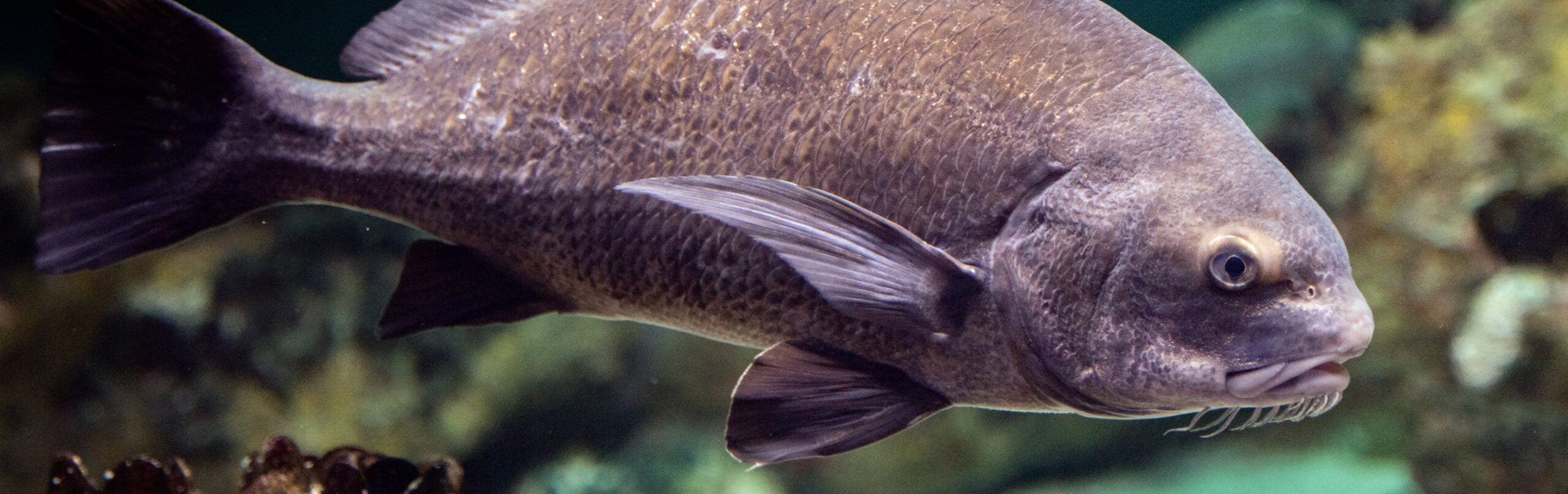
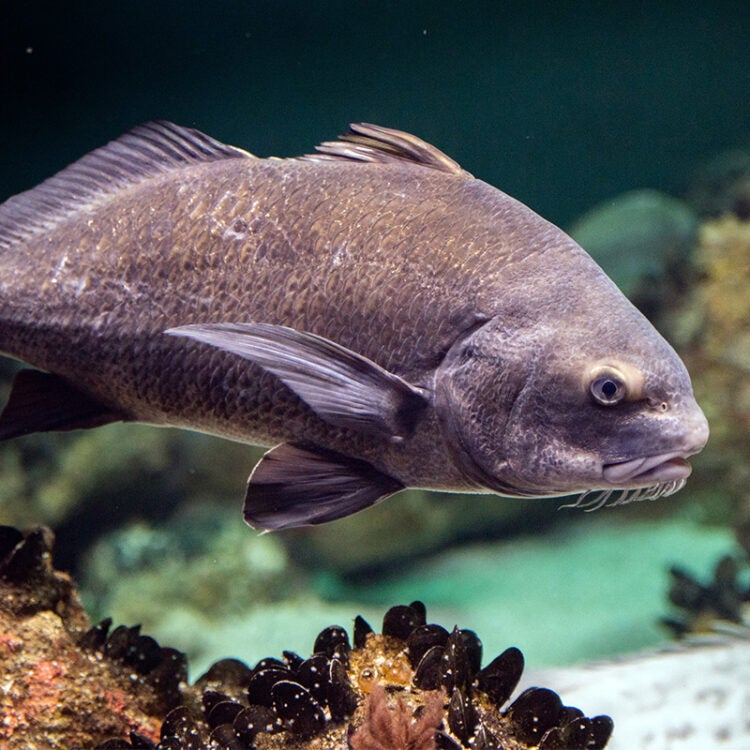
- Oblong body with a short snout, barbels on the chin, a spiny dorsal fin and a soft dorsal fin.
- Silver, grey or dark brown in color. Anal and pelvic fins are usually darker.
- Juveniles may have 4-5 vertical black bars on the sides, which disappear with age.
Animal Fun Fact
Black drum have barbels along their lower jaw, used when foraging for food along the bottom.
Diet / Feeding
- Diet varies depending on life stage:
- Larvae feed on zooplankton.
- Juveniles feed on a variety of crustaceans, fish and shrimp.
- Adults are bottom feeders that eat mollusks, bivalves and crustaceans.
Range / Habitat
- Occurs in the Western Atlantic from Massachusetts to south of the Buenos Aires peninsula in Argentina.
- Found in coastal waters, along sandy bottoms and in brackish water near rivers.
- Juveniles depend on estuaries where they can tolerate large variations in salinity and water temperature.
Reproduction & Growth
- Matures between the ages of four and six. Males tend to mature earlier than females.
- Spawns near shore, in estuaries or in bays. Spawning season is January to March.
Conservation Status
- “Least Concern” on the IUCN Red List.
Additional Information
- The maximum reported age is 50-60 years in parts of its range.
Sources
- www.fishbase.org
- iucnredlist.org
- Blasina, G.E., Barbini, S.A., & Diaz de Astarloa, J.M. (2010) Trophic ecology of the black drum, Pogonias cromis (Sciaenidae) in Mar Chiquita coastal lagoon (Argentina). Journal of Applied Ichthyology, 26, 528-534.
- David L. Nieland & Charles A. Wilson (1993) Reproductive Biology and Annual Variation of Reproductive Variables of Black Drum in the Northern Gulf of Mexico, Transactions of the American Fisheries Society, 122:3, 318-327
- Hoese, H. D., and R. H. Moore. 1977. Fishes of the Gulf of Mexico: Texas, Louisiana, and adjacent waters. Texas A&M University Press, College Station.
- Murphy, M. D. and R. G. Taylor. 1989. Reproduction and Growth of Black Drum, Pogonias cromis, in Northeast Florida. Gulf of Mexico Science 10 (2).