
-
Size
7 feet (2m) -
Diet
Fish, crustaceans and mollusks -
Range
Indo-Pacific -
Habitat
Coral reefs, intertidal zone and near reef drop-offs
Physical Characteristics
- Reaches a maximum size of 6.6 feet (200 cm).
- The maximum recorded weight is 30 lbs. (13.6 kg).
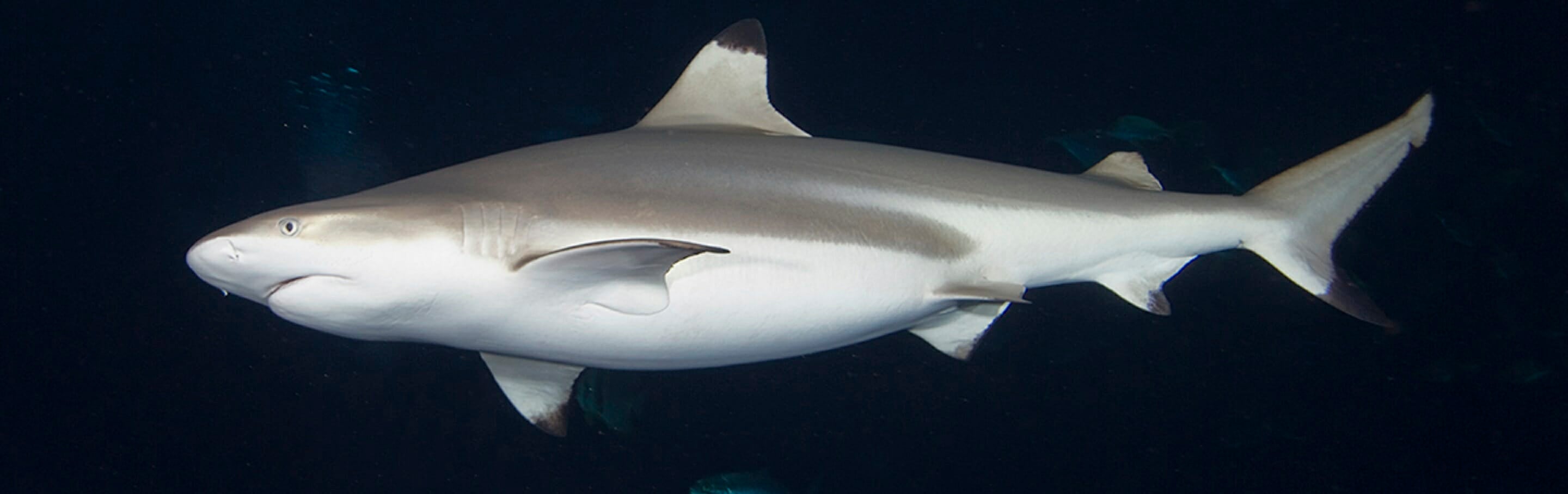
- A smaller shark with a rounded snout and distinct black tipped fins.
- Exhibits counter-shading, being gray to gray-brown on the upper body and white ventrally.
- Also displays a conspicuous white band on its flanks, which extends to the pelvic fins.
Animal Fun Fact
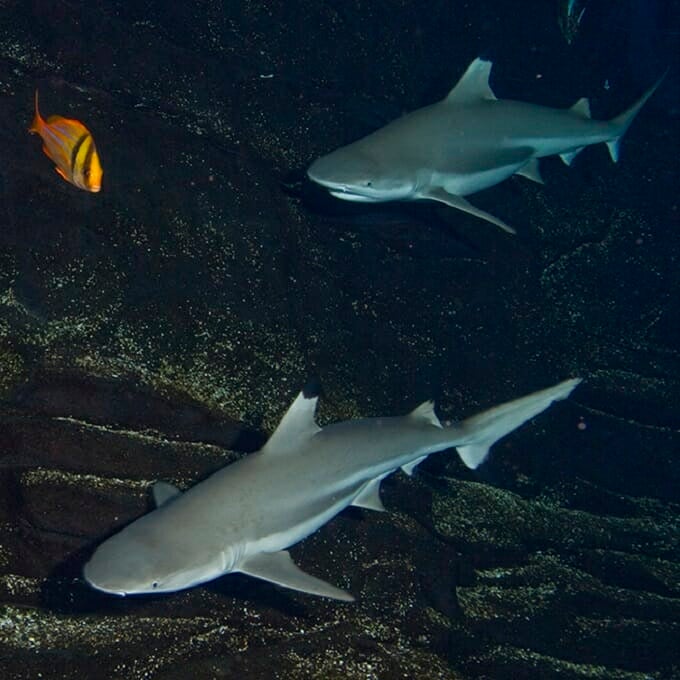
The blacktip reef shark is often seen cruising just below the surface, with only its dorsal fin showing above.
Diet / Feeding
- Prefers fish, but also feeds on crustaceans, cephalopods and other mollusks.
- Common prey includes surgeonfish and mullet. In inshore mangrove areas, this shark will also consume snakes.
- Has long, thin, serrated teeth that help with eating reef fish.
Range / Habitat
- Occurs in the Indo-Pacific from the Red Sea and East Africa to the Hawaiian Islands and south to French Polynesia
- Found in shallow inshore waters on coral reefs, in the intertidal zone (reef flats) and near reef drop-offs.
- Appears to show sexual segregation in habitat distribution, with females living in mangrove areas and males preferring coral reefs.
- Usually found in depths of 65 to 246 feet (20-75 m).
Reproduction & Growth
- Female blacktip reef sharks produce two to four pups, usually measuring around 1.5ft (46cm), after an 8-16-month gestation period, which is thought to vary due to water temperature.
Conservation Status
- “Vulnerable” on the IUCN Red List.
Additional Information
- Female blacktip reef shark produces two to four pups, measuring 1.5 to 1.7 feet (46-52 cm), after an 8-16-month gestation period, which is thought to vary due to water temperature.
- There is a degree of site fidelity for giving birth with similar female cohorts returning season after season.
- This shark cruises in very shallow water with its dorsal (top) fin often extending above the surface. It has been known at times to jump completely out of the water while in the shallows.
- It is regularly caught by inshore fisheries and is vulnerable to depletion because of its small litter size and long gestation period.
- Not to be confused with the blacktip shark, which is a different species.
Sources
- www.iucnredlist.org
- Sharks and Rays. Hennemann, R. M., pg. 144
- The Shark Almanac. Allen, T. B., pgs. 101, 102
- Mourier, S. C. Mills, S. Planes (2013) Population structure, spatial distribution and life-history traits of blacktip reef sharks Carcharhinus melanopterus. Journal of Fish Biology
- Mourier, J., Mills, S. C., and Planes, S. (2013). Population structure, spatial distribution and life-history traits of blacktip reef sharks Carcharhinus melanopterus. Journal of Fish Biology 82, 979–993.
- Mourier, J., & Planes, S. (2012). Direct genetic evidence for reproductive philopatry and associated fine-scale migrations in female blacktip reef sharks (Carcharhinus melanopterus) in French Polynesia. Molecular Ecology, 22(1), 201–214.