

-
Size
Up to 27.6 inches (70 cm) -
Diet
Coarse and leafy brown algae -
Range
Indo-Pacific -
Habitat
Channels, moats, lagoons and seaward reefs
Physical Characteristics
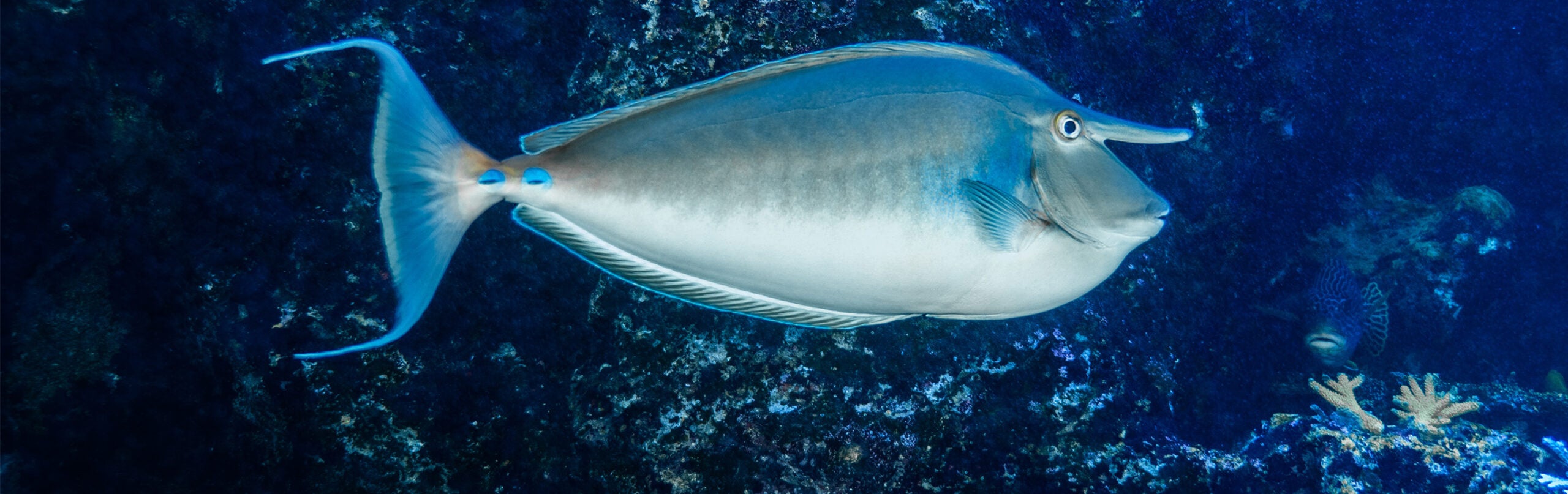
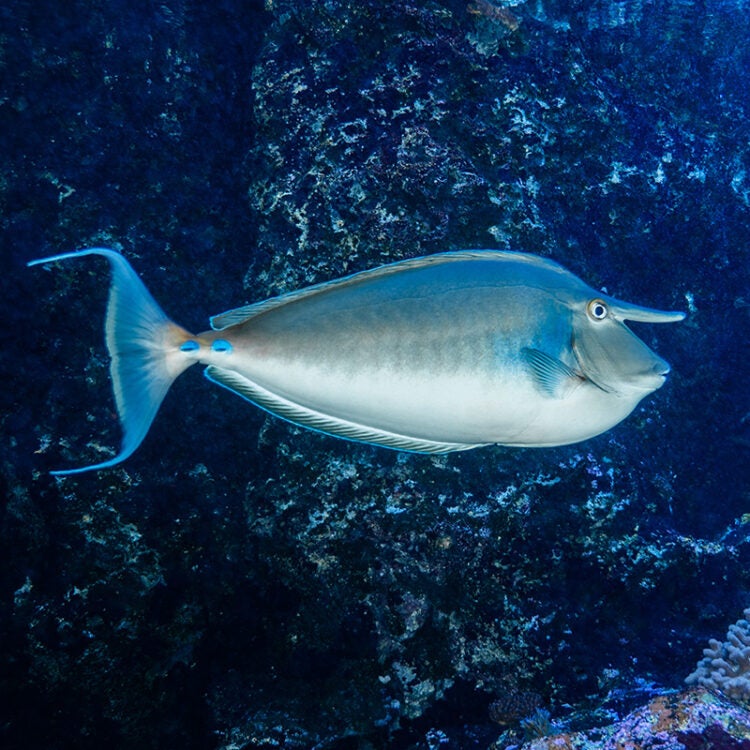
- Body is usually greenish-gray in color with a bony horn or rostrum protruding from the front of its head in between the eyes.
- Dorsal and anal fins are yellowish with thin blue lines.
- Two blue plates with sharp, forward-pointing spines on either side of the caudal peduncle.
- Thick leathery skin with tiny non-overlapping scales and small teeth with finely serrated edges.
- Lobes of the caudal fin are extended into slender thread-like filaments; more apparent in the male.
- Can reach approximately 27.6 inches (70 cm) in length.
Animal Fun Fact
This unicornfish develops long, trailing tail filaments as it grows.
Diet / Feeding
- Diet consists of coarse and leafy brown algae.
Range / Habitat
- Occurs in the Indo-Pacific from the Red Sea and East Africa across the tropical Pacific to southern Japan, throughout Micronesia and Hawaii.
- Juveniles live in clear coastal reefs with algae growth.
- Adults prefer shallow reef slopes adjacent to deep water.
- Found in channels, moats, lagoons and seaward reefs, particularly in areas with strong surges, preferring depths usually no greater than about 33 feet (10 m).
Reproduction & Growth
- Has been observed practicing pair spawning, particularly at the outermost area of a foraging group.
- In some areas, they have been observed migrating in schools around the outer reef edges and spawning during both the full and new moons.
Conservation Status
- “Least Concern” on the IUCN Red List.
Additional Information
- With age, the male tends to have a better-developed horn, peduncular spines (spines in plates just before the tail), and caudal (tail) filaments than its female counterpart.
- Usually swims within a small group.
- The function of the rostral horn on the forehead is unknown.
Sources
- www.fishbase.org
- Guide To Sea Fishes of Australia. Kuiter, R. H., pg. 370
- Handbook of Australian Fishes. Whitley, G.P., pg. 234
- Micronesian Reef Fishes. Myers, R. F., pg. 275