
-
Size
Up to 5.5 inches (14 cm) -
Diet
Mucus and parasites from other fish -
Range
Indo-Pacific -
Habitat
Coral rich areas, subtidal reef flats and seward reefs
Physical Characteristics
- Maximum length 5.5 inches (14 cm).
- Larger adults have a hook in the caudal fin.
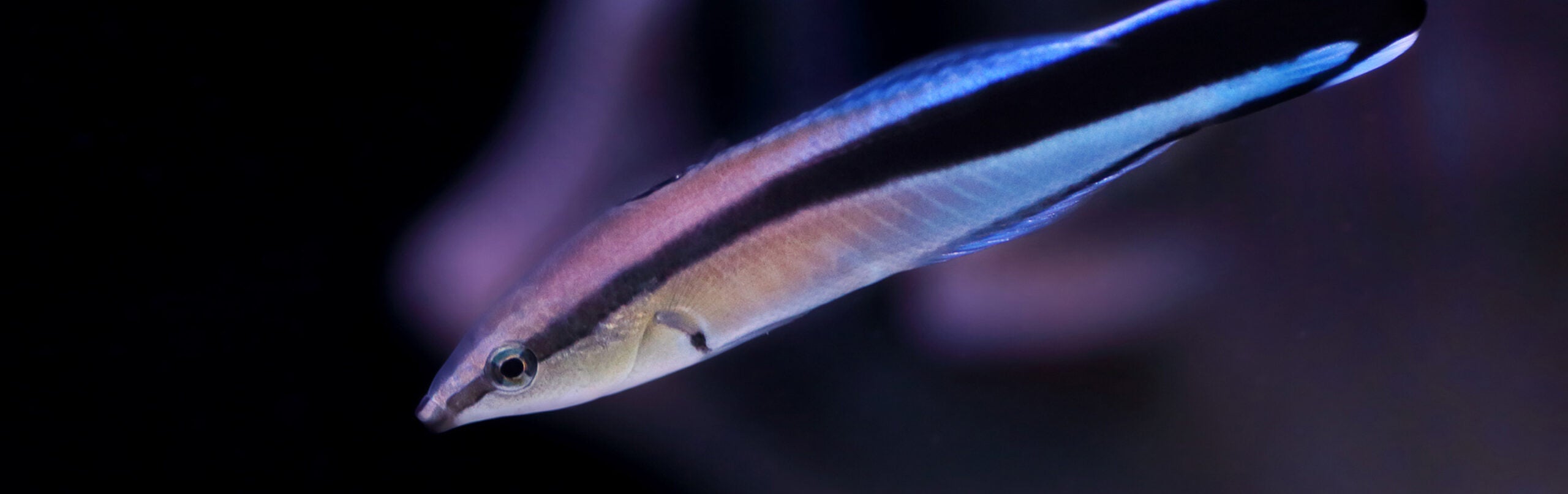
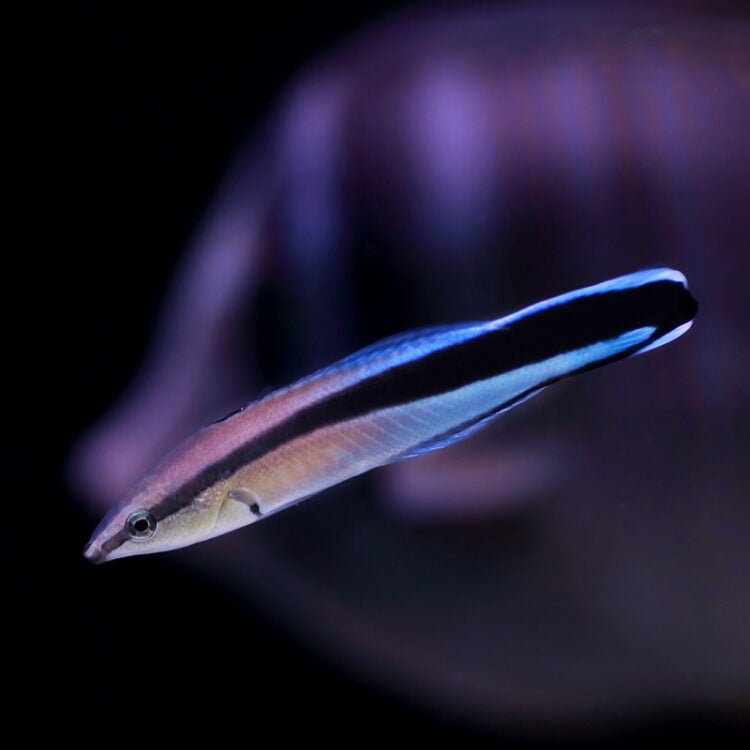
- Juveniles are predominantly black with a single blue stripe running from their snout to the upper caudal fin.
- Adults are blue with a single thick black stripe from the caudal fin through their eyes.
Animal Fun Fact
Bluestreak cleaner wrasse are also known as “blue diesel wrasse” or “bridled beauty.”
Diet / Feeding
- Diet consists mostly of crustaceans, ectoparasites and mucus or scales of fish that gather at cleaning stations. They will also eat zooplankton and fish eggs.
- Exhibits cleaning behavior exclusively during the day and mostly in the morning, most likely due to parasites predominantly infecting hosts overnight.
Range / Habitat
- Occurs in the Indo-Pacific from Southern and Eastern Africa and the Red Sea. Also from southern Japan to the southern Great Barrier Reef and south-western Australia.
- Found in coral-rich areas, subtidal reef flats and seaward reefs to depths of at least 131 feet (40 m).
- Juveniles often found in kelp or areas heavy in macroalgae. Live in a home range dominated by one male and many females that stay together over many seasons.
Reproduction & Growth
- Oviparous, or egg-laying, species.
Conservation Status
- “Least Concern” on the IUCN Red List.
Additional Information
- Other common names include “blue diesel wrasse,” “bridled beauty” and “cleaner wrasse.”
- New theories believe that fish may visit cleaning stations for wound care and old tissue removal rather than just parasite removal.
- Studies have shown that the diversity of reef fish declines without the presence of cleaner fishes.
Sources
- www.iucnredlist.org
- Bshary, R. (2003) The cleaner wrasse, Labroides dimidiatus, is a key organism for reef fish diversity at Ras Mohammed National Park, Egypt. Journal of Animal Ecology, 72, 169-176.
- Grutter, A. (1996) Parasite removal rates by the cleaner wrasse Labroides dimidiatus. Marine Ecology Progress Series, 130, 61-70.