
-
Size
9.8 feet (3 m) -
Diet
Benthic crustaceans and mollusks -
Range
Indo-West Pacific -
Habitat
Sandy or muddy bottoms close to shore
Physical Characteristics
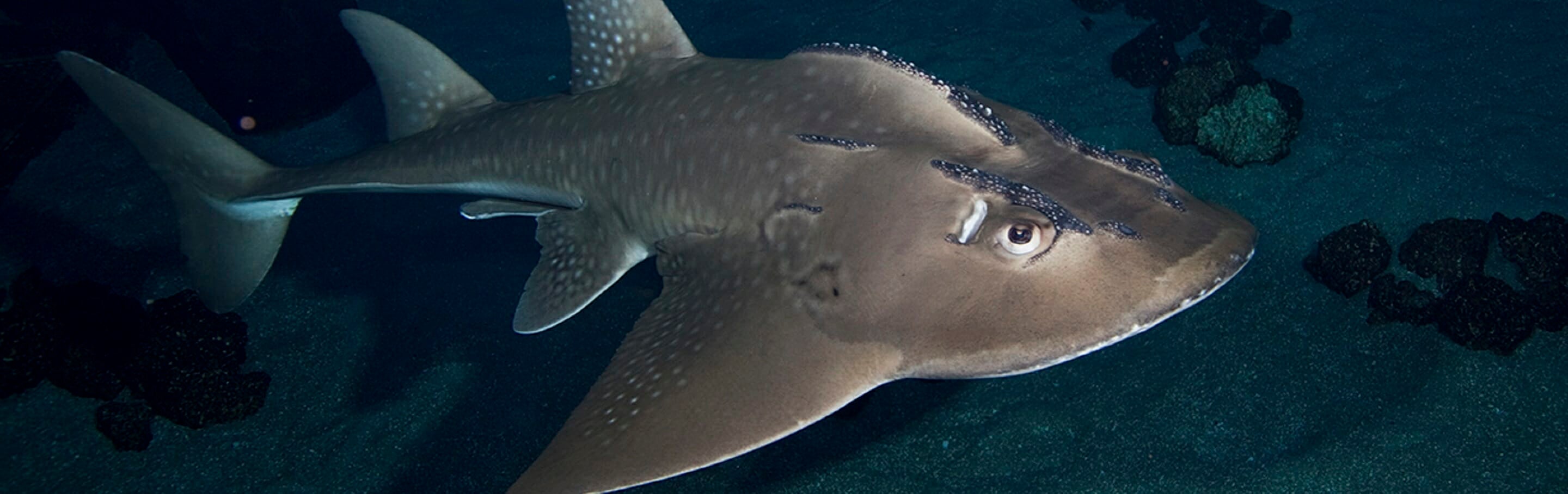
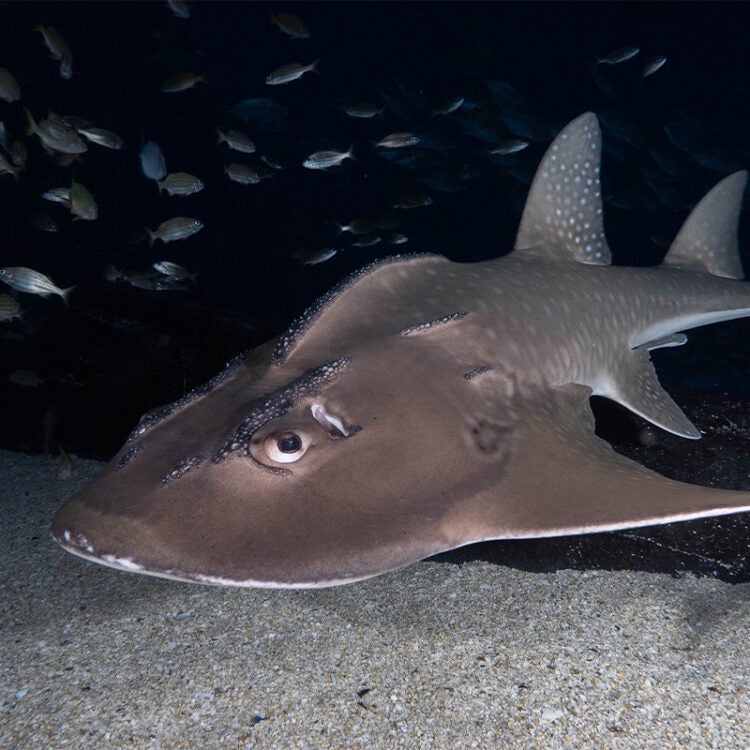
- The front of its body is flattened and wide, while the rest of its body and the large dorsal fins create a shark-like appearance, although it is a member of the ray family.
- A broad rounded snout with prominent bony ridges above both eyes, as well as along the back and shoulders.
- Tail is longer than the body and pectoral fins are large with a broad base typical of a ray.
- Adults can reach a length of approximately 9.8 feet (3 m) and a maximum weight of about 298 lbs. (135 kg).
- Adult coloration is grayish brown in color with white spots on the dorsal fins and darker spots on the head and shoulders.
- Juvenile is brown to bluish grey with large white spots, partial eye-spots on the pectoral fins and black spots between the eyes.
Animal Fun Fact
Bowmouth guitarfish have ridged jaws used to crush hard-shelled prey items.
Diet / Feeding
- Feeds primarily on benthic crustaceans and mollusks such as shrimp, crabs, and clams.
Range / Habitat
- Occurs in the tropical waters of the Indo-West Pacific (including the Red Sea) from East Africa, north to Japan and south to Australia.
- Usually encountered at depths from about 3 to 65 feet (1-20 m) on sandy or muddy bottoms close to shore or near coral reefs.
- This ray is usually seen swimming alone.
Reproduction & Growth
- Ovoviviparous, meaning it produces eggs that hatch within the mother’s body, and the young are born live.
- The female usually gives birth to four to eleven young, each about 18 inches (45 cm) long.
Conservation Status
- “Critically Endangered” on the IUCN Red List.
Additional Information
- Often the bycatch of shrimp fishermen who consider it to be a nuisance because its spiky head makes it difficult to handle, and can damage their nets.
- However, the high value of the fins creates a significant incentive to retain an accidently caught bowmouth guitarfish.
- This species is marketed commercially for human consumption in the western Pacific, though only the fins are eaten.
- Habitat destruction and pollution are thought to pose a significant threat.
- A row of large spines present above the eye, on the center of the nape and on the shoulder has a defensive function and can be used for butting.
- Its jaws are heavily ridged, with crushing teeth in undulating rows.
- It is the only ray species documented to have two rows of enamel-like structure on its teeth, all other rays only have one.
Sources