
-
Size
6 inches (15 cm) -
Diet
Snails, small crustaceans, worms and insects. -
Range
Lake Tanganyika, Africa -
Habitat
Found over muddy bottoms
Physical Characteristics
- Common length of 6 inches (15 cm), maximum length of 10.8 inches (27.4 cm).
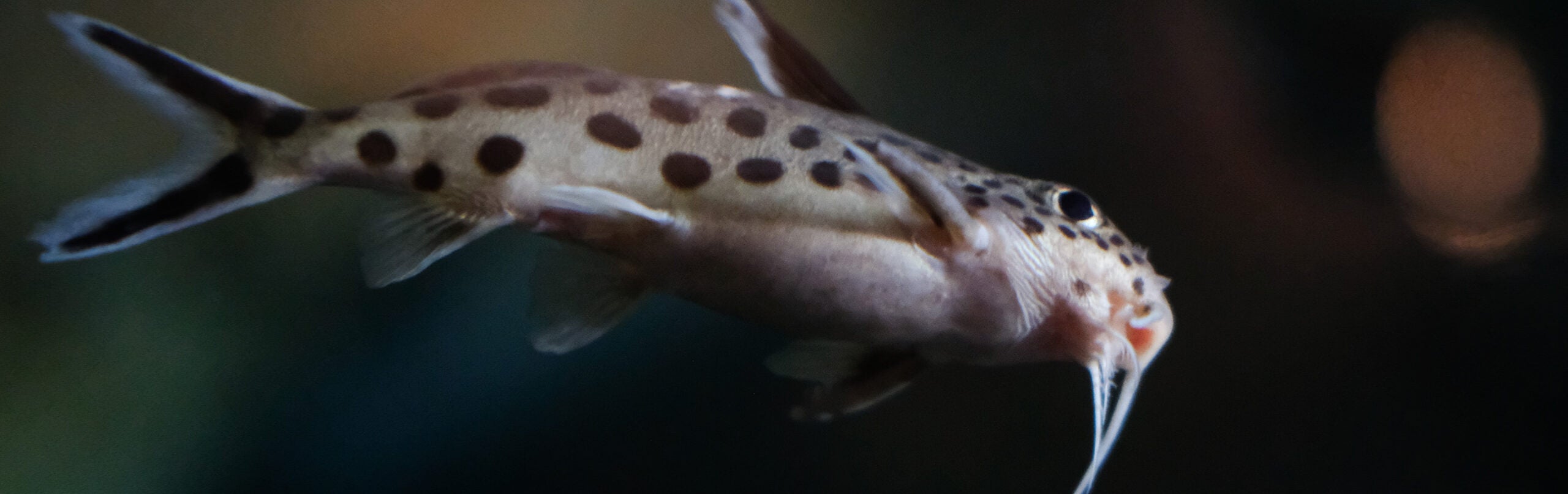
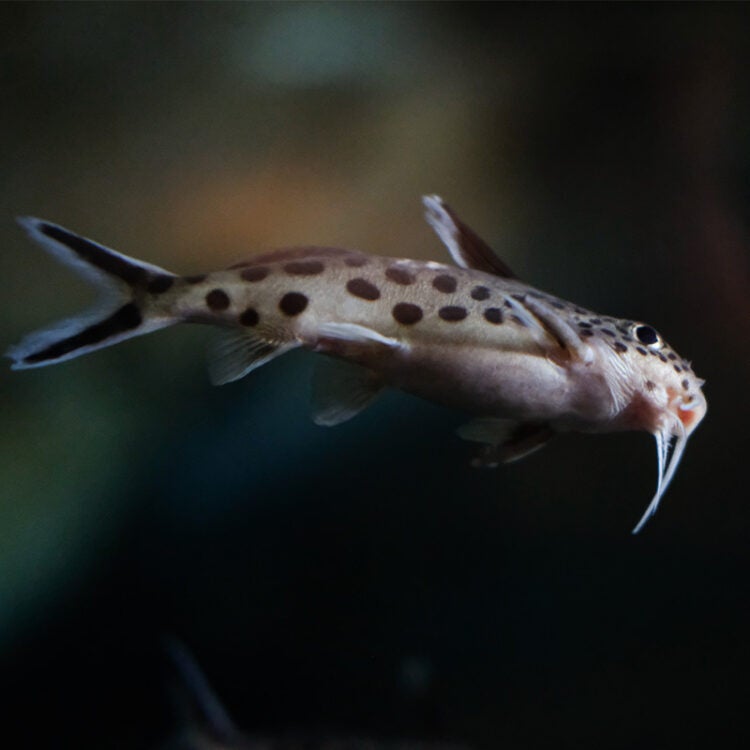
- The body is typically white, tan or gold with black spots that increase in size from the head towards the tail.
- Dorsal, pectoral and caudal fins are predominantly black with white edges. The two anal fins are also pale, with small black triangles close to the body.
- Barbles are typically white.
Animal Fun Fact
Called “cuckoo” catfish because of their practice of brood parasitism, which is a shared behavior with the cuckoo bird.
Diet / Feeding
- Omnivorous bottom feeder, preying on snails, small crustaceans, worms and insects.
Range / Habitat
- Occurs in Lake Tanganyika, Africa.
- Found over muddy bottoms at depths of up to 328 feet (100 m).
Reproduction & Growth
- Oviparous, or egg-laying, species.
- Forms distinct pairs when mating.
- They are called “cuckoo” catfish because of their practice of brood parasitism, which is a shared behavior with the cuckoo bird.
- The breeding pair of catfish will mix their eggs into the spawning nests of mouthbrooding cichlids.
- Cichlids take the catfish eggs along with their own into their mouth, mixing the catfish eggs with the cichlid eggs.
- Catfish larvae grow faster than those of the cichlid host and will often feed on the cichlid larvae and eggs.
Conservation Status
- “Least Concern” on the IUCN Red List.
Additional Information
- Cuckoo catfish, along with most of the fish species in Lake Tanganyika, Lake Malawi, and Lake Victoria, are endemic to this area, meaning they don’t live anywhere else in the world.
Sources
Radim Blažek et al. ,Success of cuckoo catfish brood parasitism reflects coevolutionary history and individual experience of their cichlid hosts.Sci. Adv.4,eaar4380(2018). DOI:10.1126/sciadv.aar4380