
-
Size
10 inches (25 cm) -
Diet
Benthic algae and zooplankton -
Range
Western Atlantic -
Habitat
Shallow reefs and rocky areas
Physical Characteristics
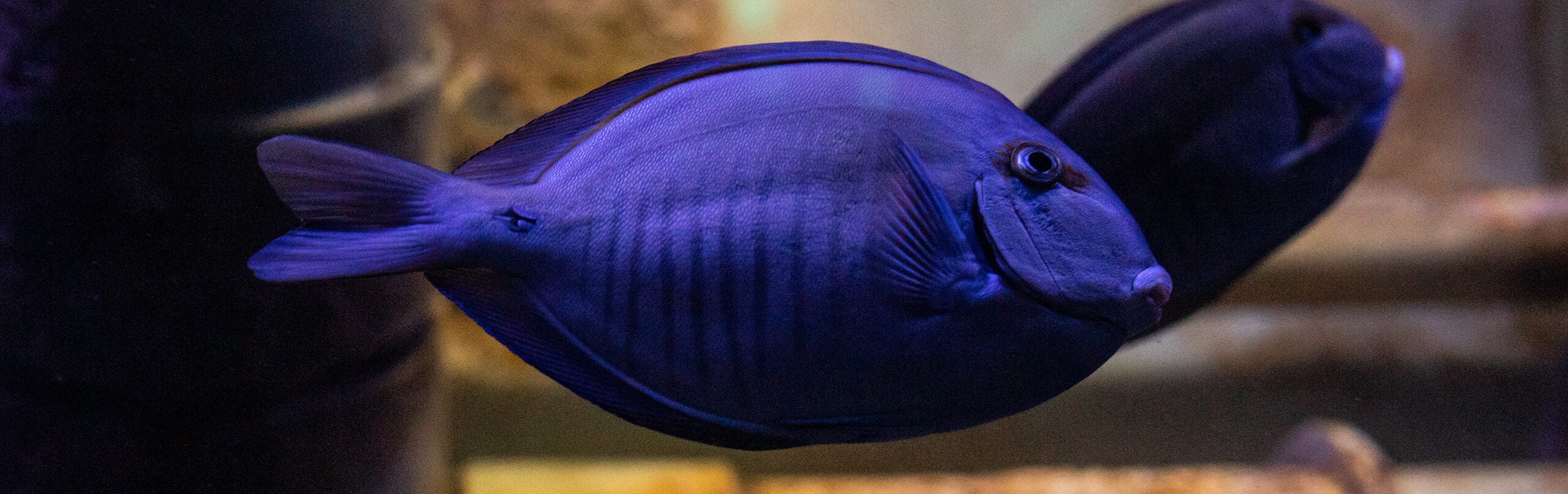
- This species grows to 15 inches (38 cm), although it is most commonly about 10 inches (25 cm) in length. Interestingly, 85% of its total growth will likely occur in its first year of life.
- A type of surgeonfish, a group that is named for the sharp, blade-like spine on both sides of the caudal peduncle (the base of the tail).
- All surgeonfish have a compressed body with the eye high on the head and a single un-notched dorsal fin.
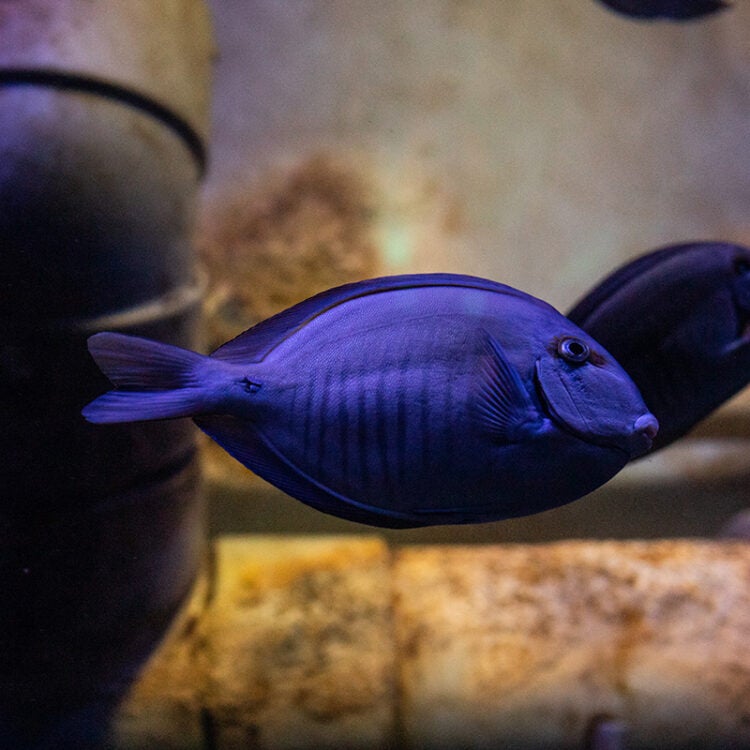
- Blue or grey to brown in color with approximately ten faint, well-spaced vertical dark bars on its sides.
- Displays a bright blue edge around its spine.
Animal Fun Fact
The doctorfish has a gizzard-like organ in the intestines that contains sand and aids in grinding up food before digestion.
Diet / Feeding
- Consumes benthic algae and zooplankton.
- Serves an important role on the reef in preventing fast-growing algae from overgrowing hard coral.
- A gizzard-like organ in the intestines contains sand particles, which aid in grinding up food before digestion and may compose 25-75% of the material in the digestive tract.
Range / Habitat
- Occurs in the Western Atlantic from South Carolina to Bermuda, and the northern Gulf of Mexico south to Brazil.
- Juveniles have been seen as far north as Massachusetts using seagrass beds and mangroves as nurseries.
- This species prefers shallow reefs and rocky areas. It occurs in loose aggregations.
- It is the least specific of the surgeonfish when it comes to habitat selection and can be found much deeper and in more turbid water than most other species. It is believed that this has helped the doctorfish to spread farther than most other surgeonfish.
Reproduction & Growth
- Spawning takes place during the lunar cycle when there are the strongest currents and largest tidal ranges.
- The male and female pair off and move to the surface and release their gametes into the open water.
- Eggs hatch after only one day, beginning the larval stage. The planktonic larval stages last up to 10 weeks, drifting with the current. The juveniles that develop from the larvae settle back onto reefs to continue the life cycle.
Conservation Status
- “Least Concern” on the IUCN Red List.
Additional Information
- Estimated lifespan of 15-30 years, depending upon location.
- The doctorfish is one of many species of surgeonfish. In addition to differences in overall body coloration, individual species can be distinguished by the color of the tail spine. The ocean surgeonfish (A. bahianus) has a white area around the spine while the blue tang (A. coeruleus) has a yellow-colored spine. The doctorfish can be distinguished by its bright blue-edged spine.
- The spine is typically held in a fleshy body groove and is used to defend territory, ward off predators and display social dominance.
- Only active by day, the surgeonfish hides and sleeps in reef crevices at night.
- Doctorfish swims singly or in small aggregations, sometimes schooling with other species of surgeonfish.
- Pectoral (side) fins are used for swimming, aided by the tail when speed is required.
- Juvenile doctorfish have been observed at cleaning stations, with other fish species, eating parasites and grazing algae from green turtles’ flippers, head and carapace.
- Adult surgeonfish will also attend cleaning stations to be groomed by gobies and cleaner wrasses. Surgeonfish can change color from dark to pale in order to highlight the problem areas where parasites are damaging their skin. However, if a shrimp comes to the cleaning station to service a surgeonfish, the fish does not pale in color because the shrimp works to clean the fish of parasites by means of touch, and not sight, like the goby.
- Algae growth increases in areas where hard corals have died due to natural causes or pollution. This new ocean habitat is an ideal area for algae feeders like surgeonfish. Surgeonfishes that travel in schools graze in these areas and the algal outbreak is soon contained, thereby allowing some recovery of coral.
Sources
- www.iucnredlist.org
- www.fishbase.org
- Surgeonfishes, Rabbitfishes and Their Relatives. Kuiter, R. H. and Debelius, H., pgs. 3-8, 65-68.
- Surgeonfishes of Hawaii and the World. Randall, J. E., pgs. 1-20.
- Reef Fish. Thresher, R. E., pgs. 144, 150.
- Reef Fish Identification. Allen, G. et al., pg. 44.