
-
Size
12-14 inches (31–36 cm) -
Diet
Invertebrates -
Range
Eastern Pacific Ocean -
Habitat
Clear water, often near crevices, small caves, and occasionally in kelp
Physical Characteristics
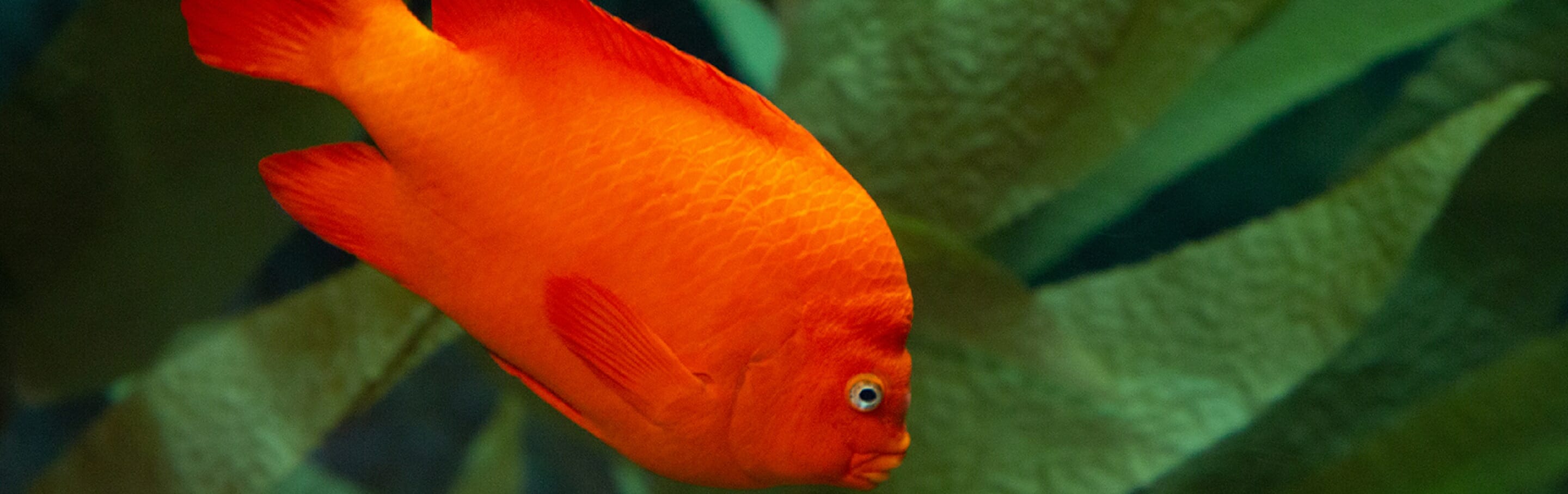
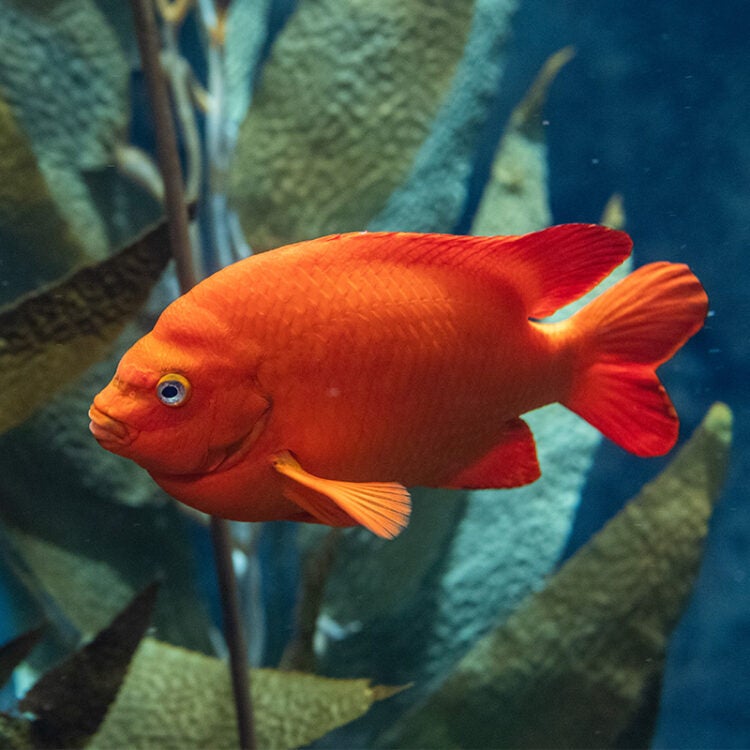
- The garibaldi is about 12 to 14 inches (31–36 cm) in length, and is the largest of the damselfish.
- The most distinguishing feature is the bright orange color of the adult. A juvenile is red-orange with bright iridescent blue spots on the body and blue edges on the fins.
- Has a small, narrow mouth and an oval-shaped body.
Animal Fun Fact
Garibaldi damselfish can make an audible thumping sound when disturbed.
Diet / Feeding
- Feeds on a wide range of invertebrates, including worms, anemones, sea stars, shrimp, sponge and small shellfish.
Range / Habitat
- Occurs in the Eastern Pacific Ocean, from Monterey Bay in California to southern Baja California and Guadalupe in Mexico.
- A reef-associated fish, found in clear water, often near crevices, small caves, and occasionally in kelp at depths to 98 feet (30 m).
Reproduction & Growth
- Life span may be up to 17 years, but closer to 12 years is more common.
- The garibaldi is a fiercely territorial fish and will attack larger animals that threaten its eggs.
- The male will select a home territory that includes a feeding area, a protective hole, and a nesting site. It will protect its territory year-round.
- The female will also establish a home range, but does not defend it with the same vigor as the male.
- One of the most interesting things about the garibaldi is its courtship and mating behavior:
- In the early spring, the male will prepare a nest by removing small animals and cleaning out the debris from a small area of a red algae bed.
- When the nest is ready, he will work hard to attract females with swimming displays.
- If the female is enticed to stay, she will release a trail of eggs, which stick to the algae nest. The male then fertilizes the eggs and chases away the female so that she won’t eat the eggs.
- He will continue to clean and guard the eggs until they hatch with no assistance from the female. A female can lay between 50 and 1000 eggs, which incubate for 2 to 7 days until they emerge into transparent, 1/6-inch hatchlings. Several females may spawn in the same nest, and each female may lay eggs in several nests.
Conservation Status
- “Least Concern” on the IUCN Red List.
- In 1995, the California Legislature placed a moratorium on garibaldi collecting for either sport or commercial purposes.
Additional Information
- The garibaldi is the official marine fish of the state of California.
- It is solitary in nature, most active during the day, and generally retreats to a protected spot at night.
- When disturbed, a garibaldi can emit an audible thumping sound.
Sources
Iucnredlist.org
www.fishbase.org
Passport to the Pacific. Aquarium of the Pacific, pgs. 10 – 11