

-
Size
5 feet (1.5 m) -
Diet
Fishes and crustaceans -
Range
Atlantic Ocean -
Habitat
Tropical waters near coral reefs, rocky shorelines and mangroves
Physical Characteristics
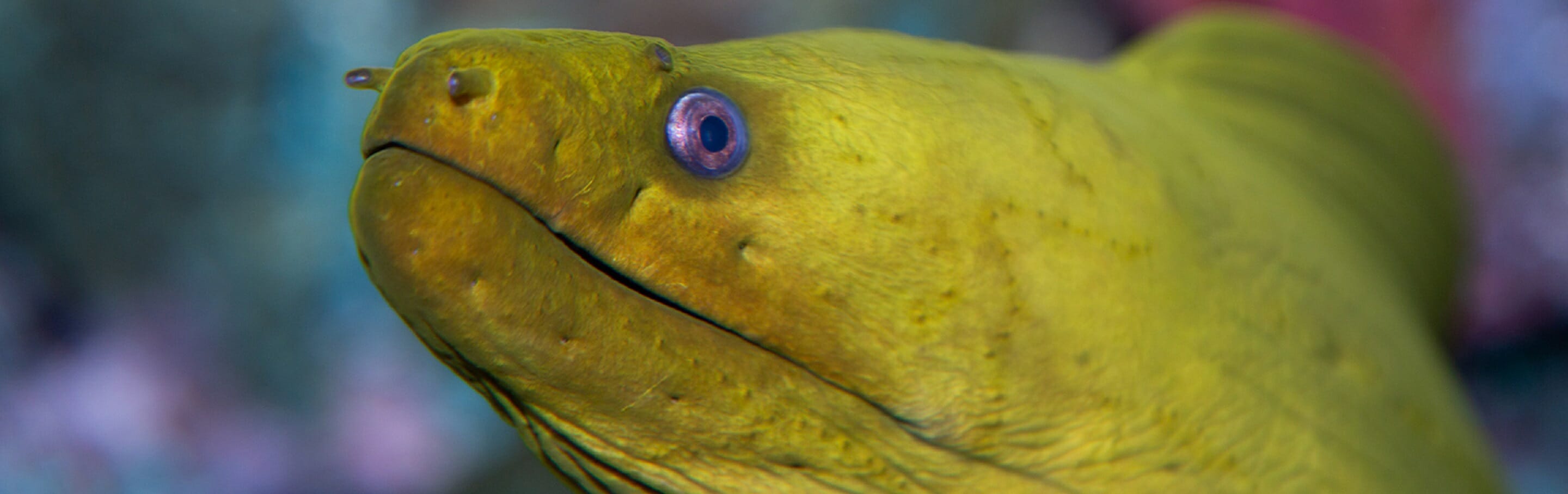
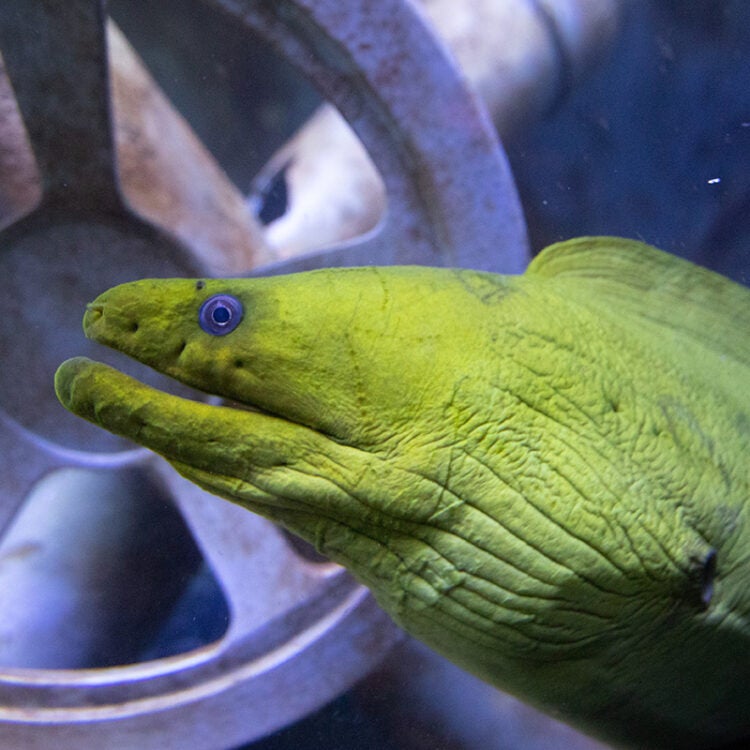
- Coloration is dark brown to green; body is elongated, muscular and snakelike with a continuous dorsal, caudal and anal fin. Lacks pectoral and pelvic fins.
- Covered in a layer of yellow mucus to protect against parasites. This mucus layer gives off the green coloration against their brown bodies.
- Large mouth with many teeth. Teeth are large with smooth edges. Pharyngeal teeth are located in the throat, surrounded by muscles that can move forward to grab the prey in its mouth.
- Common length: 5 feet (1.5 m); maximum length is 8.2 feet (2.5 m); maximum weight is 63.9 lbs. (29 kg)
Animal Fun Fact
Green moray eels have a layer of mucus on their skin for protection from parasites.
Diet / Feeding
- Diet mainly consists of crustaceans and fish.
- Nocturnal hunter.
- May wrap itself in the shape of a knot around prey to pull it into smaller pieces.
Range / Habitat
- Occurs in the Western Atlantic from New Jersey to Bermuda and the Gulf of Mexico, Brazil, and the Eastern Atlantic around the Ascension Islands.
- Found in tropical waters near coral reefs, rocky shorelines and mangroves, often seen with only the head poking out from a crevice, hole or ledge, in depths up to 164 feet (50 m). Commonly in depths less than 98 feet (30 m).
Reproduction & Growth
- Oviparous, or egg-laying.
- Transparent, leaf-like larval stage called a “leptocephalus.”
Conservation Status
- “Least Concern” on the IUCN Red List.
Additional Information
- Also known as the “green conger.”
- Solitary and aggressive species.
- Sense of smell used to locate prey and spawning site.
- One of the largest moray eel species.
- Breathe by continuously opening their mouths to pump water over their gills.
Sources
www.fishbase.org
www.iucnredlist.org
www.montereybayaquarium.org
Animal: Smithsonian Institution. David Burnie & Don E. Wilson.
Reef Fishes, Volume 1. Michael, Scott W.