
-
Size
Up to 6 feet (1.8 m) -
Diet
Fishes, small crustaceans, insect larvae -
Range
North America -
Habitat
Sluggish pools and backwaters of rivers and lakes
Physical Characteristics
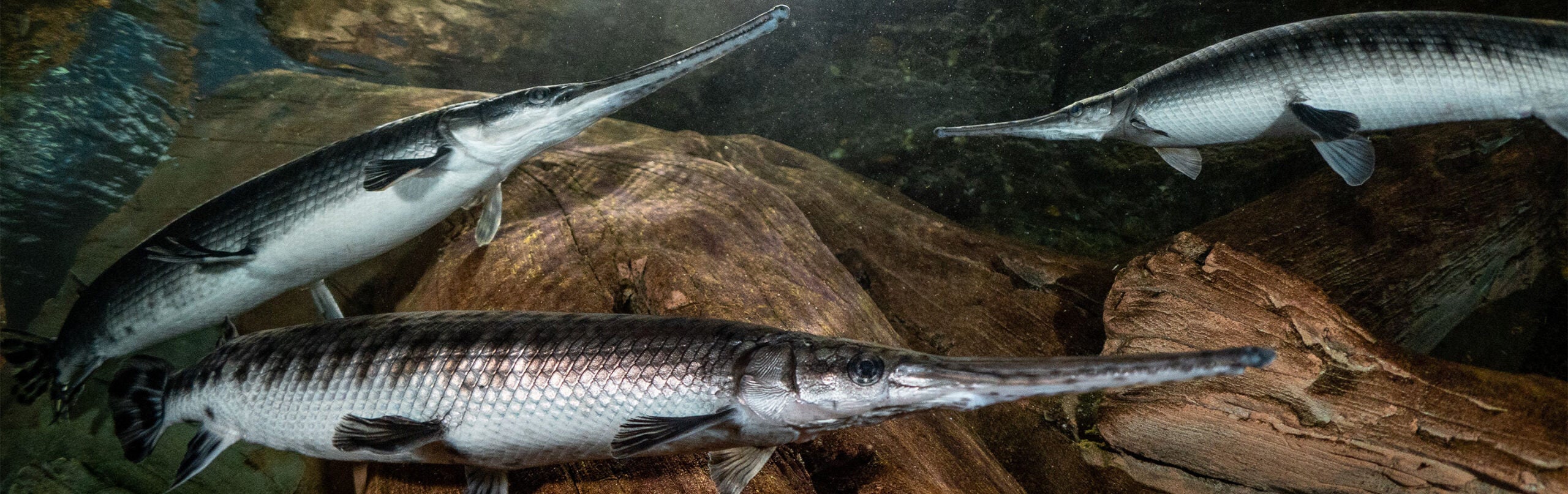
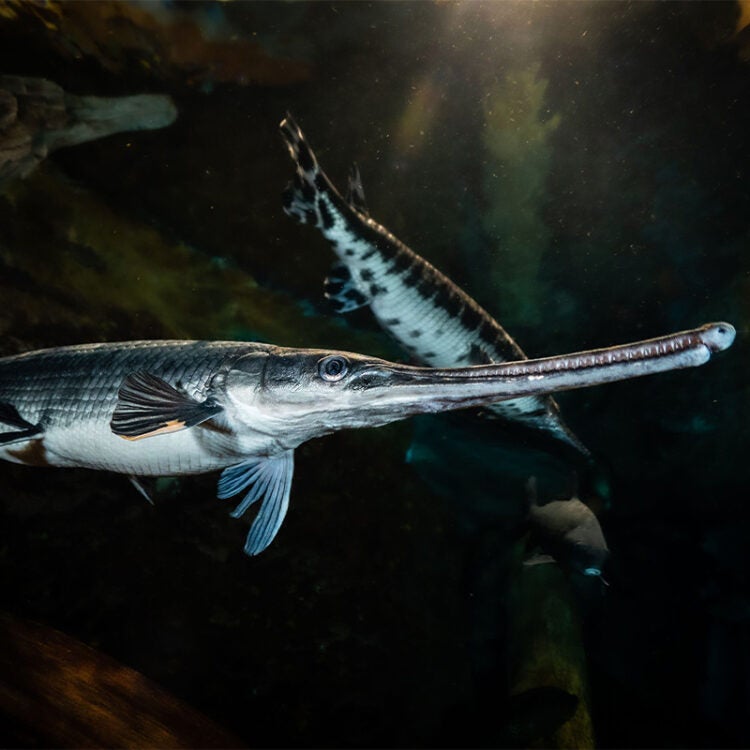
- Longnose gar have a very long, slender snout with a length of 18 to 20 times its width.
- Have a long cylindrical body covered with large, overlapping diamond-shaped scales, which distinguish it from all its freshwater relatives. These scales interlock to produce a virtual suit of armor leaving the gars with few natural predators.
- The Dorsal fin is located far back on the body, almost over the anal fin. The caudal fin is broad, as is the caudal peduncle.
- Typically grayish to olive-green dorsally and on the sides; white or yellowish below.
- Longnose gar can grow to 6 feet (1.8 m) in length and weigh up to 50 lbs. (23 kg).
- Femalesare typically larger than males.
Animal Fun Fact
Longnose gar have overlapping scales that interlock to create a great armor for protection.
Diet / Feeding
- An ambush feeder that attacks prey from the side and then adjusts its grip to swallow the prey headfirst.
- Adult longnose gar feed almost exclusively on fishes
- Juvenilesfeed voraciously on small crustaceans and insect larvae.
Range / Habitat
- Occurs from the Mississippi River system northwest to Montana, through the Great Lakes (except Lake Superior), to the St. Lawrence watershed, to Quebec and south to northern Mexico.
- Most abundant and widely distributed member of the ancient gar family.
- Found in sluggish pools, backwaters and oxbows of medium to large rivers and lakes.
- Prefers areas of vegetation and occasionally may be found in brackish waters.
Reproduction & Growth
- Adults make long migrations to spawning sites in streams that have clear water and a relatively steep gradient.
- Spawning is believed to occur between April and June, when the longnose gar will spawn on gravel shoal areas and among rocks or occasionally in the weedy shallows of lakes and rivers.
- The female longnose gar sheds her eggs in repeated batches, while the male fertilizes them as they are released. Instead of a close vent-to-vent association between males and females, the males cloud the water with milt.
- Females will produce about 30,000 plus eggs per year.
Conservation Status
- “Least Concern” on the IUCN Red List.
Additional Information
- Longnose gar is reported to live 20 to 30 years.
- Gars are a primitive group of bony fish that still retain a spiral valve intestine, which is an ancient feature of the digestive system commonly associated with sharks and rays.
Sources
http://www.flmnh.ufl.edu/fish/gallery/descript/longnosegar/longnosegar.html
Fishes of Alabama. Boschung, H. T. and Mayden, R.L., pgs. 118 -119
McClane’s Field Guide to Freshwater Fishes of North America. McClane, A.J., p. 180
Peterson Field Guides – Freshwater Fishes. Page, L.M. and Burr, B.M., pg. 30
The Fishes of Tennessee. Etnier, D.A. and Starnes, W.C., pgs.112 -113