
-
Size
20 feet (6 m) -
Diet
Plankton and small fish -
Range
Western Atlantic Ocean -
Habitat
Reefs, atolls, island groups and the continental shelf
Physical Characteristics
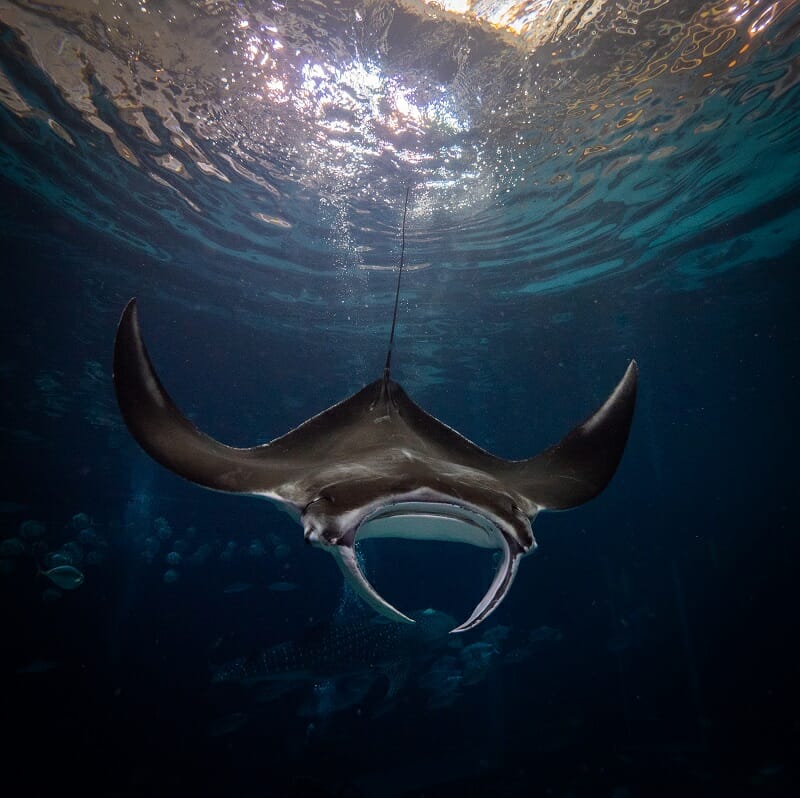
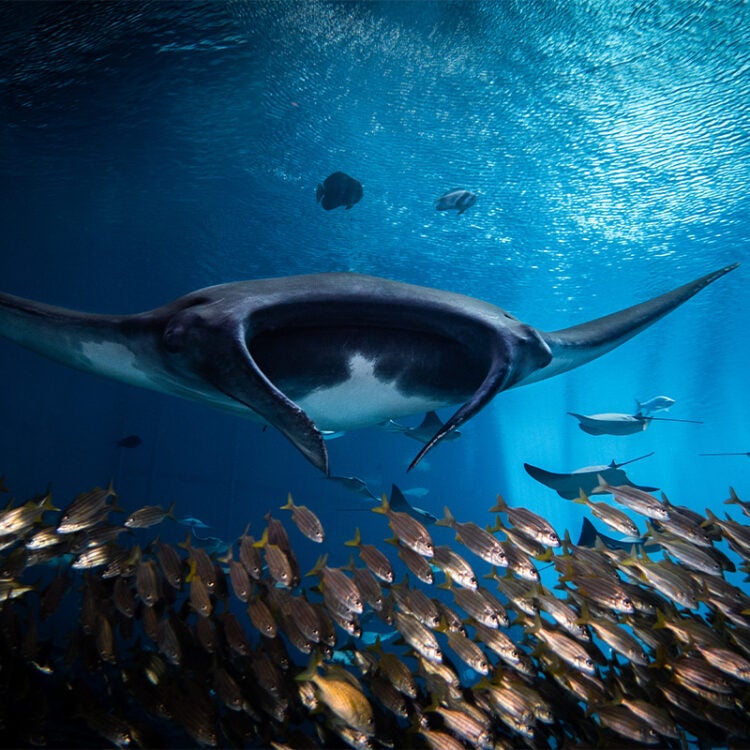
- Has a broad head with an enormous wide mouth flanked by two broad, flexible, fleshy lobes (cephalic fins). These lobes are usually kept rolled and pointed forward except when the manta is feeding. At this time the cephalic lobes will be open and extended.
- Sometimes called the “devil ray” because when rolled and projected forward, the cephalic lobes have the appearance of horns.
- Reaches weights of up to 3,080 lbs. (1400 kg) and can be up to 20 feet (6m) across.
- This species of manta may show great variation in pattern, but generally can be described as such:
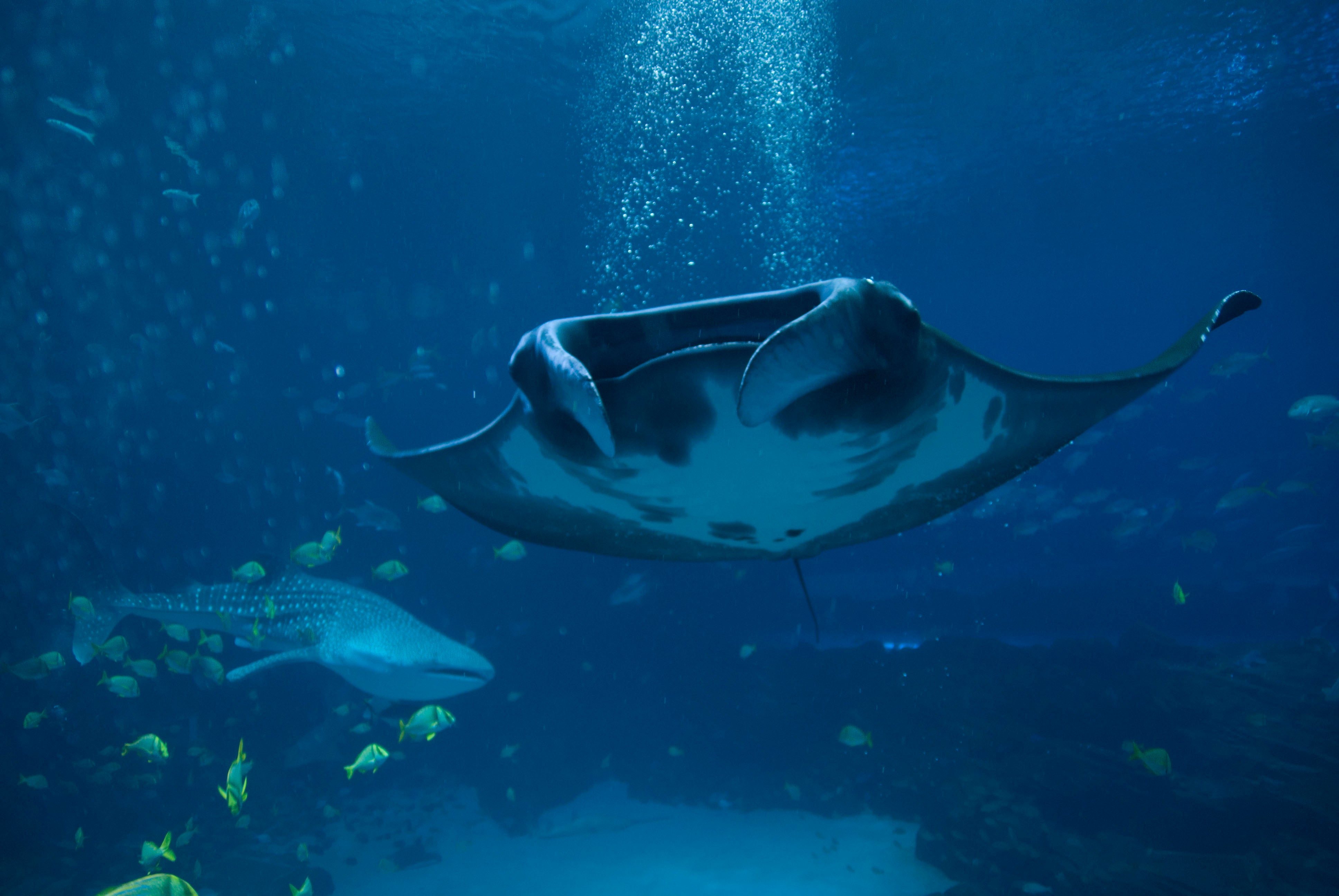
- Dorsal surface is dark in color with lighter shoulder patches. The underside is mostly white, dotted with black or charcoal blotches.
- The patterns on the shoulders and underside exhibit many arrangements and help researchers recognize individual animals.
- Tail is whip-like and has a thick round calcified mass at the base, just behind the dorsal fin. This caudal bulb is an identifying feature of this species.

Animal Fun Fact
Manta rays often somersault while feeding.
Diet / Feeding
- Primarily a plankton feeder, but sometimes also consumes small fishes.
- Its two cephalic lobes are unrolled and held at a downward angle to create a funnel guiding prey into its mouth.
- Feeds near or at the surface where plankton accumulates, frequently around reefs. The prey that enters the mouth is filtered from the water by the gill rakers (filter plates), located on the internal gill arches, and then swallowed.
- During feeding, the manta ray may repeatedly somersault underwater and occasionally break the surface. It also feeds in a horizontal orientation.
Range / Habitat
- Occurs in warm temperate and tropical waters of the Western Atlantic throughout the Western Caribbean and in some areas of the Gulf of Mexico.
- Frequently observed around reefs, atolls, Island groups and the continental shelf with consistent upwelling currents.
Reproduction & Growth
- Ovoviviparous, meaning that the embryo develops within eggs retained in the mother’s uterus.
- The embryo is nourished by its egg’s small yolk but also receives nourishment from the mother through small projections in the uterus called “villi” (trophonemata).
- Female gives birth to one or two live young. The pups are born with their wings folded around their body to allow easier passage through the birth canal.
- Only reproduces every one to seven years!
- This manta ray has 9-13 rows of teeth on the center of the lower jaw.
Conservation Status
- “Not Evaluated” on the IUCN Red List.
- This is a newly defined species as of 2025, and has not yet been evaluated by the IUCN.
- CITES Appendix 2.
Additional Information
- Has been observed jumping clear of the water, mainly in spring and autumn. This seems to be associated with mating displays, although it may also be social behavior or actions related to dislodging skin parasites.
- The name “manta ray” comes from the Latin mantum, meaning cloak or veil, and the name yarae refers to the mother of the ocean in native tongues
- Fishing pressure and bycatch in drift and set nets are depleting local populations.
- It is harpooned and harvested in some areas for its meat, sandpaper skin and oil-rich liver.
- The branchial arches of the gills are dried and used in Asian medicine. This is contributing to additional harvesting.
- The only natural enemies of the manta ray are large sharks and humans.
- Documented as significant bycatch in shrimp trawl fisheries in SE USA. Other threats include recreational cobia fishing, boat strikes, entanglement, and unregulated diving and snorkeling.
Sources
Bucair, N. et al. (2025). An integrative taxonomy investigation unravels a cryptic species of Mobula Rafinesque, 1810 (Mobulidae, Myliobatiformes), from the Atlantic Ocean. Environ Biol Fish. https://doi.org/10.1007/s10641-025-01727-2
Marshall, A.D. & Compagno, L.J.V. & Bennett, M.B. (2009) Redescription of the genus Manta with resurrection of Manta alfredi (Krefft, 1868) (Chondrichthyes; Myliobatoidei; Mobulidae). Zootaxa, 2301, 1–28
Unique Gifts from Georgia Aquarium
Bring the memories home with you! Stop by our gift shop for all your manta ray gifts or shop online here.