
-
Size
12-15 inches (30.5-38 cm) -
Diet
Small fish, crustaceans and other invertebrates -
Range
Indian, Pacific and Atlantic Oceans -
Habitat
Reefs, lagoons, estuaries and shipwrecks
Physical Characteristics
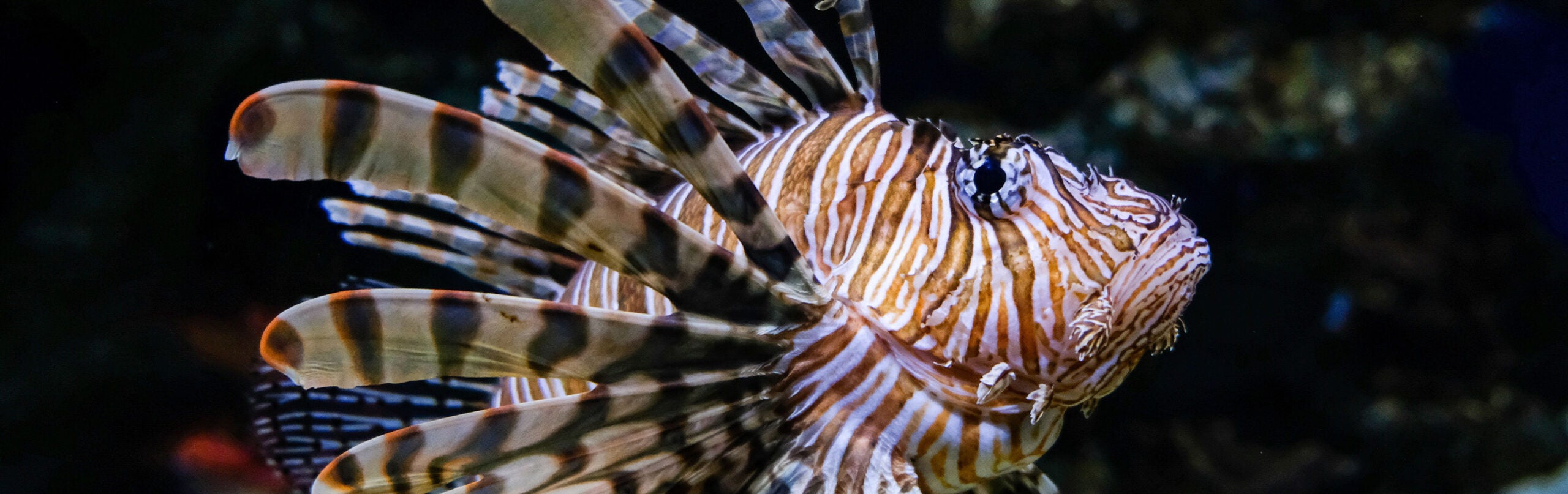
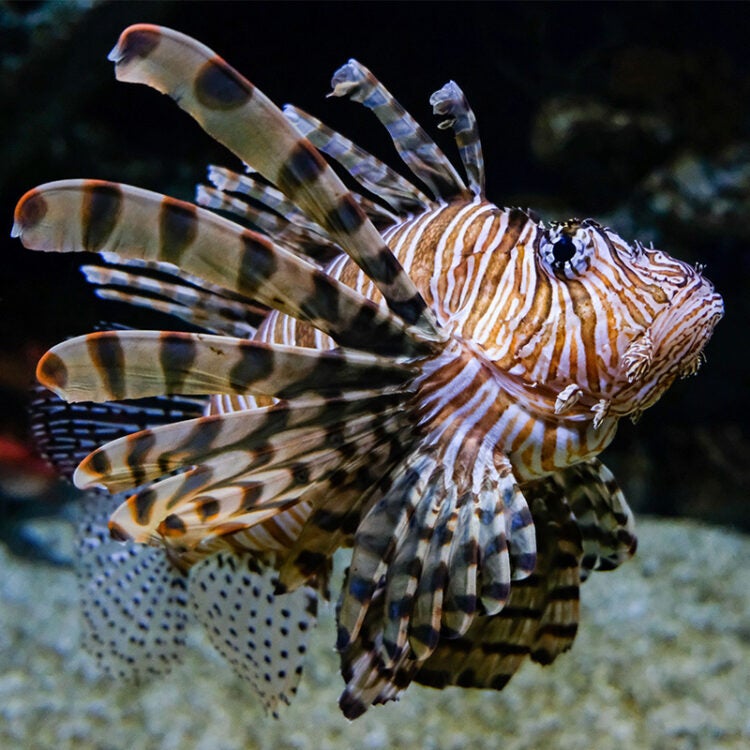
- The red lionfish is known for its elongated fin elements and distinctive color pattern.
- Coloration is highly variable depending on geographic location, habitat and water depth. It is zebra-banded with narrow reddish or golden brown vertical bars stretching across a whitish-to-yellow background. The soft dorsal, anal and caudal fins have dark rows of spots on a clear background.
- It has a fleshy protrusion above each eye and barbels below the mouth. Barbels are highly sensitive sensory organs that are used to detect pressure changes in the nearby environment and to assist in olfactory recognition.No fish species have tentacles, they can only be found in invertebrates. Tentacles are appendages with suction cups at the distal end that are used to grasp or capture prey. The exact purpose of these protrusions on lionfish is unknown, but it is speculated that they are used to mimic macroalgae as camouflage or to lure in prey.
- This lionfish ranges in length from 12-15 inches (30.5-38 cm). It can weigh 2.6 lbs. (1 kg).
- This species has venomous spines on the dorsal, anal and pelvic fins. The feather-like pectoral fins have no venomous spines.
Animal Fun Fact
The red lionfish is one of the most venomous of all fishes.
Diet / Feeding
- The red lionfish is one of the apex predators in the coral reef environment.
- Its diet consists of small fish, crustaceans (shrimp and crab) and other invertebrates.
- This species is a solitary, nocturnal hunter that stalks its prey and corners it using outstretched and expanded pectoral fins. The prey is seized in a lightning-quick lunge and is then swallowed whole.
- Cannibalism has been observed in this species.
Range / Habitat
- The red lionfish is an Indo-Pacific species that occurs naturally in the Eastern Indian Ocean from the Cocos-Keeling Islands to Western Australia and in the Pacific from Polynesia to Southern Japan and Northern New Zealand.
- It was introduced into the Western Atlantic in the early 1990s and has been reported as a highly invasive species from Long Island, New York to South Florida, as well as from Bermuda, the Bahamas and in Belize and several Caribbean islands.
- The Western Atlantic has been highly affected by this invasive species. Increased populations of red lionfish can decimate native fish populations, causing irreparable damage to local ecosystems. It is theorized that many small reef fish may not recognize red lionfish as a native predator and will attempt to defend their territory and inadvertently end up as a snack. As these small algae-grazing reef fish are eaten, the biodiversity of their reefs decreases and carpeting species of algae and macroalgae can overtake the reef, killing corals and destroying habitats for other reef-dwelling species.
- This lionfish is primarily a reef-associated species but is also found in other warm, marine waters in the tropics, including estuaries.
- It may occur in lagoons, seaward reefs and wrecks to depths of 180 feet (55 m).
- Recently, researchers have found lionfish off the coast of Florida at depths of 300 feet (91 m). This presents an expansion of the species’ typical depth range.
- This species glides along the rocks and coral during the night and hides out under ledges and in caves and crevices during the day.
Reproduction & Growth
- While courting, the male is particularly aggressive and will attack other males fiercely with violent biting and venomous dorsal spines.
- During breeding, one male may aggregate with 3-8 females. The male’s coloration darkens and its stripes are less apparent. A female with ripening eggs will become paler and, presumably, easier for the male to identify.
- Spawning takes place near the surface where the female releases eggs that are immediately fertilized by the male.
- The mass of planktonic eggs hatches in about 36 hours.
- The larvae, and later the juveniles, drift in the current for weeks before settling to the bottom.
- This accounts for the wide native distribution of the red lionfish, as well as the rapid spread after its introduction into the Western Atlantic.
Conservation Status
- “Least Concern” on the IUCN Red List.
Additional Information
- Red lionfish are slow-moving and conspicuous and rely on their unusual coloration and venomous spines to discourage predators.
- Red lionfish venom causes a severe reaction in humans, including intense pain, inflammation and, occasionally, serious systemic symptoms such as respiratory distress. A lionfish “sting” is rarely fatal.
- The protein-based venom can be denatured by applying hot compresses or immersing the wound in water at temperatures above about 113oF (45oC).
- Adults are solitary and fiercely defend their home range against other lionfish and individuals of other species. As juveniles and during the breeding season, red lionfish live in small groups.
- Red lionfish were first reported in Florida, North Carolina and Bermuda in 1990. Theories for its introduction include the transport and release of larvae or juveniles in the ballast water of large cargo vessels and the release or escape from a home aquarium.
- The first documented release of red lionfish into the Atlantic occurred in 1992 when Hurricane Andrew destroyed a large private aquarium in a house in South Florida and six lionfish escaped into Biscayne Bay. These fish were observed alive in the adjacent habitat several days later.
- There is evidence that the lionfish that have invaded the coastal waters of the eastern U.S. and the Bahamas are causing significant changes to reef environments. This voracious predator has eliminated or displaced native species.
- The red lionfish is highly valued in the home aquarium trade. It is also consumed in many parts of its native range. Human consumption of invasive lionfish should be encouraged as a method of invasive population control in the Western Atlantic. Many coastal communities host spearfishing competitions commonly called “Lionfish Rodeos” wherein scuba divers are encouraged to spear as many lionfish as possible to deplete invasive populations.
Sources
- www.fishbase.org
- http://animaldiveristy.ummz.umich.edu
- www.flmnh.ufl.edu/fish/Gallery/Descript/RedLionfish/RLionfish.html
- www.oceanservice.noaa.gov/education/stories/lionfish/factsheet.html http://nas.er.usgs.gov/queries/FactSheet.asp?speciesID=963
- www.sms.si.edu/IRLSpec/Pterois_volitans.htm
- www.nbcnews.com/science/big-lionfish-found-disturbing-depths-6C10631330