

-
Size
15 inches (38 cm) -
Diet
Leafy macro algae -
Range
Western Indo-Pacific -
Habitat
Lagoon and seaward reefs
Physical Characteristics
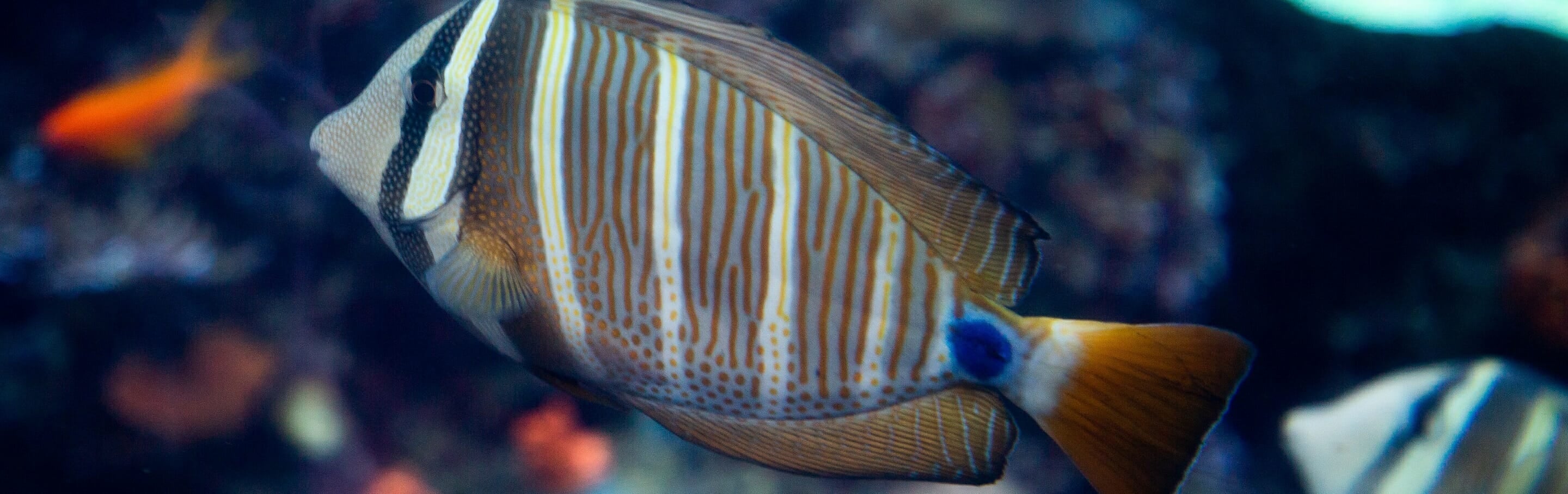
- Identified by its tall, enlarged dorsal and anal fins which are dark gray to brown with pale bands.
- Has white bars alternating with grey to brown bars with a white to yellowish and brown caudal fin that has no spots.
- Small juveniles have alternating yellow and black bars with a translucent tail. Its dorsal and anal fins are greatly enlarged.
- Adults can reach 15.7 inches (40 cm) in length.
Diet / Feeding
- Diet consists of leafy macro algae.
Range / Habitat
- Occurs throughout the Western Indo-Pacific from Indonesia to the Hawaiian and Tuamoto islands, southern Japan, the southern Great Barrier Reef, New Caledonia, and Rapa Island as well as throughout Micronesia.
- Found in lagoon and seaward reefs from the lower surge zone to a depth of about 100 feet (30.5 m).
- A solitary juvenile appears among rocks or coral in shallow protected, sometimes turbid, reefs.
Reproduction & Growth
- Oviparous, or egg-laying, species.
Conservation Status
- “Least Concern” on the IUCN Red List.
Additional Information
- Has fewer and larger pharyngeal teeth compared to other Zebrasoma species.
Sources
- Reef Fish Identification – Tropical Pacific. Allen, G.; Steene, R.; Humann, P. and Deloach, N., pg. 51
- www.fishbase.org