
-
Size
14-16 inches (36-41 cm) -
Diet
Crustaceans, mollusks, fish -
Range
Indo-Pacific -
Habitat
Sandy slopes
Physical Characteristics
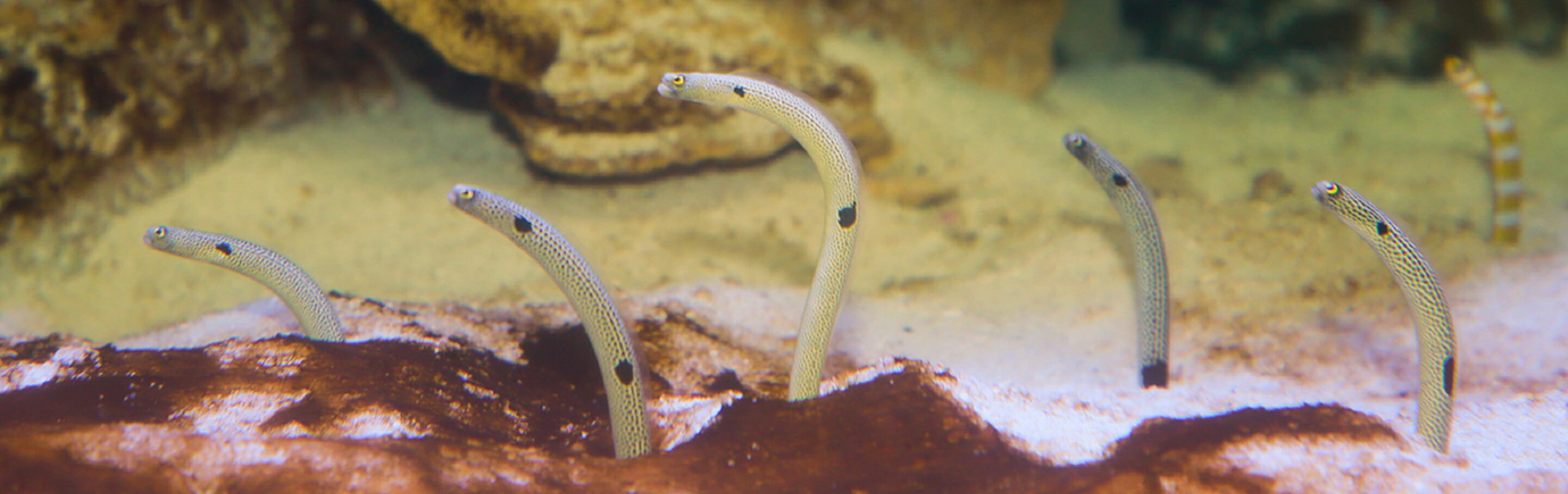
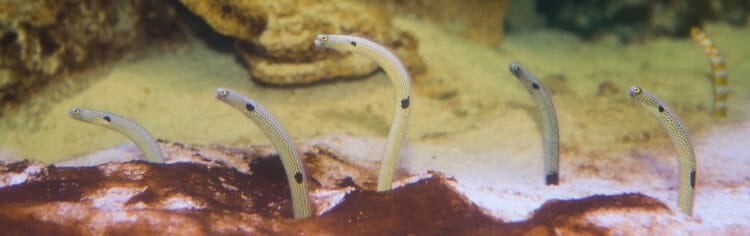
- Has a whitish body densely-covered with small black spots. Three larger black spots are seen along the side of the body: one at the gill opening, one near the pectoral fin and another at the base of the tail.
- Juveniles are entirely black.
- Can grow to about 24 inches (61 cm) in length although individuals of 14-16 inches (36-41 cm) are more common.
- Body diameter to about 0.5 inches (1.3 cm).
Diet / Feeding
- Diet consists of zooplankton it picks from the current as it flows past. For this reason, all the eels in a colony generally face the same direction: into the current.
Range / Habitat
- Occurs in tropical Indo-Pacific waters from the Red Sea and East Africa to Japan, Australia and New Caledonia, and throughout Micronesia.
- Found along sandy slopes and bottoms at depths of 23 to164 feet (7-50 m) in areas of strong currents.
- Lives in a sandy burrow that it digs tail-first. The garden eel then coats the sand walls with mucus from its body to cement the sand grains together to prevent collapse.
Reproduction & Growth
- Males and females move burrows to increase proximity during mating season.
- Will stretch from adjacent burrows and intertwine bodies to spawn.
- The male will display protective behaviors toward his female mate, keeping other competitors away. It may bite rivals.
- Pelagic spawner: after mating, females will release fertilized eggs into the current.
- After the eggs hatch in the current, larvae continue to float until large enough to settle to the ocean floor. At that point, the juvenile garden eel will dig its own burrow.
Conservation Status
- “Least Concern” on the IUCN Red List.
Additional Information
- Live in colonies of up to several hundred individuals each occupying its own burrow with approximately 15 organisms per square meter. Usually, the largest male lives in the center burrow.
- Most commonly seen with one-quarter of its body extended out of the burrow, swaying in the current like a blade of seagrass in order to feed on passing plankton.
- Easily disturbed and quickly retracts itself, tail first, into its burrow.
- Rarely leaves its sand burrow, even to spawn.
- Species discovered when SCUBA diving became popular.
Sources
- www.fishbase.org
- The Australian Museum
- Reef Fish Identification – Tropical Pacific. Allen, G.; Steene, R.; Humann, P. and Deloach, N., pg. 447
- Encyclopedia of Fishes, 2nd Edition; pg. 88
- http://sea.sheddaquarium.org