
-
Size
8 feet (2.4 m) -
Diet
Fish and larger crustaceans, such as shrimp and crabs -
Range
Atlantic Ocean -
Habitat
Coastal waters, bays, estuaries and mangrove-lined lagoons and rivers
Physical Characteristics
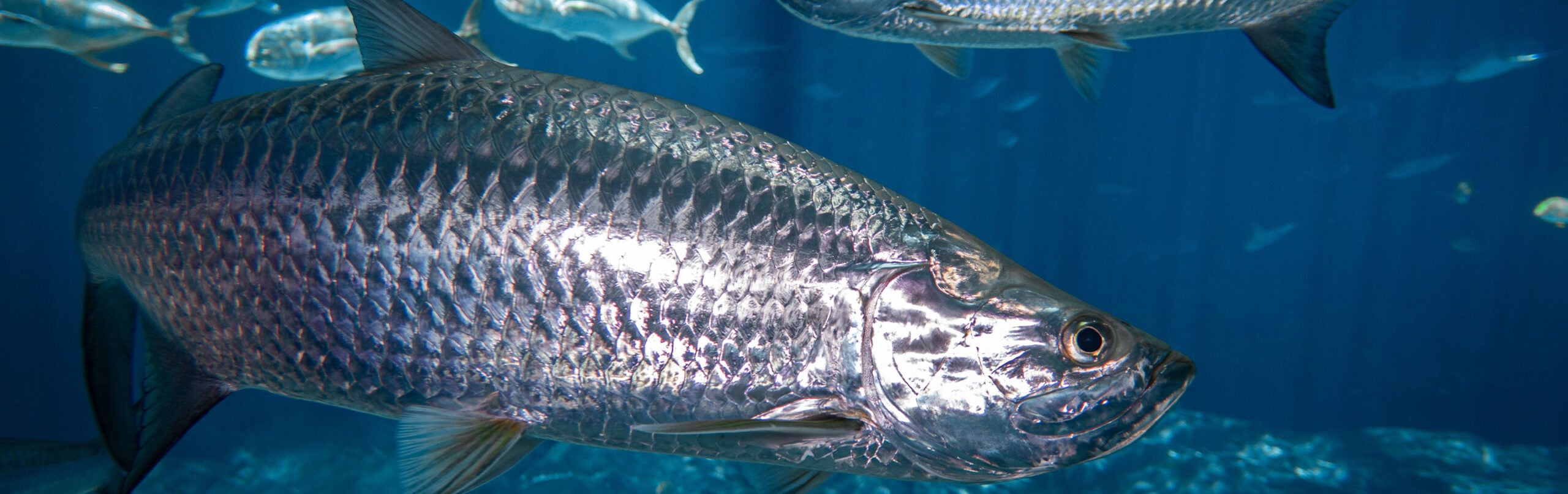
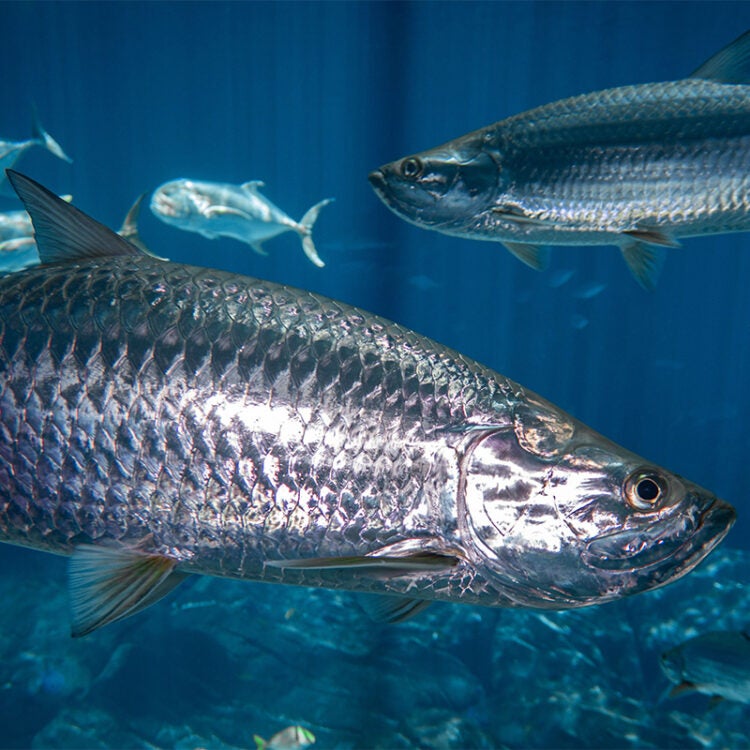
- Coloration is blue-grey on the back and bright silver on the sides and belly
- Elongated, laterally compressed body, with an enormous upturned mouth. Body covered with large scales. Resembles a large herring-like fish
- Maximum length of more than 8 feet (2.4 m). Maximum weight of 355 lbs. (161 kg).
Animal Fun Fact
The tarpon has an air bladder that helps it live in oxygen-poor water.
Diet / Feeding
- Diet consists of fish, such as mullet, pinfish, needlefish, sardines, and larger crustaceans, such as shrimp and crabs.
- Larval and small juvenile stages consume zooplankton, insects and small fishes.
Range / Habitat
- Occurs in the warm waters of the Atlantic, throughout the Gulf of Mexico and the Caribbean and in the Eastern Central Pacific near the terminus of the Panama Canal
- In the Western Atlantic, from North Carolina to Bahia, Brazil and occasionally north to Nova Scotia and south to Argentina
- In the Eastern Atlantic, occurs from Senegal to Angola and off the coasts of Portugal and Southern France
- Found in coastal waters, bays, estuaries and mangrove-lined lagoons and rivers at depths to 130 feet (40 m). Often enters river mouths and bays and travels upstream into fresh water.
Reproduction & Growth
- Females that are 6 feet (2 m) can produce from 4.5 to 12 million eggs.
- Spawning takes place in open water during April- August.
- Eggs hatch at sea and drift as transparent, ribbon-like larvae on ocean currents, eventually ending up in estuarine waters. Returns to the sea as a juvenile
- Larva resembles that of the bonefishes and eels, indicating a close evolutionary relationship.
Conservation Status
- “Vulnerable” globally on the IUCN Red List.
- Threats include: Habitat degradation and overfishing.
Additional Information
- Feeds both during the day and at night.
- Live to about 13 years of age.
- Can tolerate a variety of environments and often travels upstream into fresh water. Can survive in oxygen-poor environments due to its modified air bladder, which is connected to the esophagus and can be filled directly with air. Large individuals can often be seen rolling at the surface of the water as they gulp air.
- Swims in schools during the day; the same large groups can be found in the same area for years.
- Highly regarded as a sport fish, because of its strength, stamina and fighting ability, makes impressive leaps when hooked.
- Main predators besides humans are Bull sharks, Great Hammerheads, American alligators and multiple species of porpoise.
- One of Florida’s premier game fish, but it cannot be fished commercially. Most recreational anglers practice catch-and-release. A special tag must be purchased from the State to keep the fish as a trophy.
- Large scales are used in ornamental art and in preparing artificial pearls.
- Has been identified in fossil records dating back some 135 million years ago to the Upper Cretaceous Period.
Sources
- www.fishbase.org
- www.flmnh.ufl.edu
- www.marinefisheries.org
- www.sms.si.edu
- Encyclopedia of Fishes, 2nd Edition, 1998, pg. 85
- Mcclane’s Field Guide to Saltwater Fishes of North America. McClane, A.J., pgs. 59-60