
-
Size
5-6 feet (1.5-1.8 m) -
Diet
Bottom dwelling invertebrates and bony fishes -
Range
Eastern Indian Ocean -
Habitat
Coral and rocky reefs, sandy bottoms
Physical Characteristics
- Average length is between 5-6 feet (1.5-1.8 m).
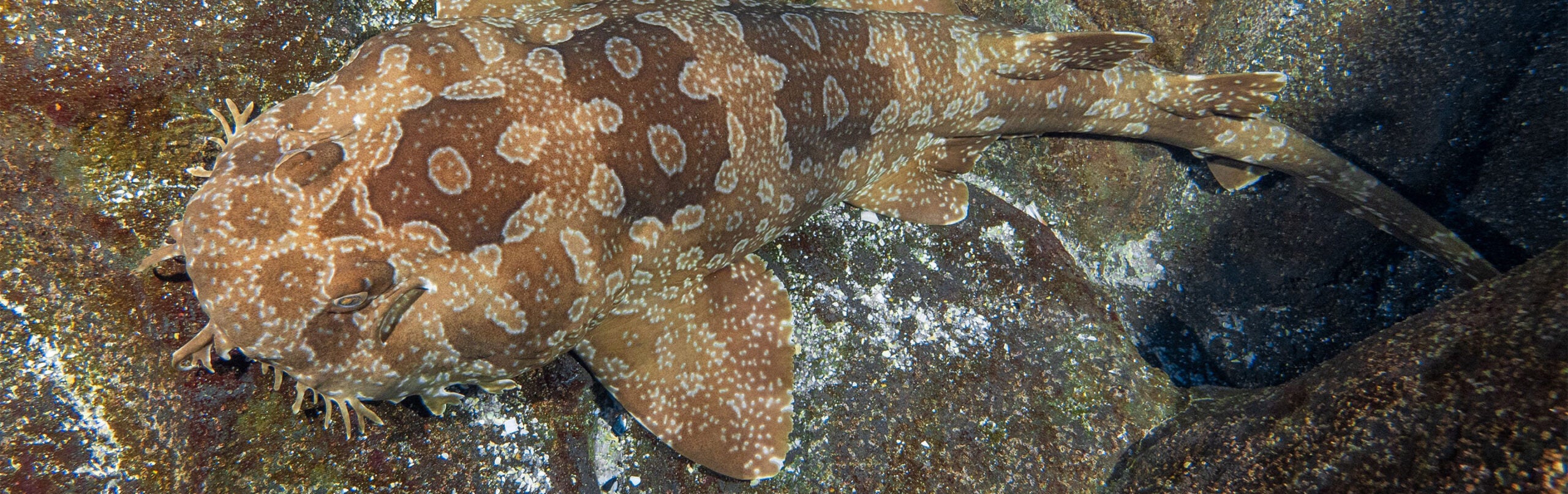
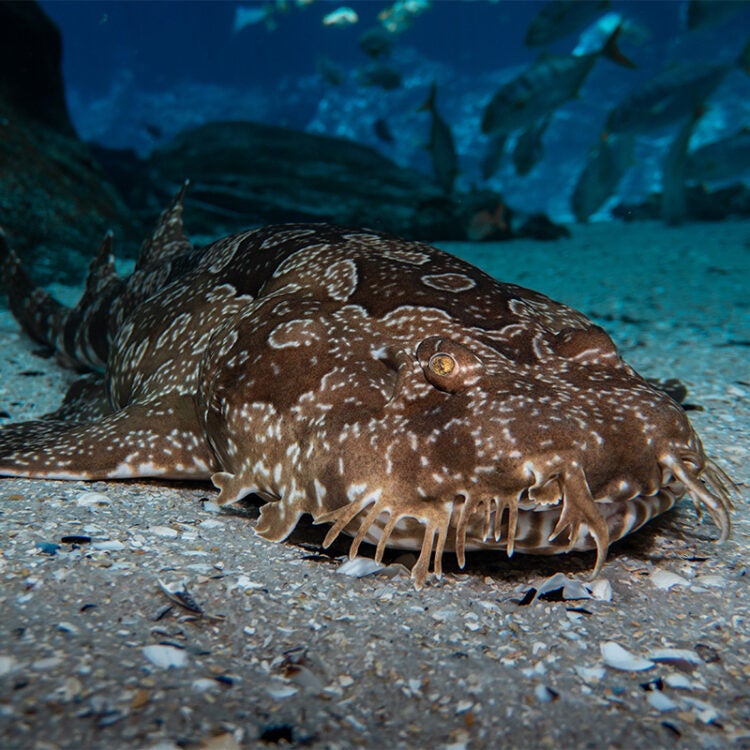
- The body and fins display usually dark brown coloration with lighter O-shaped markings obscuring darker saddles. Has an elongated caudal fin with no ventral lobe.
- This species possesses a spiracle, which allows it to breathe while remaining motionless on the bottom.
- A few branching skin flaps run continuously from the pectoral fins around the front of the head forming a lace-like beard below the mouth.
Animal Fun Fact
The spotted wobbegong possesses a spiracle, which allows it to breathe while remaining motionless on the bottom.
Diet / Feeding
- A nocturnal feeder that preys on bottom invertebrates, bony fishes and small elasmobranchs.
Range / Habitat
- Occurs in the eastern Indian Ocean, Southern and Western Australia, Japan and the South China Sea have also had sightings.
- Found in warm waters on the continental shelf from intertidal areas at any depth 0-110m.
- This species is commonly found on or near the bottom of coral and rocky reefs, under piers, and on sandy bottoms. It has been observed in water barely deep enough to cover it.
Reproduction & Growth
- Ovoviviparous- fertilization of eggs occurs internally and the young develop within the female and are born fully formed.
- Average pup size is 8.3 inches (21 cm).
- Females can produce up to 37 pups per litter.
Conservation Status
- “Least Concern” on the IUCN Red List.
Additional Information
- A master of camouflage, escaping notice in plain sight. Resting quietly on the bottom, this species is almost undetectable. Its flattened body, enlarged pectoral and pelvic fins drape over the rocky or coral substrate, barely adding to the vertical relief of the bottom. The shark’s variegated brownish-grey markings and pale ring-like spots break up the body into irregular shapes that blend imperceptibly with the surrounding underwater terrain. Even the eyes, which would ordinarily be easily detectable, are hooded and surrounded by eye-shaped markings that make them difficult to identify. A beard of fleshy tassels further obscures the outline of the shark’s head, making it very hard to tell where the animal stops and the bottom begins.
- This wobbegong appears to favor specific caves to rest in during the day. These caves are often shared with small schooling fishes.
- The species will bite if stepped on or provoked.
- The name “wobbegong” is Australian aboriginal in origin, but its exact meaning is unknown. It is speculated that it may mean “living rock.”