

Work continues for the conservation of Whale Sharks in the Galapagos Islands

Work continues for the conservation of Whale Sharks in the Galapagos Islands after a decade since the creation of the project.

A team of scientists from the Galapagos Whale Shark Project (GWSP), the Galapagos National Park Directorate (DPNG), and the Georgia Aquarium (GA) embarked upon a second annual expedition to Darwin Island on the week of the 9th of September. The expedition goal was to carry out fieldwork for the long-term study on the unique grouping of whale sharks sighted passing by seasonally in the waters of the far northern region of the Galapagos Archipelago.

The Galapagos Whale Shark Project, cofounded by Dr Alex Hearn and Jonathan R Green a decade ago, has been working to better understand the movement ecology and reproductive biology of female adult whale sharks sighted in greater numbers in the Galapagos than anywhere else in the world. Since the beginning of the project, the scientists from the GWSP have carried out groundbreaking science for the conservation of this endangered species, working in collaboration with multiple organizations and expert scientists from around the world.

This year, the team, reduced to small numbers due to the continued impact of the COVID-19 pandemic for travel and global collaborations, was made up of five members from the abovementioned organizations.

During a week of work, they carried out various field methods to gather data that will continue to shed light on the remaining mysteries of this species. During this expedition, the main activities carried out were photo-ID of four whale sharks, satellite tagging (SPLASH tags) of four sharks, tagging with animal-bourne video cameras (CATS) of one shark, and sampling of the microbiome of two of the sharks.

The data from the photo-ID and the satellite tagging provides information of estimates on population size, residency indexes, mortality, and allows for both passive and active tracking of the animals, respectively. Satellite tagging also provides information on the activities. Galapagos Whale Shark Project Press Release Image 1. A satellite tag was placed on the dorsal fin of a whale shark. ©Sofía M Green performed by the whale sharks underwater, giving insight about their diving behavior and habitat preference and use in the water column.
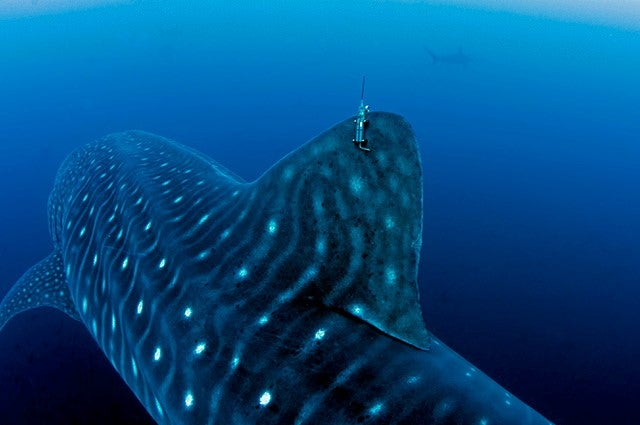
Work continues for the conservation of Whale Sharks in the Galapagos Islands after a decade since the creation of the project 1

Meanwhile, the animal-bourne video cameras allow a visual insight of their movements underwater and any possible interactions with other individuals both inter- and intra-specific in areas not easily observed by the human eye, while also avoiding any change in behaviour that may occur from human presence. The camera’s also have inbuilt accelerometers which allow fine scale resolution data collection of their movements in different planes during various activities such as foraging, navigating, diving, and more.

The microbiome samples serve for innovative research which is looking at the role of body-associated microbiomes in determining elasmobranch health and how the unique microbiome might be involved in host immunity, nutrition, disease and waste- processing.

This year the Galapagos Whale Shark Project team reports a low frequency of whale shark sightings which are probably influenced by the fluctuation of sea surface temperatures (SSTs) due to climatic patterns such as the warming of waters with El Niño Southern Oscillation (ENSO) and the cooling counter event of La Niña. Specifically in 2021 NOAA reports a neutral climate state with “near to below average” SST’s with a 70-80% chance of La Niña during the northern hemisphere winter 2021-22.

Jonathan R Green states “The lower SSTs in April and May brought early sightings of whale sharks but in June and July temperatures again rose with a corresponding decrease in numbers and frequency of sightings from reports from the dive Masters, visiting divers, [and our team].” With climate change it is predicted that the Oceanic phenomena’s such as El Niño and la Niña will occur with higher frequencies and thus it is probable that this will affect the regularity with which whale sharks are sighted in their known aggregation locations. The shift in seasonal sightings and possibly also location of sightings make it more complicated to apply proper measures of management for the conservation of this species. The impact of climate change on this species is uncertain and is being considered in current and future studies.

The GWSP would like to thank the Galapagos National Park Directorate (DPNG), the Georgia Aquarium (GA), the Galapagos Science Center (GSC), the Galapagos Conservation Trust (GCT), the World Wildlife Fund (WWF), Save Our Seas Foundation (SOSF) and Galapagos Shark Diving (GSD) for their funding and/or support in this project.

For further information:

galapagoswhalesharkproject@gmail.com

www.galapagoswhaleshark.org

This article was published on: September 23, 2021

New Global Study Finds Unprecedented Shark and Ray Extinction Risk

New Global Study Finds Unprecedented Shark and Ray Extinction Risk

France, Marseille, 6th September 2021: A new analysis published today in the journal Current Biology finds that one-third of the world’s chondrichthyan fishes – sharks, rays, and chimaeras – are now threatened with extinction according to the International Union for Conservation of Nature (IUCN) Red List criteria. A team of experts from around the world assessed 1,199 species and classified 391 (twice as many as in the 2014 assessment) in the IUCN threatened categories of Critically Endangered (90 species), Endangered (121 species), or Vulnerable (180 species). Rays are the most threatened of the three chondrichthyan fish groups (41% of 611 species). About 36% of 536 shark species and 9% of 52 chimaera species are threatened.

“On one hand, we’re pleased that chondrichthyan science contributions have doubled since our first global analysis of this kind, allowing us to assess the status of many more species with greater confidence,” said Dr. Nicholas Dulvy, Professor at Simon Fraser University. “On the other hand, our study reveals an increasingly grim reality, with these species now making up one of the most threatened vertebrate lineages, second only to the amphibians in the risks they face. The widespread depletion of these fishes, particularly sharks and rays, jeopardizes the health of entire ocean ecosystems and food security for many nations around the globe.”

The study documents disproportionately high levels of threat for sharks and rays in tropical and subtropical coastal waters, where more than three-quarters of species are threatened. Three such species are now, for the first time, considered “possibly extinct”. The Java Stingaree and Red Sea Torpedo Ray have not been reported for well over a century. The South China Sea’s Lost Shark has not been seen since 1934.

“The tropics host incredible shark and ray diversity, but too many of these inherently vulnerable species have been heavily fished for more than a century by a wide range of fisheries that remain poorly managed, despite countless commitments to improve,” said Dr. Colin Simpfendorfer, Adjunct Professor at James Cook University. “As a result, we fear we will soon confirm that one or more of these species has been driven to extinction from overfishing, a deeply troubling first for marine fishes. We will work to make this study a turning point in efforts to prevent any more irreversible losses and secure long-term sustainability.”

Chondrichthyans are exceptionally susceptible to overfishing because they tend to grow slowly and produce few young. At particular risk are the sharks and rays, sought for meat, leather, oil, fins, gill plates, and recreation (fishing and diving). Overfishing of these species has outpaced effective resource management. Governments have fallen far short in heeding scientific advice, fulfilling treaty obligations to end unsustainable exploitation, protecting important habitats, and prioritizing protections for chondrichthyan species. The top four most imperiled chondrichthyan families are the sawfishes, giant guitarfishes, devil rays, and pelagic eagle rays, with 100% of species listed as threatened.

“Our analysis is alarming and yet offers some hope.
- Sonja Fordham, president of Shark Advocates International

“Our analysis is alarming and yet offers some hope,” said Sonja Fordham, president of Shark Advocates International, a project of The Ocean Foundation. “We document significant rebuilding for several species of heavily fished skates, achieved through science-based limits. We have the frameworks, tools, and commitments to replicate this success across the globe, but time is running out for more and more shark and ray species. We urgently need governments, encouraged by citizens, to follow through with strict limits on unsustainable fishing and finally turn the tide for these extraordinary animals.”

Notes to Editors: The study was completed by the Global Shark Trends Project (GSTP), a collaboration of the IUCN Shark Specialist Group, Simon Fraser University, James Cook University, and the Georgia Aquarium established with support from the Shark Conservation Fund to assess the extinction risk for chondrichthyan fishes (sharks, rays, and chimaeras). The team engaged 322 experts from around the world to complete the 8-year long analysis. The analysis classifies 391 of 1,199 chondrichthyan species (32.6%) as threatened, according to IUCN Red List criteria. That statistic increases to more than one-third (37.5%) if Data Deficient species are assumed to be threatened in the same proportion as assessed species.

The IUCN Red List website uses the higher value to convey global extinction risk. Chondrichthyans make up the oldest and largest evolutionary radiation of vertebrates and one of the three taxonomic Classes of fishes. Class Chondrichthyes comprises three main lineages: sharks, and rays, and chimaeras(a relatively small group of mainly deepwater species). Starting in the 1990s, sharks and rays have been increasingly addressed through Regional Fisheries Management Organizations and international wildlife treaties, particularly the Convention on International Trade in Endangered Species. Through various associated actions aimed primarily at ending overexploitation of threatened species, member governments are obligated to restrict fishing and/or exports to sustainable levels, but the record for fulfilling these commitments has to date been generally poor.

This article was published on: September 8, 2021

Georgia Aquarium Shares Results of Largest-ever Cetacean Welfare Study

ATLANTA – Georgia Aquarium is announcing the peer-reviewed journal PLOS ONE published findings from the Cetacean Welfare Study, the largest-ever groundbreaking, multi-institutional study of how physical habitat, environmental enrichment, and animal training impact the welfare of cetaceans in zoos and aquariums worldwide. The collection of nine manuscripts highlights tools and findings that can be utilized for the continuous improvement of the care and welfare of cetaceans in professional care.

From Chicago to Singapore, data was collected across 46 cetacean habitats at 43 accredited facilities in seven countries. Over the course of the data collection phase of the study, which took place in 2018 and 2019, scientists gathered information regarding 216 common and Indo-Pacific bottlenose dolphins, 13 beluga whales, and eight Pacific white-sided dolphins.

Georgia Aquarium contributed physiological data from its common bottlenose dolphins and beluga whales. Specifically, the dolphins at the Aquarium wore special packs that collected data on their behavior, swimming, spatial use, and videos were collected to gain insight into their behavior and social interactions. This data from the dolphins and beluga whales ultimately added to the robust set of information that would inform these findings on cetacean health and welfare.

Using cutting-edge technology, the study explored cetacean welfare through various lenses, including habitat characteristics, training programs, environmental factors, and demographics like age and sex. An important outcome of the work was a whole new set of research tools, including the creation of an iOS app, ZooPhysioTrak—a comprehensive database of health and welfare biomarkers from all the participating institutions that provides veterinarians and cetacean care managers with standard health reference intervals and welfare indicators to compare their animals’ test results (from blood and fecal samples). This resource places important health and welfare information directly into the hands of cetacean caregivers and managers like never before.

“Thirty-four Alliance of Marine Mammal Parks and Aquariums member facilities from all over the world eagerly participated in this groundbreaking study in order to contribute to an increased understanding of cetacean welfare,” said Kathleen Dezio, AMMPA president and CEO. “We commend Dr. Lance Miller and his colleagues on this cutting-edge research that will empower zoo and aquarium professionals with important new tools and insights to help them continue to enhance the welfare of the inspiring animals in their care.”

Additionally, findings suggest the environmental enrichment programs and social management of bottlenose dolphins are more closely related to behaviors likely indicative of positive welfare than habitat characteristics. This suggests that welfare is less related to the size of the animals’ habitat, and more related to how the mammals are cognitively challenged through their environment enrichment and appropriate social management. Coming out of the study, institutions implemented additional protocols to their already existing and robust enrichment programs to continually grow and enhance them based on findings from this study.

Association of Zoos and Aquariums members are known for providing the best care and welfare possible for their animals. This groundbreaking study provides new insights into how our members can better care for cetaceans. The important science-backed findings will also help enhance our rigorous accreditation standards related to cetaceans,” said Dan Ashe, president and CEO of the Association of Zoos and Aquariums.

These findings, and others from the study, will be used to enhance cetacean care and welfare best practices, and will advise future animal welfare research, which advances the goal of zoos and aquariums everywhere to continuously improve knowledge and welfare assessment tools for species under professional care.

This article was published on: August 31, 2021

Sharks & Rays in Rapid Global Decline: IUCN Report

Georgia Aquarium is an active partner and participant in The Global Shark Trends Project which concluded its multi-year assessment of extinction risk of 1,250 species of sharks, rays, and chimaeras. The Project is part of the International Union for Conservation of Nature (IUCN) and has come to a startling realization: these species’ populations have declined 71 percent in the last 50 years.

This important data sheds light on a rapidly growing problem in our oceans: many of its species may be headed towards extinction.

In a unique commitment to conservation by the Aquarium, researcher Katelyn Herman is a specially trained Red List Officer for the IUCN. The Red List is the most detailed, objective catalog of animal and plant species, documenting their risk of extinction and drawing a picture of the world’s biological health. She supports the IUCN’s Shark Specialist Group, working alongside leading scientists who contribute research to the Red List.

Georgia Aquarium is one of two facilities in the United States to commit this way to the IUCN, with Herman just one of three Red List Officers at facilities accredited by the Association of Zoos and Aquariums (AZA).

Herman’s work also makes Georgia Aquarium one of only 10 IUCN “Red List Hubs” developed worldwide with professional zoo organizations, where more Red List Officers will be trained. Hubs are now at ABQ BioPark in New Mexico, The Deep in England, Lisbon Oceanarium in Portugal, and another four are in development.

“Sharks were not originally a species I felt strongly about, but since getting involved in this project I’ve fallen in love with them. There are so many cool and unusual species of sharks, and they are too often overlooked and misunderstood,” Herman said.

She’s the only person on the team creating GIS (Geographic Information System) field maps, showing where every shark and ray species can be found across the planet. Herman’s research work at Georgia Aquarium also involves dolphin and whale shark research and GIS spatial analysis.

The maps also include a lot of other information, including species names, whether their range is seasonal, what year the assessment was done, the species’ status, and more. These maps also have longevity. They can be used for future policy planning and research studies past this project. With the rate of environmental threats and extinction risks, every Red List species must be re-assessed every 10 years, and maps must be updated.

The Global Shark Trends Project faced tough challenges. Fewer marine species have been assessed for the Red List than terrestrial species because it is hard to count animals in the depths of the ocean, especially when many species travel over wide ranges.

“Marine animals are more difficult,” Herman said. “You can’t wait by a watering hole to count them or track them on foot. It’s not easy to tag them and even when you can use photo identification on a species, it’s still a matter of whether or not that one individual happens to be in the exact place I am, at that moment.”

In 2018 and 2019, prior to the COVID-19 pandemic, Herman traveled to Brazil and Colombia to help assess the southwest Atlantic Ocean with experts and fisheries from other countries, including Colombia, Venezuela, Brazil, the Falkland Islands, and more.

“It’s more efficient to have the regional experts in one place,” Herman says. “They’ll share things such as the known habitat of a species, and how fishing activities are affecting the species in each region.”

It was a busy time for her – they assessed 120 species and found that range maps needed to be updated, or created, for 115 of them.

In addition to Herman’s diligent work with the Global Shark Trends Project and IUCN, Georgia Aquarium has also been the scene for important research decisions and collaboration among institutions. The Aquarium hosted a weeklong sawfish workshop in 2017, where experts came together and talked about how to best protect them.

“One of the coolest things I’ve done is help organize the sawfish workshop,” Herman says. “Before starting with the IUCN, I only knew about a handful of shark and ray species but being part of this project has broadened my knowledge and understanding to some of the most obscure, fascinating species I constantly cited IUCN in papers during college, and to now be engaging with this group professionally is a privilege.”

Georgia Aquarium’s commitment is part of a partnership between AZA and the IUCN, which in the past has relied on academic experts.

This article was published on: January 27, 2021

Georgia Aquarium Offers Temporary [Warm] Home to Cold-Stunned Turtles

On Monday, December 14, Georgia Aquarium welcomed four new temporary residents: cold-stunned loggerhead sea turtles. This endangered species was flown in from New England to stay in Georgia Aquarium’s care for an extended period of time until they are able to safely return to the ocean.

The four loggerhead sea turtles in the care of Georgia Aquarium are juveniles and weigh between 20 and 50 pounds. Georgia Aquarium’s team of aquarists and veterinarians will monitor them regularly behind-the-scenes. Providing feedings, and any veterinary care they may need. Organizations like NOAA and the U.S. Fish and Wildlife Service will determine when they can be released back into the ocean, most likely off the coast of Florida where the weather is warmer.

This season, hundreds of cold-stunned turtles were rescued off the coast of New England due to cold weather. The chilly temperatures happen so quickly that turtles are unable to swim to warmer waters fast enough and become cold-stunned. They can suffer from hypothermia causing them to become lethargic affecting their diets and overall health.

Georgia Aquarium is proud to offer a temporary home and important care to these rescued animals and work in this multi-institutional effort alongside other zoos, aquariums, and rescue organizations to save hundreds of turtles.

Loggerhead sea turtles are found all over the world from the Atlantic to the Pacific, Indian Oceans, Mediterranean Sea, the northern Gulf of Mexico through the Bahama Islands, and the Antilles. Full-grown loggerhead sea turtles can weigh up to 350 pounds and reach 3 feet long.

For high-res photos click here.
For b-roll click here.

This article was published on: December 16, 2020