
-
Size
3-4 feet (1-1.2 m) -
Diet
Crabs, bivalves, lobsters and bony fishes -
Range
Atlantic Ocean and Gulf of Mexico -
Habitat
Tropical climates in open water and near the coast
Physical Characteristics
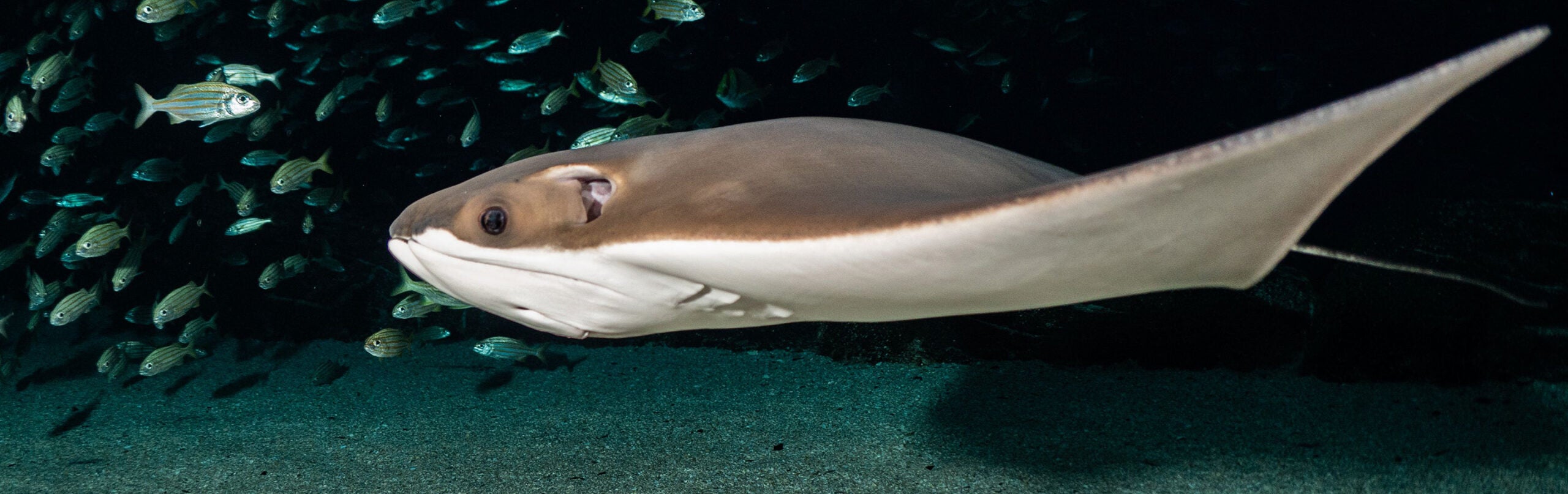
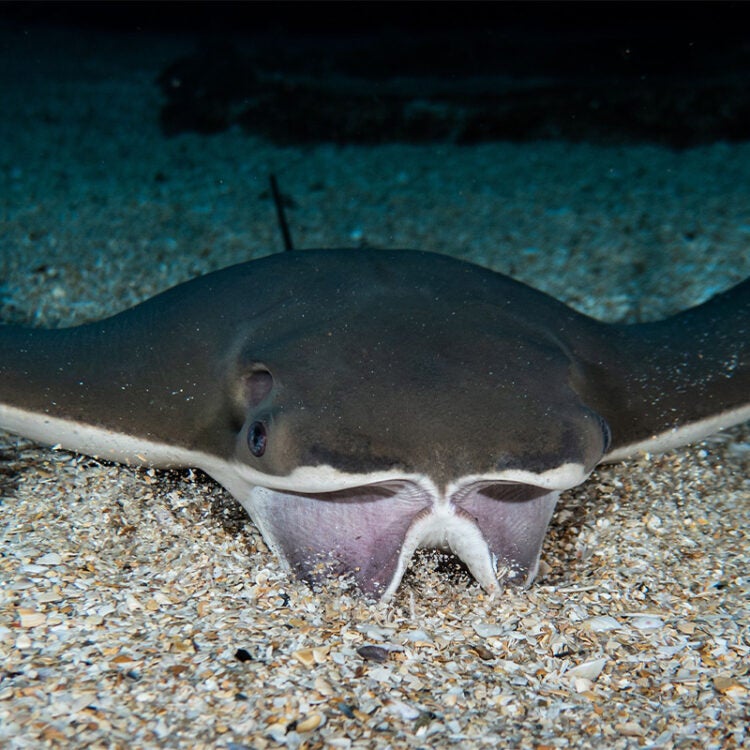
- Forehead resembles a cow’s nose, with an indented groove around the front of its head and a distinctly bi-lobed snout.
- Coloration is usually brown to olive on the back (dorsal surface), with no spots or marks. The lower body (ventral surface) is white or yellowish.
- The wings (pectoral fins) are long and pointed.
- It has a long whip-like tail with one or two barbs at the base.
- Common length of 3.8 feet (1.2 m), but there seems to be some differences in size based upon location. Rays in the Gulf of Mexico seem to get larger and reproduce sooner than rays farther north.
Animal Fun Fact
The cownose ray feeds by using its snout to forage in the sand along the ocean bottom, much like a pig would do on land.
Diet / Feeding
- An opportunistic feeder of benthic invertebrates puts the cownose in competition with commercial shellfish industries. Feeds on crabs, bivalves, lobsters and bony fishes.
- The mouth is located on the underside of the body and has strong, plate-like teeth for crushing mollusk shells.
- One way the cownose ray eats is by using its pectoral fins to stir up the bottom sediments to reveal its prey. It may also use its snout to forage and root on shallow saltwater flats in much the same way as a wild pig would on land.
Range / Habitat
- Occurs throughout the Western Atlantic Ocean from Massachusetts to Uruguay and in the Gulf of Mexico.
- Found in tropical climates to depths of 196 feet (60 m).
Reproduction & Growth
- Males typically mature at age 5 or 6 while females mature at about age 7 or 8, although farther south the estimates decrease to about 4 to 5 years old.
- Cownose rays exhibit strong philopatry to their pupping and mating estuaries.
- Cownose rays typically produce one pup per pregnancy since only one ovary (the left) is usually functional.
- Gestation for cownose rays is about 11-12 months and they tend to give birth in June or July. Females are often already pregnant again by August before beginning winter migrations
- Cownose rays are ovoviviparous, meaning that the pups develop from an egg with a yolk in the uterus before being born live.
Conservation Status
- “Vulnerable” on the IUCN Red List.
Additional Information
- Cownose rays are a semi-pelagic species, living along the sea floor as well as in open water.
- Forms large schools and are often seen in aggregations numbering in the thousands, often followed by large schools of fish looking for similar food items.
- There are 5 recognized species of cownose rays.
- Preyed upon by many sharks, especially hammerheads. Barbs from the species have been found embedded in the heads, jaws and mouths of various shark species.
- Cownose rays live approximately 15-20 years.
- Occasionally seen jumping and landing with a loud smack – probably as a territorial display.
- The cownose ray is considered to be oceanadromous, meaning that it undertakes long migrations to different parts of the ocean. It moves in large groups, usually in a seasonal pattern. In the Atlantic, the species moves northward in the late spring and southward in the late fall. In the Gulf of Mexico, it migrates in a clockwise manner according to season.
- Has the lowest electro-sensitivity of any shark or ray studied thus far.
Sources
iucnredlist.org
https://www.floridamuseum.ufl.edu
The Shark Almanac. Allen, T. B., pg. 144
Sharks and Rays. Hennemann, R. M., pg. 278
Fisher, R.A., Call, G.C. and Grubbs, R.D. 2013. Age, growth, and reproductive biology of cownose rays in Chesapeake Bay. Marine and Coastal Fisheries 5: 224–235.
Ogburn, M.B. & Bangley, C.W. & Aguilar, R. & Fisher, R.A. & Curran, M.C. & Webb, S.F. & Hines, A.H. (2018) Migratory connectivity and philopatry of cownose rays Rhinoptera bonasus along the Atlantic coast, USA. Marine Ecology Progress Series, 602, 197–211 DOI: 10.3354/meps12686
Rogers, C. & Roden, C. & Lohoefener, R. & Mullin, K. & Hoggard, W. (1990) Behavior, distribution, and relative abundance of cownose ray schools Rhinoptera bonasus in the northern Gulf of Mexico. Northeast Gulf Science, 11, 69–76
Smith, J.W. and Merriner, J.V. 1986. Observations on the reproductive biology of the cownose ray, Rhinopteras bonasus, in Chesapeake Bay. Fishery Bulletin 84 (4):871-877.