
-
Size
5.5 feet (1.7 m) -
Diet
Mollusks, fish, sea urchins, crustaceans, and other invertebrates -
Range
Indo-Pacific region -
Habitat
Steep outer reef slopes, channel slopes and lagoon reefs
Physical Characteristics
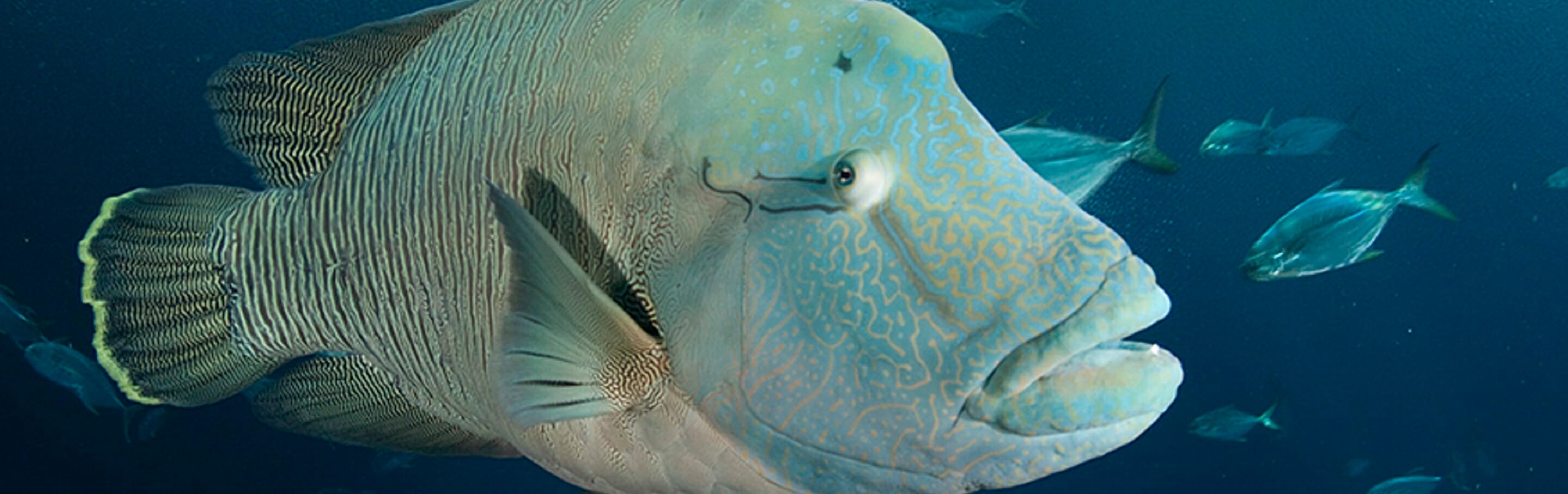
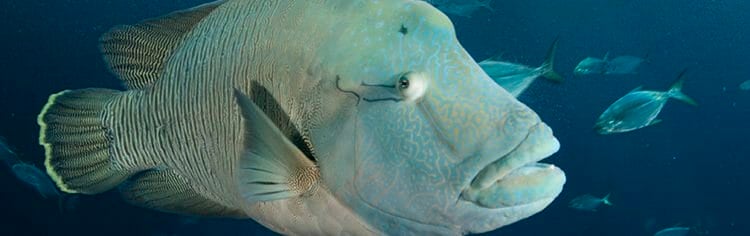
- Develops thick lips and a prominent bulbous hump on its forehead.
- Juveniles are a pale green to almost white color with dark spots on its scales which tends to form a bar. It often has two black lines that run from behind the eyes.
- Adults are darker green to blue green with irregular pattern of yellow lines across their heads.
- Like many members of the wrasse family, it rarely moves its tail for locomotion but flaps its pectoral fins to swim.
- The largest member of the wrasse family, it can grow to a maximum size of 5.5 feet (1.7 m) and reach weights as large as 421 lbs. (191 kg).
- Life span is about 30 years.
Animal Fun Fact
The humphead wrasse feeds on dangerously toxic aquatic species.
Diet / Feeding
- Diet consists of mollusks, fish, sea urchins, crustaceans and other invertebrates.
- One of the few predators of toxic animals such as sea hares, boxfishes and crown-of-thorns sea stars.
- Can extend its jaws out in front of its snout, pulling prey out of reef holes and crevices and other hideaway positions.
- Also hunts concealed prey by biting off coral branches and tables or blowing jets of water aimed at the substrate to uncover hidden animals. If an escaping prey dives under a rock on the reef, the wrasse turns over the rock with its powerful jaws.
Range / Habitat
- Occurs in the Indo-Pacific region from the Red Sea to French Polynesia.
- Found more offshore than inshore in steep outer reef slopes, channel slopes and lagoon reefs. Juveniles inhabit coral-rich areas of lagoon reefs and algae reefs or seagrasses.
- Adults are found across the reefs by day and rest in reef caves and under coral ledges at night.
Reproduction & Growth
- Adult females will sometimes change into males, but some of the larger females will become “supermales.” This happens when a current supermale dies.
- The supermale is larger than all the other males and has distinct colors and patterns on its skin. This coloration attracts females to the supermale.
- Sex change in wrasses ensures there will be a male to reproduce with females.
- Does not appear to migrate far for its spawning. A single male will spawn with a large group of 6-10 females. There has been documentation of 150 individuals at one spawning location. Spends about 25 days as a larvae potentially traveling long distances in the currents.
Conservation Status
- “Endangered” on the IUCN Red List.
Additional Information
- Usually solitary but may occur in pairs or small groups of 3-7.
- It is estimated that less than one percent of these animals reach maturity as males because the fish can spontaneously switch sex from female to male.
- Under heavy fishing pressure at the center of its range in southeastern Asia where its coral reef habitat is most abundant, and particularly in key supply countries for the live reef fish trade, where it fetches some of the highest prices in the trade.
Sources
http://www.iucnredlist.org/details/4592
Chateau, O., & Wantiez, L. (2006). Site fidelity and activity patterns of a humphead wrasse, Cheilinus undulatus (Labridae), as determined by acoustic telemetry. Environmental Biology of Fishes, 80(4), 503–508. https://doi.org/10.1007/s10641-006-9149-6
Nair, R.J. 2004. Note on a rare coral fish Cheilinus undulatus (Riippell, 1835). Journal of the Marine Biological Association of India 46(2): 234-236.
Randall, J.E., Head, S.M. and Sanders, A.P.L. 1978. Food habits of the giant humphead wrasse Cheilinus undulatus (Labridae). Environmental Biology of Fishes 3: 235-238.