
-
Size
Common length 12-18 feet (3.6-5.5 m) -
Diet
Rays and skates -
Range
Most commonly found in shallow water -
Habitat
Warm temperate and tropical seas worldwide
Physical Characteristics
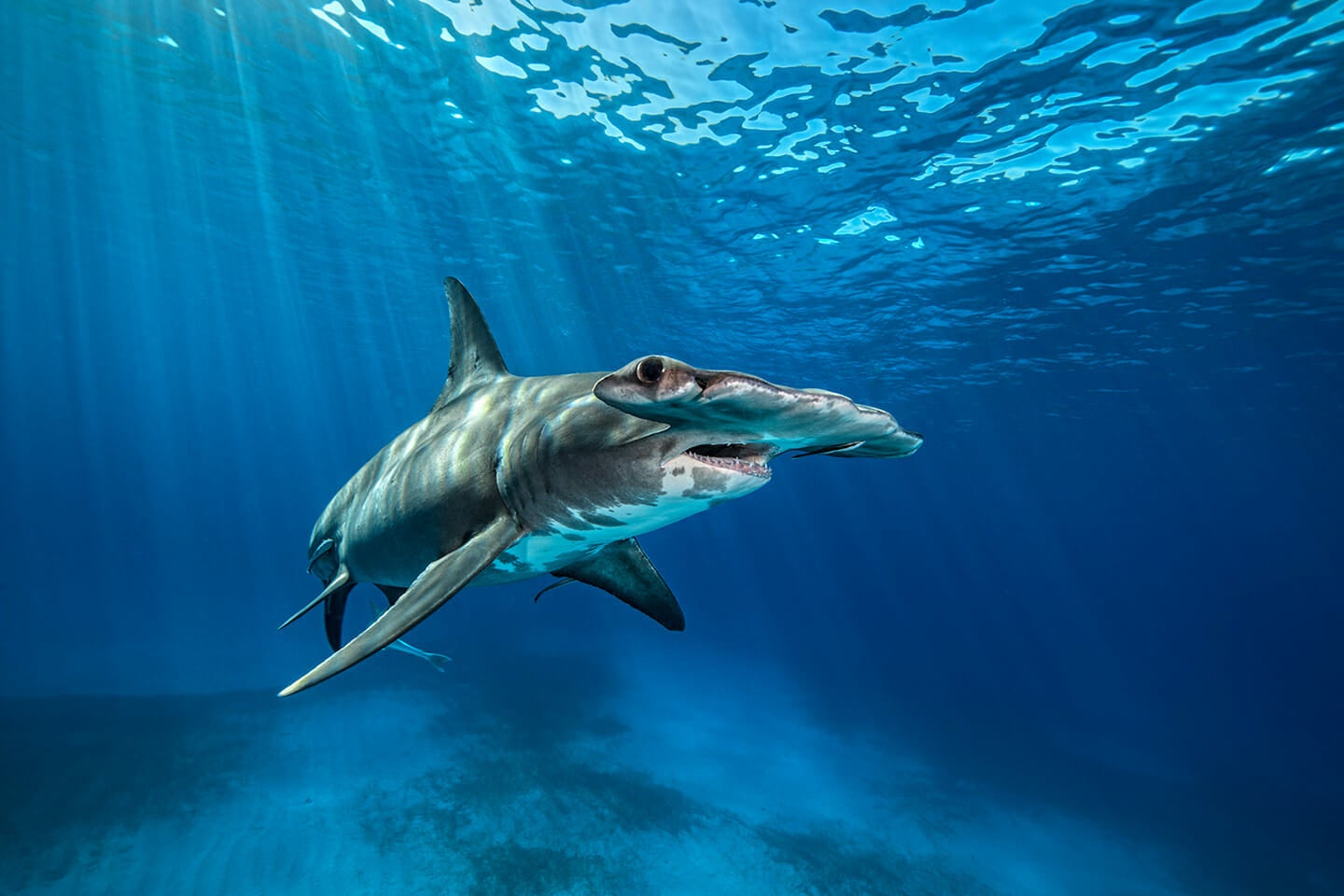
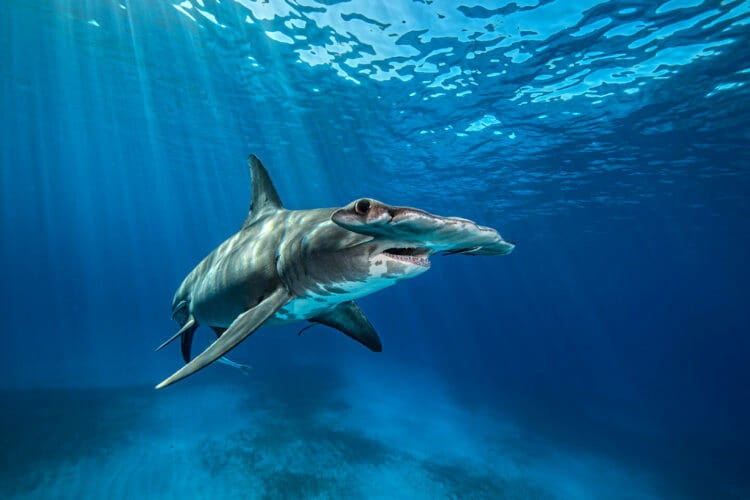
- Largest species of hammerhead shark, who get their name from the large, hammer-shaped head called a cephalofoil.
- Coloration is dark grey to brown dorsally and the ventrum is white.
- Body is broad and streamlined in shape with a tall, curved dorsal fin, and a large, well-developed tail with distinct lobes that aid in building speed and lift while swimming.
- Front of the head is nearly straight across and greatly elongated laterally with flattened lobes. Eyes and nares are located at the ends of the lobes.
- Juveniles have a more curved cephalofoil.
- As in many shark species, females are larger than males.
- Common length for adult females is 15.8-18 feet (4.9-5.5 m); common length for adult males is about 12.1 feet (3.7 m).
- Common length at birth is about 1.6-2.3 feet (50-70 cm).
- Maximum length recorded was 20 feet (6.1 m).
- Maximum weight recorded was 991 pounds (449.5 kg).
Diet / Feeding
- Diet consists primarily of various reef fish species, rays and skates.
- May also consume other sharks, including other hammerhead sharks, bony fish, including groupers and sea catfish, squid and bottom-dwelling crustaceans.
- It is theorized that hammerheads feed by pinning prey down with their cephalofoil and biting pieces off.
- Feeding primarily occurs at dusk.
Range / Habitat
- Occurs in warm temperate and tropical seas worldwide.
- Highly migratory species. May be found in both inshore and offshore waters. Typically found over the continental shelf, near islands and reefs, and in lagoons.
- Most commonly found in shallow water at depths to 328 feet (100 m) but may occasionally be found at depths to 984 feet (300 m).
Reproduction & Growth
- Viviparous species, meaning the young are born live.
- Common litter size of 13-42 pups.
- Gestation period is about eleven months. Reproduces once every two years.
- Births usually occur in late spring and summer
Conservation Status
- Listed as “Critically Endangered” on the IUCN Red List.
- This species is sometimes targeted for fishing due to its large fins, which are considered particularly desirable in the Asian fin trade for use in shark fin soup. Also targeted for its meat, liver oil, hides, carcasses (for fishmeal) and for sport.
- Caught as bycatch during many commercial fishery operations.
- Adults have no natural predators except for humans and larger sharks. Juveniles may be preyed upon by larger sharks.
Additional Information
- Genus name, Sphyrna, is Greek for “hammer.”
- There are many theories as to the purpose of the hammer shaped head of this genus. One theory is that the lobes enlarge the surface area for the electro-sensory organs called “ampullae of Lorenzini,” which this shark uses to find its prey.
Sources
www.fishbase.org
www.iucnredlist.org
www.arkive.org
www.floridamuseum.ufl.edu
Grzimek’s Animal Life Encyclopedia. Thoney, D. A. and Loiselle, P. V.
Sharks and Rays of Australia. Last and Stevens