
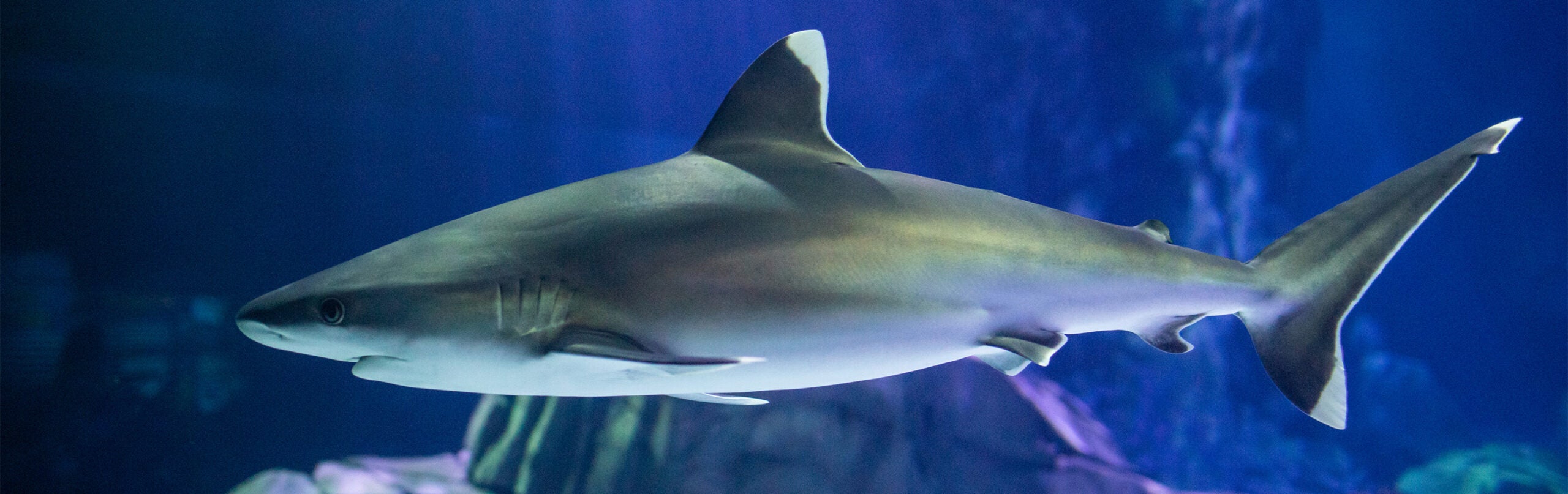
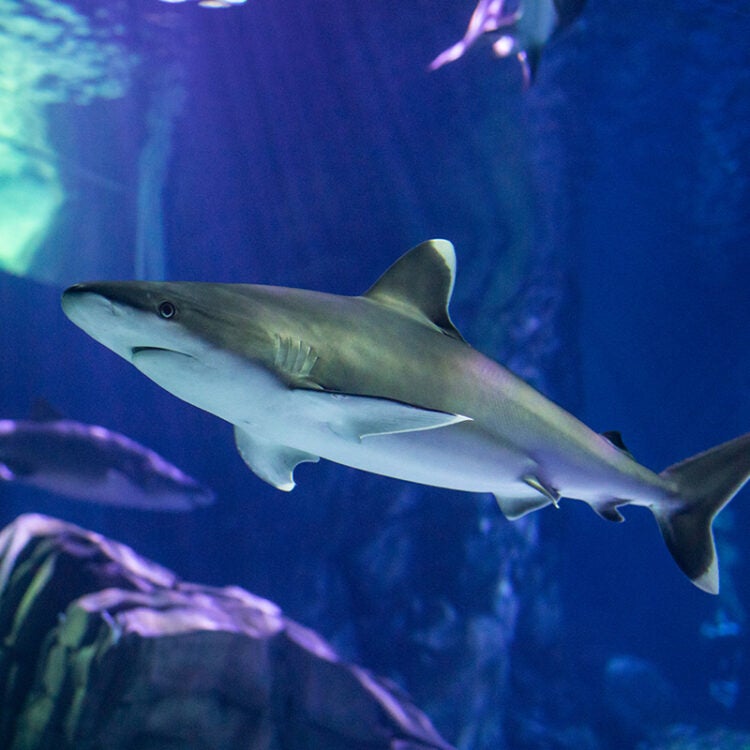
-
Size
6-8 feet (2-2.4 m) -
Diet
Fish, small sharks and rays, cephalopods, octopuses, squids and crustaceans -
Range
Western Indian Ocean -
Habitat
Offshore islands, coral banks and reefs
Physical Characteristics
- The body is long and slender with a broad, rounded snout and distinct large eyes.
- Large pectoral fins that are narrowly rounded or pointed at the tips.
- Coloration is a dark gray or blue-gray dorsal surface with a bronzy sheen that fades into a white ventral surface.
- The most distinguishing feature is the white or “silver” tips and borders on all fins.
- Common length between 6-8 feet (2-2.4 m).
- The maximum recorded length is 9.8 feet (2.9 m).
- The maximum recorded weight is 357.6 pounds (162.2 kg).
- Females tends to be larger than males.
Diet / Feeding
- Diet consists of bony fish, rays, cephalopods, small sharks, octopuses, squids, and crustaceans.
- Has been observed swimming among other feeding sharks and darting into the group to swipe food.
- Pups feed on small fish.
Range / Habitat
- Occurs inshore over or adjacent to continental and insular shelves.
- Commonly found around offshore islands, coral banks, and reefs.
- Depth range of 3-2,625 feet (1-800 m).
- Juvenile typically remains close to shore and in shallow water to minimize predation risk.
- Found primarily in the western Indian Ocean.
- Including the Red Sea and eastern African waters surrounding Madagascar, Seychelles, Aldabra Group, Mauritius, and the Chagos Archipelago.
- Occupies the western Pacific Ocean from southern Japan, northern Australia, and eastern-central Pacific areas ranging from southern Baja, California, and Mexico, to Colombia including Cocos, Galapagos, and Revillagigedo Islands.
Reproduction & Growth
- Aplacental viviparous; the embryos develop within the mother’s uterus and are nourished by yolk sac ; female gives birth to live young.
- Average gestation period is 12 months.
- May give birth to up to 11 pups per litter; average litter has 5-6 pups.
- When born, pups are typically 1.6-2.6 feet (0.5-0.8 m).
- Pups live among shallow reefs and move out into deeper water as their size increases.
- Mates once a year in the summer months.
- No male or female rearing. Sharks are born with all their natural instincts
- Breeding and pupping both occur during the summer months in the Southern Hemisphere.
- Males reach sexual maturity around 5.2-5.9 feet (1.6-1.8 m).
- Females reach sexual maturity around 5.2-6.2 feet (1.6-1.9 m).
Conservation Status
- Listed as “Vulnerable” on The IUCN Red List.
- Population trend is decreasing.
- Humans are the largest threat to this species as they are caught and utilized for their high-value fins, meat, skin, teeth and cartilage.
Additional Information
- The species name, albimarginatus, derives from the Latin words “albi” meaning white and “marginatus” meaning to enclose with a border.
- Often dominates interactions with other sharks, even those that are larger than itself.
- Communicates through visual displays. When threatened, will display movements that include lowering the angles of the pectoral and tail fins, stiff and jerky movements, “shivering,” opening of the jaws, and making quick movements away from the potential threat.
- Large eyes can see in dark, murky waters and can see up to 10 times more accurately than humans in clear water.
Sources
www.fishbase.org
www.iucnredlist.org
www.flmnh.ufl.edu/fish
www.animaldiversity.org