

-
Size
7 inches (17.8 cm) -
Diet
Vegetation and dry grasses -
Range
Tanzania and Kenya -
Habitat
Crevices on rocky hillsides
Physical Characteristics
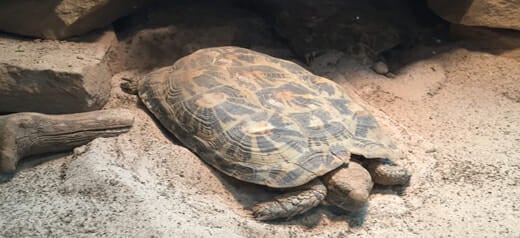
- Coloration is brown and yellow.
- Shell is thin, flat and flexible.
- Shell bones have many openings, which allow the tortoise to be lighter and more agile to escape predators.
- Instead of retreating into its shell, the African pancake tortoise will flee danger. Its flexible shell allows it to hide in narrow crevices.
- Carapace length to 7 inches (17.8 cm).
Animal Fun Fact
The African tortoise’s shell hinges at the joints that make up the bony plates of its shell. This allows these tortoises to climb better than others.
Diet / Feeding
- Herbivorous diet typically consists of vegetation and dry grasses.
Range / Habitat
- Occurs in northern and eastern Tanzania and southern Kenya and may also occur in Zimbabwe.
- Found in crevices on rocky hillsides in scrub and arid savannah environments.
Reproduction & Growth
- Mating season between January and February.
- Nesting appears to occur in July and August in their natural environment, but in human care, pancake tortoises produce clutches year-round.
- Females dig a hole in loose, sandy soil and typically lay one egg. but females can also lay several eggs over the course of one season.
- Incubation period of four to six months in human care.
Conservation Status
- “Critically Endangered” on the IUCN Red List
Additional Information
- Live in colonies, and many individuals may share the same crevice.
- Also known as “crevice tortoise,” “softshell tortoise,” and “Tornier’s tortoise.”
- Active mainly during the early morning, late afternoon and early evening.
- Primary defense mechanism is to wedge themselves under and between rocks where predators can’t reach.
Sources
- cites.org/sites/default/files/ndf_material/WG7-CS3.pdf
- reptifiles.com/pancake-tortoise-care-sheet/