
-
Size
Up to 10 feet (3.1 m) -
Diet
Benthic crustaceans, mollusks and bottom-dwelling fishes, including stingrays -
Range
Indo-West Pacific -
Habitat
Soft bottoms close to shore or coral reefs
Physical Characteristics
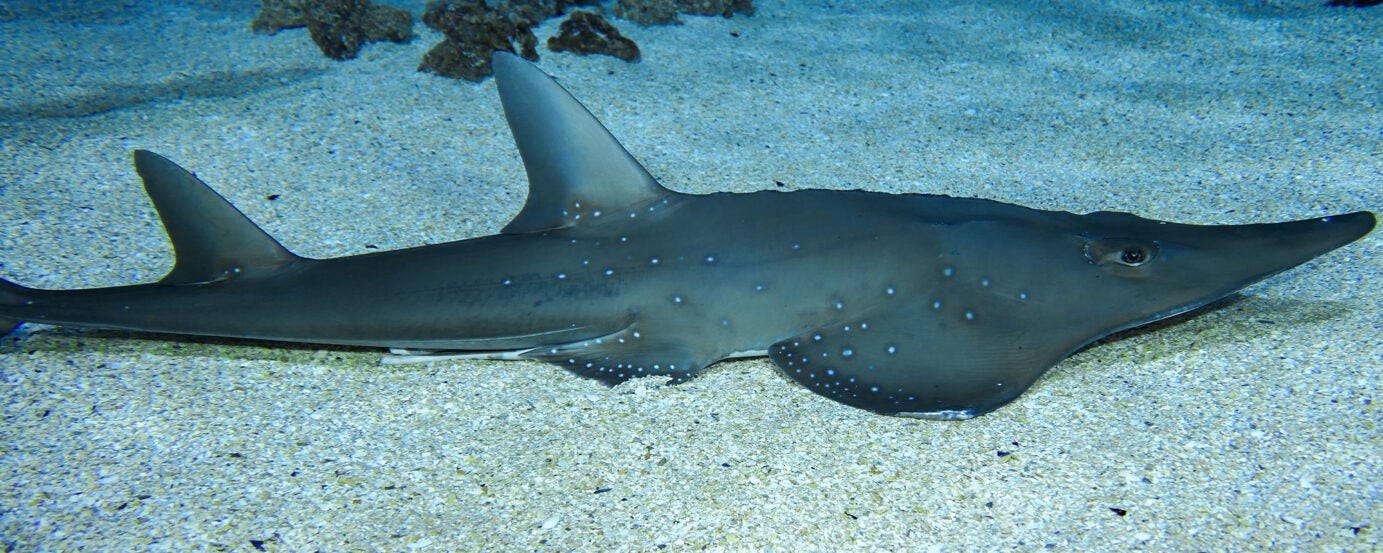
- Bottlenose wedgefish have a distinctive shape that resembles a cross between a shark and a ray. However, it is a member of the ray family.
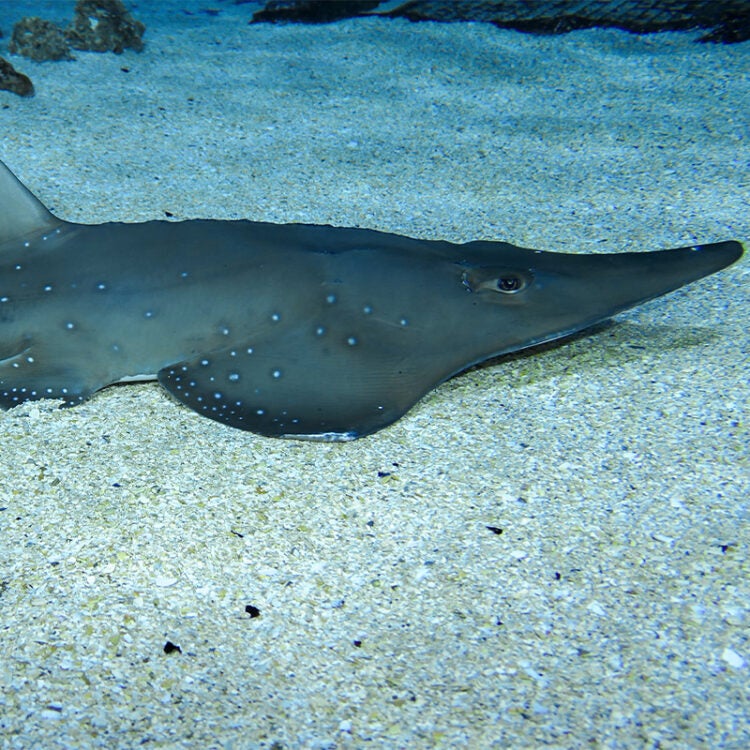
- The front of the body is flattened and wide, with a bottle shaped snout and flattened pectoral fins. The rest of its body and the large dorsal fins create a shark-like appearance.
- Adults can reach a length of approximately 10 feet (3.1 m) in length.
- Juveniles are sandy brown with white spots and a black spot on the pectoral fin. There are three white spots above each black spot.
- Adults are considerably darker in color, appearing almost black from above with white spots. They maintain their black spot on the pectoral fin with the three white spots above.
Animal Fun Fact
"Critically Endangered” on the IUCN Red List.
Diet / Feeding
- Feeds primarily at night on benthic crustaceans, mollusks and bottom-dwelling fishes, including stingrays.
Range / Habitat
- Occurs in the subtropical waters of the Indo-West Pacific from the East African coast to Taiwan, the Philippines and south to Australia.
- Usually encountered at depths up to 197 feet (60 m) on soft bottoms close to shore or coral reefs.
- Adults, specifically females, appear to be highly resident to one area.
Reproduction & Growth
- Ovoviviparous, meaning it produces eggs that hatch within the mother’s body, and the young are born live.
- Litters range from 7-19 pups.
- Pups are about 1 ft (30.5 cm) at birth.
Conservation Status
- “Critically Endangered” on the IUCN Red List
- Commonly caught by gillnet, trawl and longline fisheries.
- This species is unfortunately a victim of the shark fin trade and is also highly valued for their meat.
Additional Information
- Guitarfish have been around since at least the Jurassic period.
Sources
- www.iucnredlist.org
- www.shark-references.com
- Dean MN, Bizzarro JJ, Clark B, Underwood CJ, Johanson Z. 2017 Large batoid fishes frequently consume stingrays despite skeletal damage. R. Soc. open sci. 4. http://dx.doi.org/10.1098/rsos.170674
- Lear, K.O. & Estrabeau, C. & Morgan, D.L. & Whitney, N.M. & Gleiss, A.C. & Bignell, C. & Pillans, R.D. & Bateman, R.L. (2024) The secret lives of wedgefish: first insights into fine-scale behaviour and movement ecology of a globally imperilled ray. Marine Biology, 171(9), Article 180 DOI: 10.1007/s00227-024-04500-8
- Jabado, R. W. (2019). Wedgefishes and giant guitarfishes: A guide to species identification. New York, NY: Wildlife Conservation Society
- Whitley, G.P. (1939) Taxonomic notes on sharks and rays. Australian Zoologist, 9(3), 227–262
- White, J. (2014) Age and growth parameters of shark-like batoids. Journal of Fish Biology, 84(5). 1340-1353. https://doi.org/10.1111/jfb.12359