
-
Size
27.5 inches (70 cm) -
Diet
Algae and a variety of invertebrates -
Range
Indo-Pacific -
Habitat
Coastal lagoons out to seaward reefs
Physical Characteristics
- Adults grow to approximately 27.5 inches (70 cm) in length.
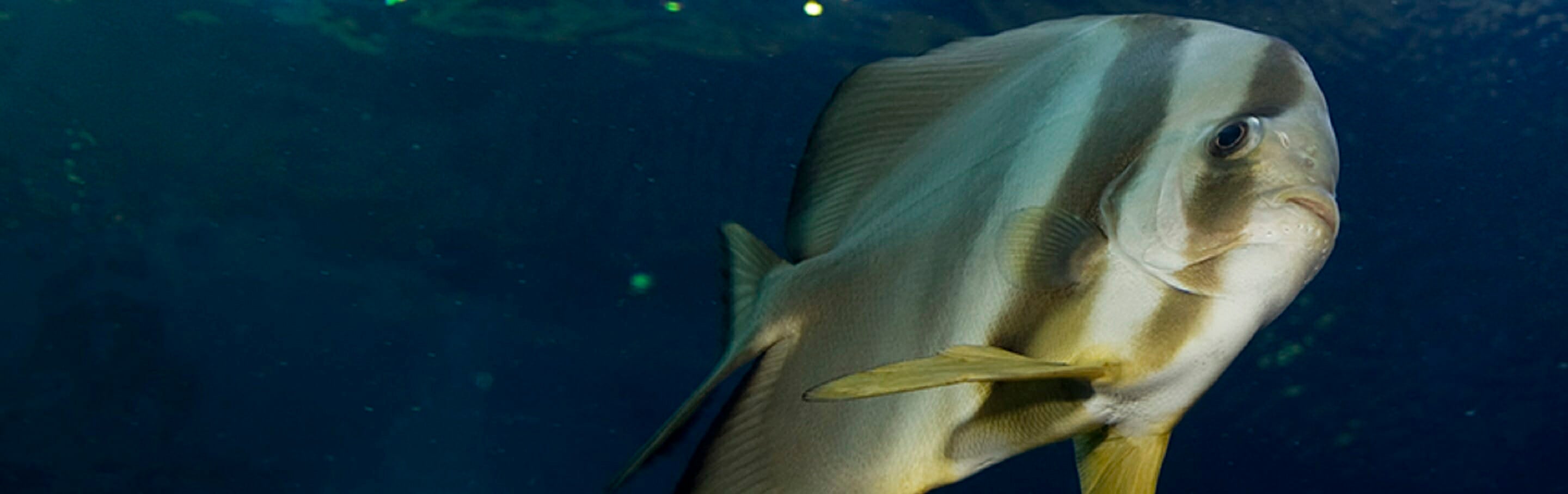
- The body is rounded and strongly compressed.
- Coloration is yellowish silver or dusky in color and have a short dark vertical bar through the eye and another wider bar behind the operculum.
- Adult has a bony hump on the forehead and its dorsal and anal fins are high and arched, but in proportion to its body.
- The juvenile looks very different from the adult. It has a very short body with extremely tall dorsal and anal fins and does not have a forehead hump.
Animal Fun Fact
Juvenile orbicular batfish will mimic leaves for protection.
Diet / Feeding
- Feeds on algae and a variety of invertebrates, such as jellies or other plankton.
Range / Habitat
- Western Pacific species native mostly to Australia (Ryukyu Islands)
- Juveniles inhabit seagrass meadows, mangrove areas and floating sargassum weed beds in shallow protected inner reefs.
- Adults usually found from coastal lagoons out to seaward reefs and occasionally in deeper water offshore.
- Found most often at depths to 65 feet (20 m).
- Commonly encountered near a deep wreck, mainly in the mid-waters above it.
Reproduction & Growth
- Oviparous (egg-laying species)
- It is believed that this batfish spawns in the open ocean and its larvae transform into juveniles when they are less than an inch (2.5 cm) long.
Conservation Status
- “Least Concern” on the IUCN Red List.
Additional Information
- Adult may be solitary or occasionally form large schools.
- Juveniles have been observed mimicking floating leaves in coastal waters. They also will form schools under floating rafts of sargassum.
Sources
- www.fishbase.org
- Coral Sea Reef Guide. Halstead, B.
- Southeast Asia Tropical Fish Guide. Kuiter, R. H. and Debelius, H.