
-
Size
10 feet (3 m) -
Diet
Bottom dwelling fishes, bivalves, crabs and shrimp -
Range
Indo-West Pacific -
Habitat
Reefs and shallow lagoons to outer reef slopes
Physical Characteristics
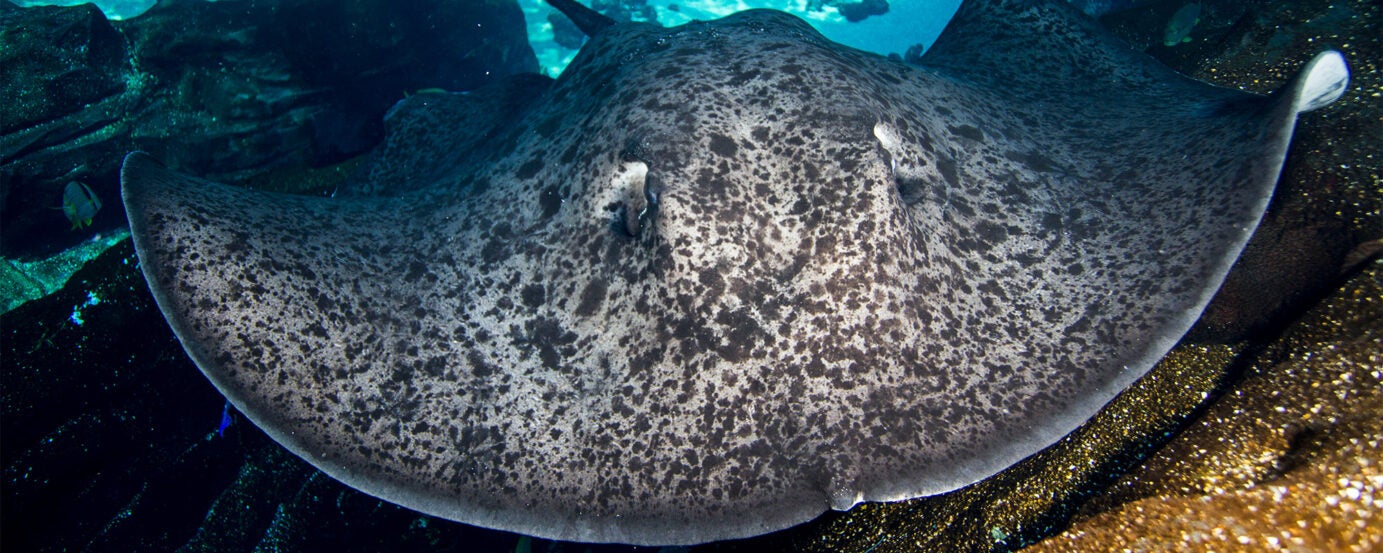
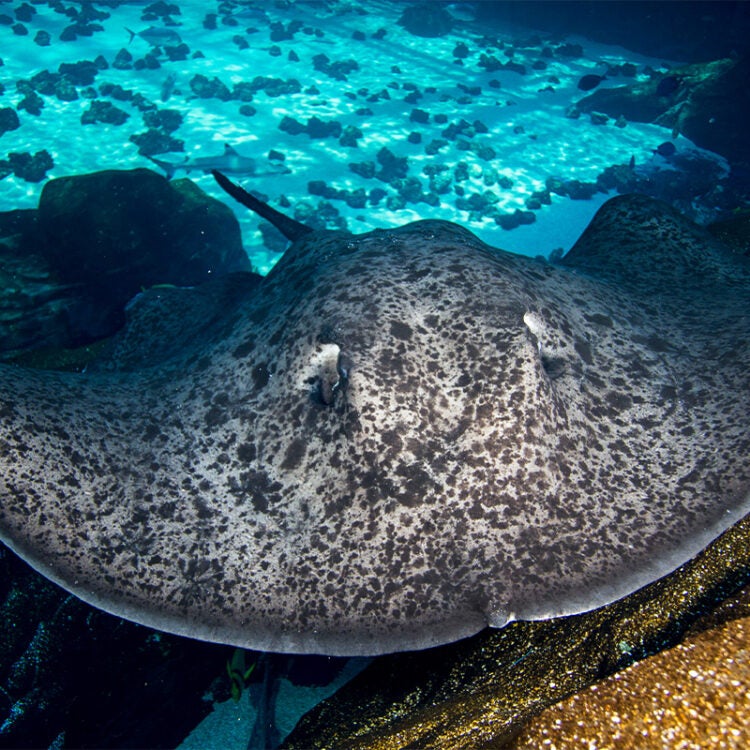
- Circular body shape, no thorns and a black and white mottled upper surface.
- It has a deep and prominent ventral skin fold that extends to the tail tip.
- Its length from snout to tail can reach almost 11 feet (3.35 m). Disc widths of about 10 feet (3 m) and weights of 330 lbs. (150 kg) have been reported.
Animal Fun Fact
The round ribbontail ray blows water to find prey hidden in the sand.
Diet / Feeding
- Diet consists of bottom dwelling fishes, bivalves, crabs and shrimp.
- To find prey this ray often excavates large holes in the sand by blowing water from its mouth.
Range / Habitat
- Occurs in the Indo-West Pacific from the Red Sea and East Africa to Southern Japan, Micronesia and tropical Australia.
- Usually associated with reefs and occurs in a wide variety of habitats from shallow lagoons to outer reef slopes.
- This ray can be encountered from near the surface to depths of about 1,640 feet (500 m). It is most common between about 66-197 feet (20-60 m).
Reproduction & Growth
- Ovoviviparous, eggs develop internally, and pups are born live.
- Litters of up to 7 are born at about 13 inches (33 cm) in disc width.
Conservation Status
- “Vulnerable” on the IUCN Red List.
Additional Information
- Can be found swimming alone or in schools and is often accompanied by jacks or cobia swimming near them.
- Fished commercially in some parts of its range, valued for its meat and cartilage. It may also be sought by recreational fishermen. This species is often also captured as bycatch in other fisheries.
- Possesses a venomous barb at the base of the tail.
- Also called the “marbled ray” or “blotched fantail ray.”
- Taeniurops is a latin root “taenia” meaning ribbon or band while “oura” means tail.
Sources
- www.fishbase.org
- www.iucnredlist.org
- Sharks & Rays Guide of the World, Hennemann, R., pg. 259