

Georgia Aquarium Introduces New Coastal (and Colorful) Feathered Friends
For the first time ever, Georgia Aquarium is now home to a brand-new coastal birds exhibit, featuring roseate spoonbill and scarlet ibis.
These colorful birds are now on display for guests in the Margaritaville Vacation Club Dolphin Coast gallery. This new habitat is the first of its kind at the Aquarium and features both aquatic and arboreal elements. Guests will learn about the importance, diversity, and delicate balance of coastal ecosystems – especially those found in Georgia.
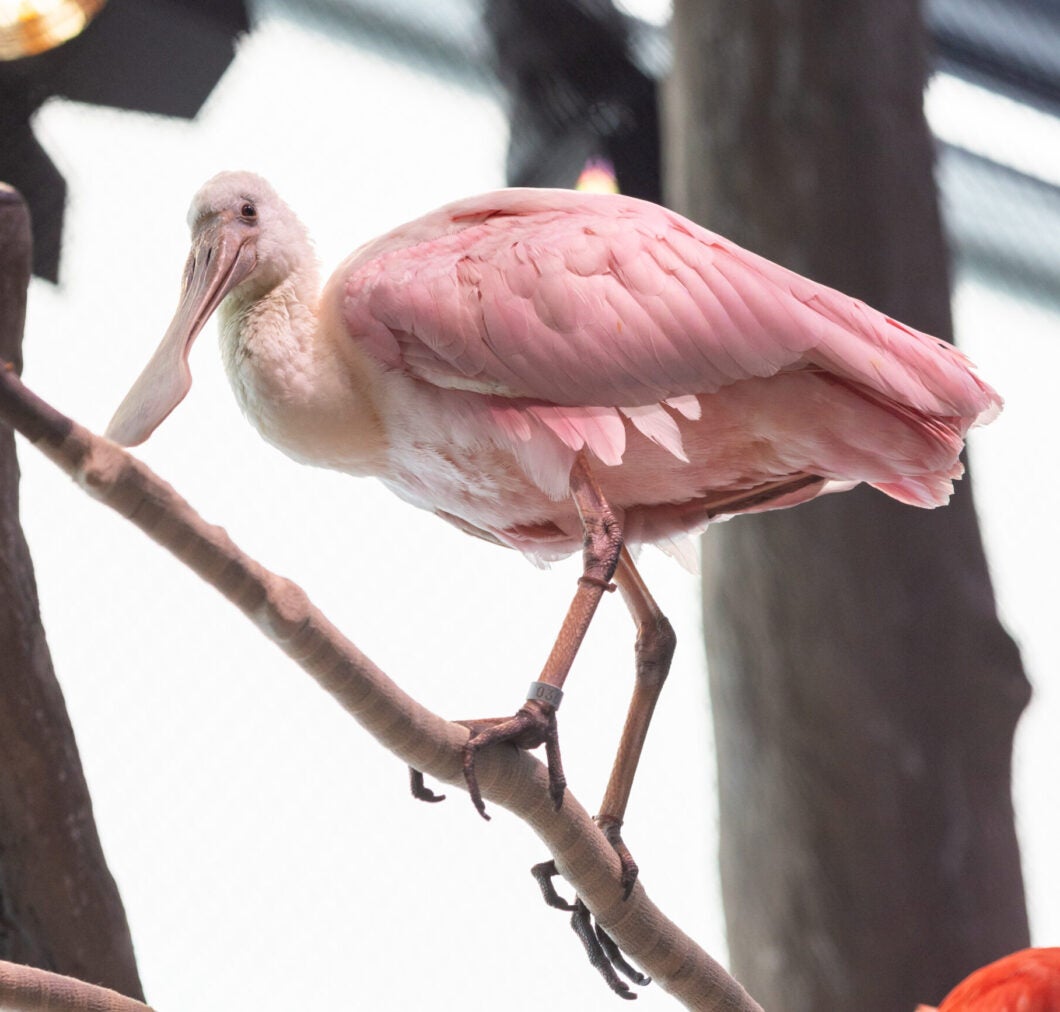
Roseate spoonbills live in shallow waters and marsh areas along the coastal areas of Southeast U.S. through Central America, the Caribbean, and South America. These light pink to dark red colored birds are aptly named for their long, spoon-shaped bills which have a distinct yellow-green color. They use this large bill to sweep through the water and catch prey. Spoonbills feed mainly off small fish and aquatic invertebrates. This species is very social and will colonize with members of the same order for feeding and breeding. The largest threat to roseate spoonbills is habitat destruction. Learn more about the roseate spoonbill on our animal guide.
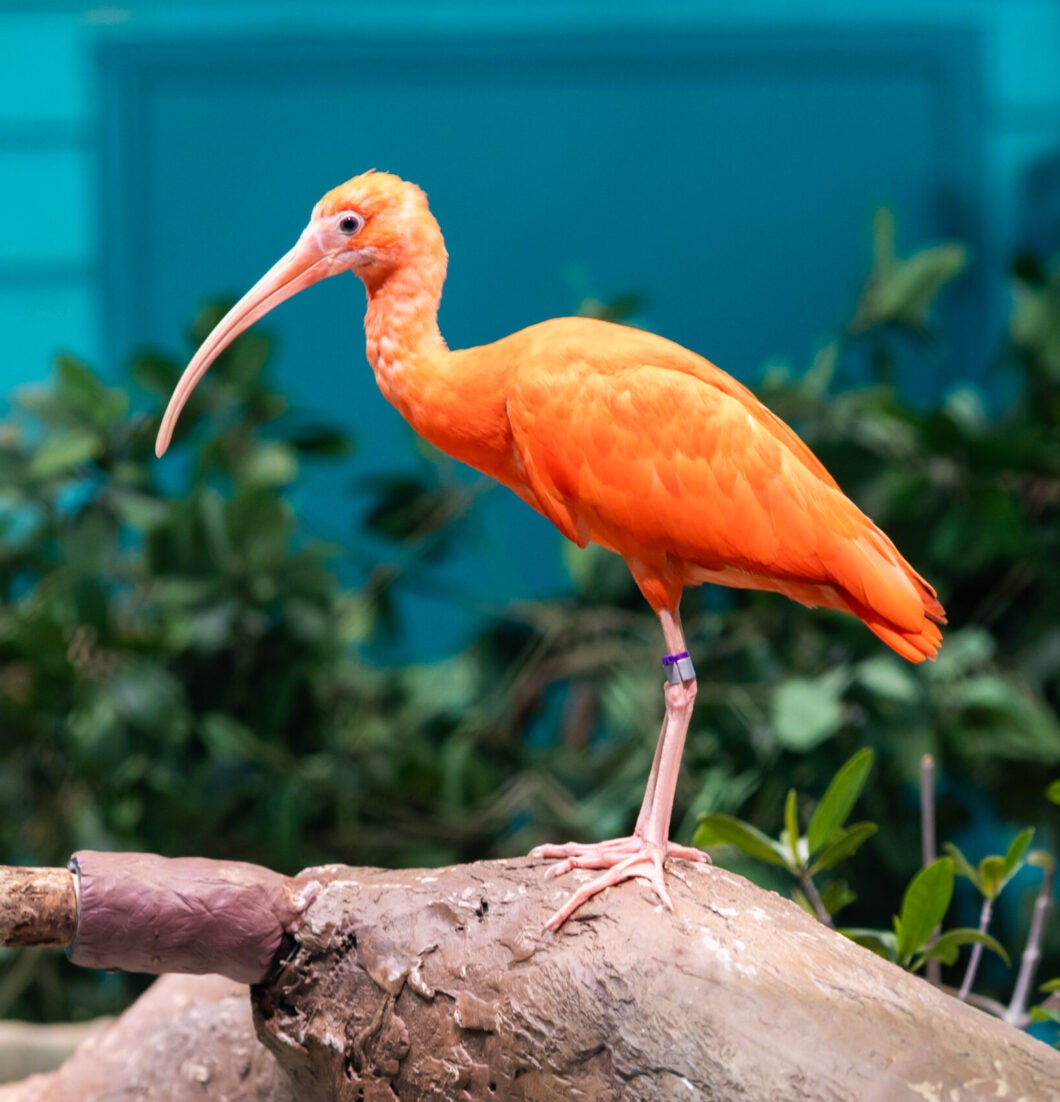
Scarlet ibis can be easily spotted from their bright red to pink color with long legs, necks, and beaks. These birds can be found throughout South America, occasionally seen in Florida. Seasonal shifts and migrations move this species between coastal environments and interior wetlands. Ibises use their long beaks to search through water for food and to peck surfaces for other prey. Their diet consists of small fish, crustaceans, mollusks, worms and insects. Like the spoonbill, these are highly social animals, not just for breeding, but also for foraging. This species is vulnerable to predation by large cats which is another reason they stay in large groups. Adult ibises will make a “honking” noise as a form of communication; males and females may also greet each other by wrapping necks. Learn more about scarlet ibis on our animal guide.
See here for photos of our new exhibit and coastal birds.
To learn more about our exhibits, and to purchase tickets, please visit our website.
Be sure to follow us on Facebook, Twitter, Instagram and TikTok.
Published on Jun 21, 2023.
Georgia Aquarium’s Whale Sharks Are Great Teachers
Millions of visitors gaze, transfixed, by Georgia Aquarium’s massive whale sharks slowly cruising through their Ocean Voyager home – but few know that these gentle giants are also helping solve the biggest mysteries about their little-known species.
Since whale sharks came to the Aquarium in 2005, veterinary staff and researchers have studied them daily as expert aquarists provide the care needed for them to thrive. Here are just some of the critical data scientists have learned from caring for Georgia Aquarium’s whale sharks:
Safe, effective blood draws:
As with people, sharks’ bloodwork provides important health information. Blood draw expertise developed at the Aquarium helped create the first successful health assessments of free-ranging whale sharks. This has taught us about their exposure to pollutants, nutrition needs, health, and overall well-being. Knowledge from this data has helped us to understand this species so we can better protect them.
Just how big are they?
Whale sharks’ body size and mass reveal their age, sexual maturity, and other important details that help conservationists. But it’s hard to get those measurements as they plow through the open ocean. In the Aquarium, scientists are able to work on perfecting accurate measurement techniques that will be used in the ocean.
Genome mapping:
Georgia Aquarium, Georgia Institute of Technology, and Emory University completed the first-ever shark genome map, using detailed blood chemistry and DNA from our sharks. This genetic blueprint helps scientists understand diseases and treatments for whale sharks.
Babies:
We know very little about how whale sharks breed, and no birth has ever been recorded. The birthing process is mysterious, with females keeping to themselves. But their numbers have fallen sharply in recent years – so every pup born really matters. Georgia Aquarium doesn’t breed whale sharks, but its researchers study their reproductive behavior to influence fieldwork. A recent partnership that performed ultrasound tests in the Galapagos Islands discovered that, surprisingly, big-bellied females weren’t pregnant at all. Learning more about breeding behavior will help scientists discover where they go to give birth to their pups, so those areas can be protected.
Lessons after loss:
Researchers learn a wealth from whale sharks during their life, and even after their death. Our whale sharks continue to help researchers piece together the life history of this species, even after their passing. Researchers conducted necropsies revealing incredible insights about their reproductive systems, ages, and sexual maturity. This data is something that hasn’t been seen before and is nearly impossible to collect outside of an aquarium setting.
What’s that smell? Dinner!
As filter-feeders that eat only plankton and small fish or shrimp, whale sharks don’t have the complex brains needed by other shark species that hunt large prey. But studies at Georgia Aquarium show they do have a well-developed sense of smell, which triggers them to forage and eat. Such nuggets of information help conservationists working to protect ocean food supplies.
Saving this special species:
Using what’s been learned here, Georgia Aquarium and its partners have studied and tracked more than 1,000 whale sharks around the world via satellite tags, aerial surveys, acoustic receivers, and photo identification software, from Mexico to the Galapagos Islands, Indonesia, St. Helena Island, and Taiwan.
The things learned from these gentle giants in their aquarium home are helping paint a vibrant picture of how they behave, what they eat, where they migrate and more – including how we can make sure they’ll still be cruising oceans for a long time into the future.
Published on Jun 13, 2023.
Ultrasounds on Whale Sharks Deepen Mysteries of This Big Fish
Whale sharks are the ocean’s biggest fish and perhaps its biggest mystery. With the goal of unlocking secrets about female reproduction, new methods were developed to conduct ultrasounds on free-swimming whale sharks.
But the results weren’t exactly what researchers had expected or hoped. The findings, published recently in the journal Endangered Species Research, quash the leading scientific theory that the exceptionally large females with bulging bellies that show up annually in the Galapagos Marine Reserve in Ecuador and near St. Helena Island are pregnant. They aren’t.

It’s a head scratcher, really. We know a lot about male whale sharks, but little about females because they don’t congregate the way males do. We had hoped to confirm that the females were pregnant so we could track their movements and locate important pupping grounds.
The research, led by Okinawa Churaumi Aquarium, in collaboration with Marine Megafauna Foundation, Galapagos Whale Shark project and Universidad San Francisco de Quito in Ecuador, included developing underwater ultrasound technology which was coupled with conducting blood draws, a technique developed by Georgia Aquarium on free-swimming whale sharks.
“To our surprise, none of the sharks were pregnant.”
One of the greatest secrets that whale sharks hold is where they give birth. Truly little is understood about their reproductive lifecycle because only one pregnant female – caught by a commercial fishing boat in 1995 – has ever been examined. Births have never been recorded.
Whale shark populations are declining, and the species is at risk of extinction. The best hope for protecting and conserving them is understanding them – their movements, the habitats they need protected, and what is posing the greatest threat to survival.
That is one reason Georgia Aquarium is shifting their research focus from Galapagos and St. Helena to Taiwan. The only pregnant female ever recorded was caught in Taiwanese waters, and much more needs to be known about the biodiversity, abundance, and migration dynamics of sharks in Taiwan.
The Aquarium, National Taiwan Ocean University (NTOU) and Taiwan’s Fisheries Research Institute (TFRI) recently entered a 10-year conservation program with Georgia Aquarium that will compile baseline data on multiple marine species living off Taiwanese shores. The research will include placing receivers onto fishing trap nets throughout Taiwan’s coastal waters and acoustic tags onto individual animals to track where they travel and for how long.
“There is so much for us to learn about whale sharks, and this partnership has great potential to help us uncover details about the whale sharks who visit these waters,” Dove said. “We are excited to embark on research in this region. There is much to learn and contribute to conservation knowledge for not only whale sharks, but other threatened shark and ray species as well.”
Published on Apr 18, 2023.