
Georgia Aquarium’s Whale Sharks Are Great Teachers

Millions of visitors gaze, transfixed, by Georgia Aquarium’s massive whale sharks slowly cruising through their Ocean Voyager home – but few know that these gentle giants are also helping solve the biggest mysteries about their little-known species.

Since whale sharks came to the Aquarium in 2005, veterinary staff and researchers have studied them daily as expert aquarists provide the care needed for them to thrive. Here are just some of the critical data scientists have learned from caring for Georgia Aquarium’s whale sharks:

Safe, effective blood draws:

As with people, sharks’ bloodwork provides important health information. Blood draw expertise developed at the Aquarium helped create the first successful health assessments of free-ranging whale sharks. This has taught us about their exposure to pollutants, nutrition needs, health, and overall well-being. Knowledge from this data has helped us to understand this species so we can better protect them.

Just how big are they?

Whale sharks’ body size and mass reveal their age, sexual maturity, and other important details that help conservationists. But it’s hard to get those measurements as they plow through the open ocean. In the Aquarium, scientists are able to work on perfecting accurate measurement techniques that will be used in the ocean.

Genome mapping:

Georgia Aquarium, Georgia Institute of Technology, and Emory University completed the first-ever shark genome map, using detailed blood chemistry and DNA from our sharks. This genetic blueprint helps scientists understand diseases and treatments for whale sharks.

Babies:

We know very little about how whale sharks breed, and no birth has ever been recorded. The birthing process is mysterious, with females keeping to themselves. But their numbers have fallen sharply in recent years – so every pup born really matters. Georgia Aquarium doesn’t breed whale sharks, but its researchers study their reproductive behavior to influence fieldwork. A recent partnership that performed ultrasound tests in the Galapagos Islands discovered that, surprisingly, big-bellied females weren’t pregnant at all. Learning more about breeding behavior will help scientists discover where they go to give birth to their pups, so those areas can be protected.

Lessons after loss:

Researchers learn a wealth from whale sharks during their life, and even after their death. Our whale sharks continue to help researchers piece together the life history of this species, even after their passing. Researchers conducted necropsies revealing incredible insights about their reproductive systems, ages, and sexual maturity. This data is something that hasn’t been seen before and is nearly impossible to collect outside of an aquarium setting.

What’s that smell? Dinner!

As filter-feeders that eat only plankton and small fish or shrimp, whale sharks don’t have the complex brains needed by other shark species that hunt large prey. But studies at Georgia Aquarium show they do have a well-developed sense of smell, which triggers them to forage and eat. Such nuggets of information help conservationists working to protect ocean food supplies.

Saving this special species:

Using what’s been learned here, Georgia Aquarium and its partners have studied and tracked more than 1,000 whale sharks around the world via satellite tags, aerial surveys, acoustic receivers, and photo identification software, from Mexico to the Galapagos Islands, Indonesia, St. Helena Island, and Taiwan.

The things learned from these gentle giants in their aquarium home are helping paint a vibrant picture of how they behave, what they eat, where they migrate and more – including how we can make sure they’ll still be cruising oceans for a long time into the future.

Published on Jun 13, 2023.
Celebrate World Ocean Day at Georgia Aquarium

By Harlee Goldermann, Guest Programs Team Specialist

Have you heard June 8th is World Ocean Day? World Ocean Day is a United Nations-recognized day to raise awareness, help create policy, and inform the public of the importance of our ocean and what we can do to help protect it!

Did you know that the ocean covers 70% of the planet and contributes 50% of the oxygen we breathe? Our ocean also protects us by absorbing nearly 30% of carbon dioxide created by humans, reducing the impacts of global climate change. The ocean contains most of the earth’s biodiversity, with many of the species found on our coral reefs. Coral reefs cover less than 1% of the ocean floor but account for 25% of all known ocean life. Unfortunately, many of the species that diversify our ocean and reefs are depleted. Many of these negative impacts are caused directly by humans. Overfishing, plastic pollution, and chemical runoff are hurting the ocean – furthering the importance of protecting our ocean ecosystem. All of this has led many to campaign for a global ocean protection effort. This effort is one of the many reasons why World Ocean Day came to fruition!

World Ocean Day at Georgia Aquarium

We are committed to conservation efforts that not only aim to restore coral reefs that contribute so much to the ocean’s biodiversity but also fish populations and other animals to help restore order to our ocean ecosystems. One of the ways we are doing that is by partnering with conservation institutions around the globe. Georgia Aquarium is a founding partner of the StAR Project. This project brings facilities around the world together to help replenish zebra shark (Stegostoma tigrinum) populations in Raja Ampat, Indonesia. These waters have been protected since 2004. However, zebra sharks have been functionally extinct from this area for so long that the young people of that region no longer have a common name for them in their language. Georgia Aquarium is one of 76 partners and 15 countries involved with the project. Read more about this project at https://www.reshark.org/project-star

Wold Ocean Day Over the Years

World Ocean Day was first proposed in 1992 by Canada at the Earth Summit in Rio De Janeiro, Brazil. In December of 2008, the United Nations General Assembly officially recognized and established June 8th as World Ocean Day. Over the years, thousands have participated in global World Ocean Day events and pledged to help with their latest campaign #30×30. This is an effort to protect 30% of our planet by 2030. Currently, less than 17% of our lands and only 8% of our oceans worldwide are protected. Protecting our ocean is vital as we have reached a point where we are taking more than what can be replenished.

Help our ocean this World Ocean Day, too! Come visit us at Georgia Aquarium on June 8th for World Ocean Day. Enjoy festivities for the whole family and learn more. The proceeds from your visit will go towards helping us care for our animals and our conservation efforts protecting animals around the world, including our work with the StAR Project. We cannot wait to see you there! For more information and to purchase tickets, visit georgiaaquarium.org.

Published on May 24, 2023.

Georgia Aquarium Releases Rehabbed Sea Turtles

On Monday, April 17, Georgia Aquarium released eight rescued sea turtles off the coast of Jekyll Island, GA.

Earlier this year, Georgia Aquarium welcomed 11 sea turtles (four loggerhead and seven Kemp’s Ridley) to their off-site care facility. These turtles will receive temporary care and housing after being found off the coast of New England suffering from cold-stunning – a condition in which sea turtles become weak and inactive from exposure to cold temperatures. The Aquarium’s teams have been providing exceptional care to these animals so they can be released back into the ocean.

While at Georgia Aquarium’s off-site facility, the 11 sea turtles received uninterrupted care from animal care and vet teams. A few of these turtles received advanced imaging through CAT scans at BluePearl Veterinary Hospitals to help monitor their care. Following health care check-ups, eight of the rescued turtles (six Kemp’s Ridley and two loggerhead) were cleared to be released. The remaining turtles were transferred to the Georgia Sea Turtle Center on Jekyll Island, GA where they will continue to receive care until they are strong enough to be released. Staff from the GSTC assisted aquarists from Georgia Aquarium in releasing the turtles back into the ocean. These teams also provided beachgoers the rare opportunity to see these turtles up close.

See the turtles’ arrival posts here: Instagram, TikTok, Newsroom

An increasing number of sea turtles have become cold-stunned due to exposure to the colder temperatures. Cold-stunning causes turtles to become very weak and inactive, similar to hypothermia. The National Oceanic and Atmospheric Administration (NOAA) actively plans for cold-stunning events months in advance – organizing and deploying resources to look for and assist cold-stunned turtles. Georgia Aquarium is part of this multi-institutional effort alongside other zoos, aquariums, and rescue organizations saving hundreds of turtles each year. Nearly all species of sea turtles are now classified as endangered. Some species including Kemp’s Ridley sea turtles are classified as critically endangered on the IUCN Red List. Six species are found in U.S. waters, all of which are listed and protected under the Endangered Species Act.

Georgia Aquarium’s dedicated staff helps not only animals at the Aquarium but anywhere by offering temporary housing and care to animals in the wild. Each year, the Aquarium works alongside other zoos and aquariums across the country to help give cold-stunned turtles temporary homes. These operations help to save many turtles and would not be possible without the generous support of organizations like Turtles Fly Too, whose pilots donated their time, planes, and fuel to get these turtles to their temporary homes. Without the intervention of zoos, aquariums, and partners like National Oceanic and Atmospheric Administration (NOAA) and U.S. Fish and Wildlife Service, these turtles could develop secondary health problems or potentially die.

For photos and video assets of the release please see below:

Photo / Video Credit: Georgia Aquarium

Photos

Social Video

Published on May 1, 2023.

Teaching the Next Generation of Aquatic Engineers

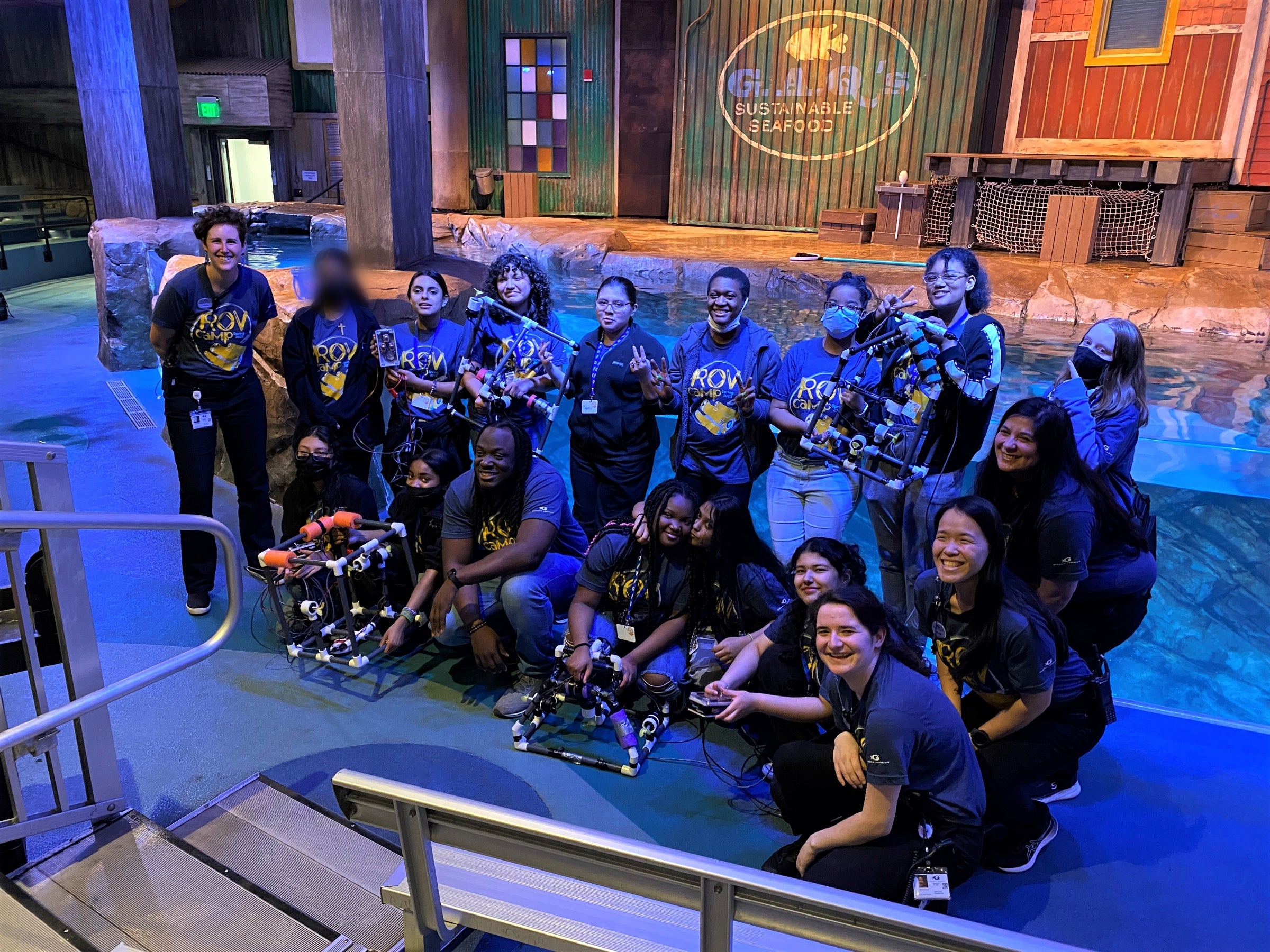
Teaching the next generation of aquatic engineers: Georgia Aquarium’s ROV camp hosted a group of girls from Sweetwater Middle School.

By Billie Snieder, environmental educator, Georgia AquariumTeaching the Next Generation of Aquatic Engineers 2

Have you ever wondered how remote-operated vehicles, or ROVs, are used by scientists to collect data or various samples? Maybe, you are curious how engineers build and fly ROVs in the ocean? Or what challenges they face while building and navigating ROVs? These were some of the questions asked by a group of twelve middle school girls from Sweetwater Middle School during Georgia Aquarium’s ROV camp.

Over the course of five days, these students learned various engineering skills that allowed them to design, assemble, and operate an ROV. They learned how engineers brainstorm solutions by creating, testing, and improving a design. During the first two days, students learned how to strip, splice, and solder wire. They also learned how to ensure their connections were waterproof. Students practiced their navigation skills by flying drones. These skills were then applied to the actual construction of their ROVs. They were able to assemble the control box and attach it to the tether and propellers.

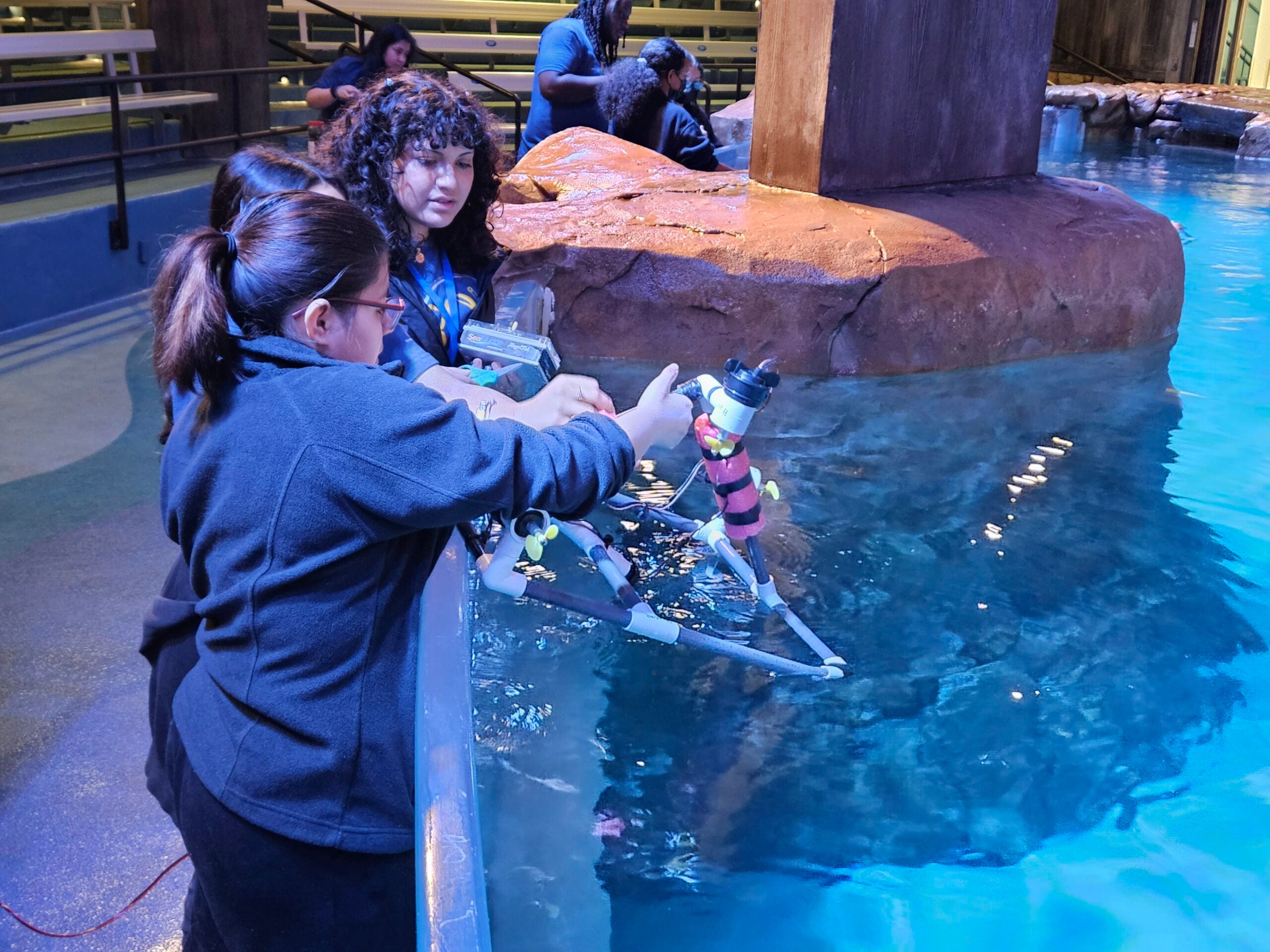
Once the main parts of the ROV were complete, each group designed and built the frame. All four groups were able to take their design from a paper sketch to a finished 3D shape. Taking into consideration the materials available and the need to be waterproof. Led by Georgia Aquarium Environmental Educators, these students were able to integrate STEM skills to complete their Angelfish ROVs from the Marine Advanced Technology Education center (MATE).

The benefits of working in groups, was seeing the different methods of problem-solving and design strategies. They also showed encouragement to one another as they practiced their newly learned skills. Each ROV was uniquely designed, with several different shapes being utilized to construct their frames. Each group faced the challenge of balancing three propellers on the frame, while preventing the ROV from tipping over once submerged.Teaching the Next Generation of Aquatic Engineers 3

These students also had the opportunity to hear from several women in STEM careers. From how ROV engineers utilize biomimicry to design devices that look or act like animals, to understanding how constraints impact design choices. These speakers encouraged the girls to embrace challenges, learn new skills, and pursue their dreams in the STEM field. The students explored the science behind buoyancy and used technology to create a functioning control box. They also applied the engineering design process and geometry skills to construct their frames from PVC pipes. Students also learned how ROVs are tools that help scientists explore the ocean, aid in clean-up projects, and collect data/samples.

The highlight of the week was seeing the students finally test their ROVs in the water. Each group piloted their ROVs in the Sea Lion Pier 225 gallery pool. The groups made a few final adjustments to maintain negative buoyancy. Then all four ROVs were able to successfully navigate and explore the pool. The groups even practiced landing the ROVs on a specific target area. The biggest challenge they faced during this portion of the camp was finding ways to improve the design. One common fix was removing materials to make the ROV less buoyant to navigate more easily through the water column. This gave the students an excellent opportunity to practice the engineering design process as they tested and improved their designs.

Opportunities for exposure to STEM careers are important for young girls, especially young girls of color.  Exposure to new career fields like this can spark a newfound passion for science and engineering. These skills are also extremely valuable regardless of the career they pursue as they learn to problem solve, identify roadblocks, and collaborate with others. One of the biggest takeaways from this was how empowering it can be to work with a team of all women in a traditionally male-dominated field. One of the goals of this camp is to help build not only competency but also confidence in the student’s abilities. As these students continue their education, we hope they will not only continue to pursue their dreams but also share their knowledge and skills as they inspire more young girls, and young girls of color, to join STEM fields.

Published
04/18/2023

Ultrasounds on Whale Sharks Deepen Mysteries of This Big Fish

Whale sharks are the ocean’s biggest fish and perhaps its biggest mystery. With the goal of unlocking secrets about female reproduction, new methods were developed to conduct ultrasounds on free-swimming whale sharks.

But the results weren’t exactly what researchers had expected or hoped. The findings, published recently in the journal Endangered Species Research, quash the leading scientific theory that the exceptionally large females with bulging bellies that show up annually in the Galapagos Marine Reserve in Ecuador and near St. Helena Island are pregnant. They aren’t.

It’s a head scratcher, really. We know a lot about male whale sharks, but little about females because they don’t congregate the way males do. We had hoped to confirm that the females were pregnant so we could track their movements and locate important pupping grounds.
- Dr. Al Dove, vice president of Science and Education at Georgia Aquarium and co-author on the research

The research, led by Okinawa Churaumi Aquarium, in collaboration with Marine Megafauna Foundation, Galapagos Whale Shark project and Universidad San Francisco de Quito in Ecuador, included developing underwater ultrasound technology which was coupled with conducting blood draws, a technique developed by Georgia Aquarium on free-swimming whale sharks.

“To our surprise, none of the sharks were pregnant.”
- Dove said.

One of the greatest secrets that whale sharks hold is where they give birth. Truly little is understood about their reproductive lifecycle because only one pregnant female – caught by a commercial fishing boat in 1995 – has ever been examined. Births have never been recorded.

Whale shark populations are declining, and the species is at risk of extinction. The best hope for protecting and conserving them is understanding them – their movements, the habitats they need protected, and what is posing the greatest threat to survival.

That is one reason Georgia Aquarium is shifting their research focus from Galapagos and St. Helena to Taiwan. The only pregnant female ever recorded was caught in Taiwanese waters, and much more needs to be known about the biodiversity, abundance, and migration dynamics of sharks in Taiwan.

The Aquarium, National Taiwan Ocean University (NTOU) and Taiwan’s Fisheries Research Institute (TFRI) recently entered a 10-year conservation program with Georgia Aquarium that will compile baseline data on multiple marine species living off Taiwanese shores. The research will include placing receivers onto fishing trap nets throughout Taiwan’s coastal waters and acoustic tags onto individual animals to track where they travel and for how long.


“There is so much for us to learn about whale sharks, and this partnership has great potential to help us uncover details about the whale sharks who visit these waters,” Dove said. “We are excited to embark on research in this region. There is much to learn and contribute to conservation knowledge for not only whale sharks, but other threatened shark and ray species as well.”

Published on Apr 18, 2023.