

Celebrate World Ocean Day at Georgia Aquarium

By Harlee Goldermann, Guest Programs Team Specialist

Have you heard June 8th is World Ocean Day? World Ocean Day is a United Nations-recognized day to raise awareness, help create policy, and inform the public of the importance of our ocean and what we can do to help protect it!

Did you know that the ocean covers 70% of the planet and contributes 50% of the oxygen we breathe? Our ocean also protects us by absorbing nearly 30% of carbon dioxide created by humans, reducing the impacts of global climate change. The ocean contains most of the earth’s biodiversity, with many of the species found on our coral reefs. Coral reefs cover less than 1% of the ocean floor but account for 25% of all known ocean life. Unfortunately, many of the species that diversify our ocean and reefs are depleted. Many of these negative impacts are caused directly by humans. Overfishing, plastic pollution, and chemical runoff are hurting the ocean – furthering the importance of protecting our ocean ecosystem. All of this has led many to campaign for a global ocean protection effort. This effort is one of the many reasons why World Ocean Day came to fruition!

World Ocean Day at Georgia Aquarium

We are committed to conservation efforts that not only aim to restore coral reefs that contribute so much to the ocean’s biodiversity but also fish populations and other animals to help restore order to our ocean ecosystems. One of the ways we are doing that is by partnering with conservation institutions around the globe. Georgia Aquarium is a founding partner of the StAR Project. This project brings facilities around the world together to help replenish zebra shark (Stegostoma tigrinum) populations in Raja Ampat, Indonesia. These waters have been protected since 2004. However, zebra sharks have been functionally extinct from this area for so long that the young people of that region no longer have a common name for them in their language. Georgia Aquarium is one of 76 partners and 15 countries involved with the project. Read more about this project at https://www.reshark.org/project-star

Wold Ocean Day Over the Years

World Ocean Day was first proposed in 1992 by Canada at the Earth Summit in Rio De Janeiro, Brazil. In December of 2008, the United Nations General Assembly officially recognized and established June 8th as World Ocean Day. Over the years, thousands have participated in global World Ocean Day events and pledged to help with their latest campaign #30×30. This is an effort to protect 30% of our planet by 2030. Currently, less than 17% of our lands and only 8% of our oceans worldwide are protected. Protecting our ocean is vital as we have reached a point where we are taking more than what can be replenished.

Help our ocean this World Ocean Day, too! Come visit us at Georgia Aquarium on June 8th for World Ocean Day. Enjoy festivities for the whole family and learn more. The proceeds from your visit will go towards helping us care for our animals and our conservation efforts protecting animals around the world, including our work with the StAR Project. We cannot wait to see you there! For more information and to purchase tickets, visit georgiaaquarium.org.
Driving Coral Recovery: Introducing The “Coral Bus”

The Coral Restoration Foundation™ (CRF™), in partnership with Georgia Aquarium, has proudly unveiled the “Coral Bus”, a cutting-edge aquarium trailer system designed to transport nursery-raised corals safely to their new homes within the Florida Keys National Marine Sanctuary. 

With the world’s coral reefs facing unprecedented challenges from climate change, pollution, and other human-induced stressors, the need for innovative solutions in coral restoration and conservation has never been more urgent. The Coral Bus was developed to address the issue of coral stress during transport – removing as many stressors as possible gives these endangered animals an even better chance of survival in the wild.  

The Coral Bus is a first-of-its-kind coral transport technology that closely replicates the open ocean conditions to which the corals are already acclimated. The state-of-the-art aquarium trailer enables practitioners to monitor and regulate water temperature, pH, filtration, and water flow to ensure the well-being of corals during transport, minimizing the stress experienced by these fragile animals while they are on the move.  

“The Coral Bus now constitutes an incredible tool for our daily operations at CRF offering us year-round transport capabilities that can adapt to seasonal in-situ conditions,” says Jessica Levy, CRF Director Restoration Strategy, “By closely replicating the natural environment during transport, this system will help ensure the comfort and well-being of the corals we are moving. By reducing shock to these delicate animals, we are giving them an even better chance of surviving and thriving in the wild. We are deeply grateful to Georgia Aquarium for their invaluable contributions to this groundbreaking project. Their expertise and support have been instrumental in revolutionizing coral transportation, paving the way for a brighter future for coral reefs and marine ecosystems. Now we are just looking forward to hitting the road!”  

“Coral restoration and conservation is an on-going mission for Georgia Aquarium, both at home and in tandem with partners, like CRF,™” said Steve Hartter, associate curator of fish and invertebrates at Georgia Aquarium. “We were thrilled to have contributed to the completion of the Coral Bus, which will give CRF™ the ability to expand their impactful work preserving our ocean’s coral reefs.” 

The Coral Bus was designed and built by Coral Restoration Foundation™ and Georgia Aquarium with support from the National Marine Sanctuary Foundation.  

Georgia Aquarium Releases Rehabbed Sea Turtles

On Monday, April 17, Georgia Aquarium released eight rescued sea turtles off the coast of Jekyll Island, GA.

Earlier this year, Georgia Aquarium welcomed 11 sea turtles (four loggerhead and seven Kemp’s Ridley) to their off-site care facility. These turtles will receive temporary care and housing after being found off the coast of New England suffering from cold-stunning – a condition in which sea turtles become weak and inactive from exposure to cold temperatures. The Aquarium’s teams have been providing exceptional care to these animals so they can be released back into the ocean.

While at Georgia Aquarium’s off-site facility, the 11 sea turtles received uninterrupted care from animal care and vet teams. A few of these turtles received advanced imaging through CAT scans at BluePearl Veterinary Hospitals to help monitor their care. Following health care check-ups, eight of the rescued turtles (six Kemp’s Ridley and two loggerhead) were cleared to be released. The remaining turtles were transferred to the Georgia Sea Turtle Center on Jekyll Island, GA where they will continue to receive care until they are strong enough to be released. Staff from the GSTC assisted aquarists from Georgia Aquarium in releasing the turtles back into the ocean. These teams also provided beachgoers the rare opportunity to see these turtles up close.

See the turtles’ arrival posts here: Instagram, TikTok, Newsroom

An increasing number of sea turtles have become cold-stunned due to exposure to the colder temperatures. Cold-stunning causes turtles to become very weak and inactive, similar to hypothermia. The National Oceanic and Atmospheric Administration (NOAA) actively plans for cold-stunning events months in advance – organizing and deploying resources to look for and assist cold-stunned turtles. Georgia Aquarium is part of this multi-institutional effort alongside other zoos, aquariums, and rescue organizations saving hundreds of turtles each year. Nearly all species of sea turtles are now classified as endangered. Some species including Kemp’s Ridley sea turtles are classified as critically endangered on the IUCN Red List. Six species are found in U.S. waters, all of which are listed and protected under the Endangered Species Act.

Georgia Aquarium’s dedicated staff helps not only animals at the Aquarium but anywhere by offering temporary housing and care to animals in the wild. Each year, the Aquarium works alongside other zoos and aquariums across the country to help give cold-stunned turtles temporary homes. These operations help to save many turtles and would not be possible without the generous support of organizations like Turtles Fly Too, whose pilots donated their time, planes, and fuel to get these turtles to their temporary homes. Without the intervention of zoos, aquariums, and partners like National Oceanic and Atmospheric Administration (NOAA) and U.S. Fish and Wildlife Service, these turtles could develop secondary health problems or potentially die.

For photos and video assets of the release please see below:

Photo / Video Credit: Georgia Aquarium

Photos

Social Video

Teaching the Next Generation of Aquatic Engineers

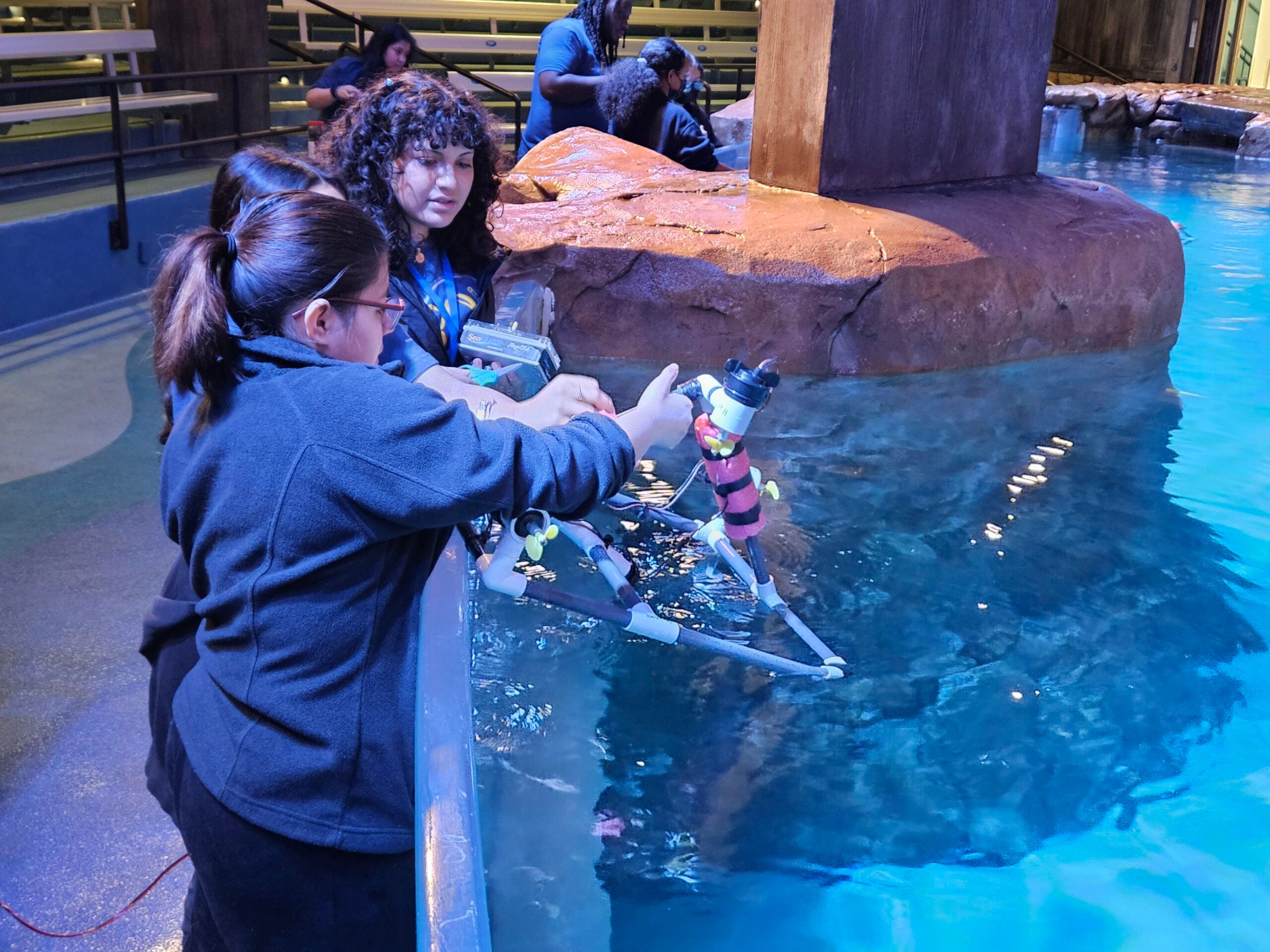
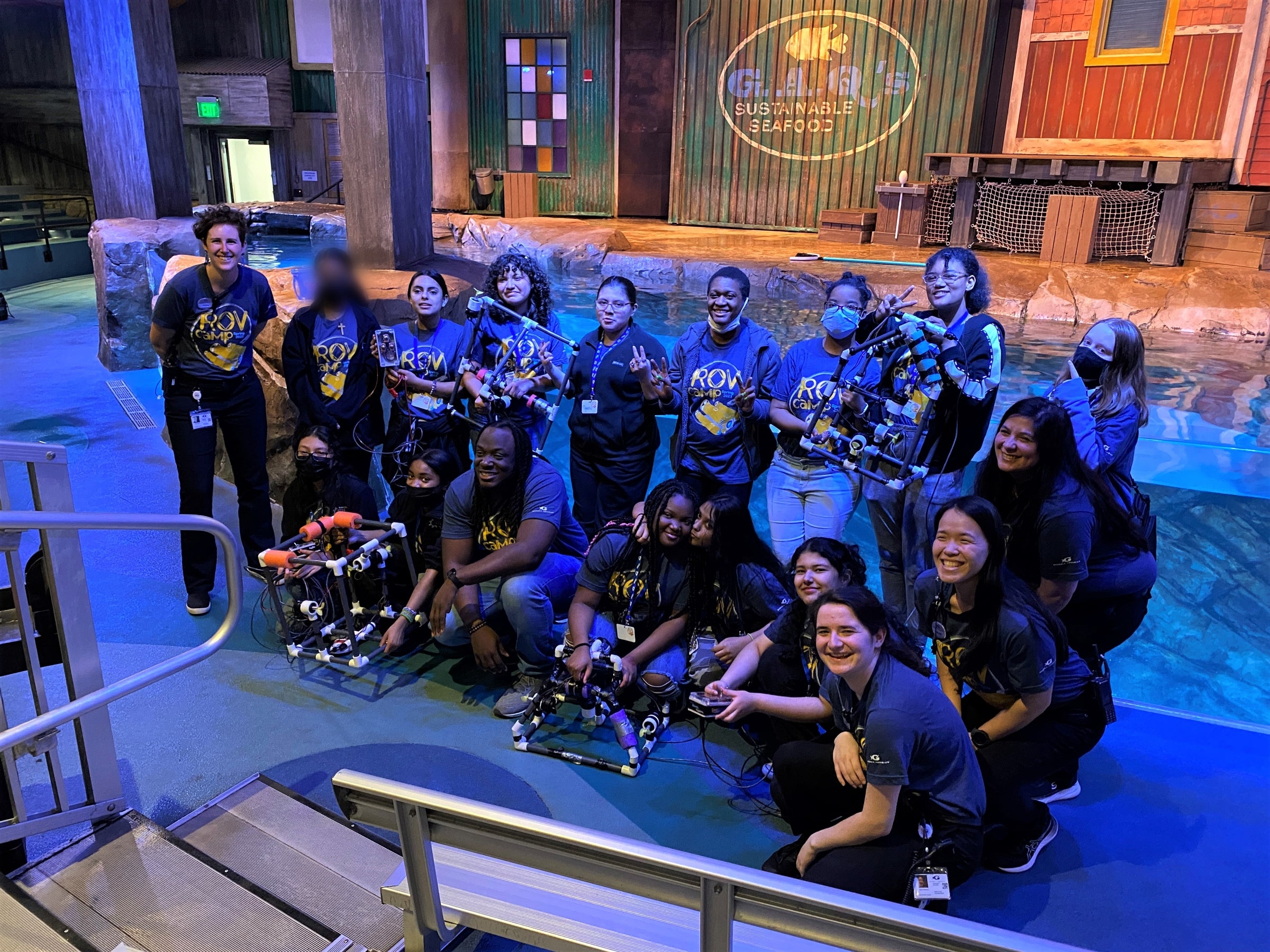
Teaching the next generation of aquatic engineers: Georgia Aquarium’s ROV camp hosted a group of girls from Sweetwater Middle School.

By Billie Snieder, environmental educator, Georgia AquariumTeaching the Next Generation of Aquatic Engineers 2

Have you ever wondered how remote-operated vehicles, or ROVs, are used by scientists to collect data or various samples? Maybe, you are curious how engineers build and fly ROVs in the ocean? Or what challenges they face while building and navigating ROVs? These were some of the questions asked by a group of twelve middle school girls from Sweetwater Middle School during Georgia Aquarium’s ROV camp.

Over the course of five days, these students learned various engineering skills that allowed them to design, assemble, and operate an ROV. They learned how engineers brainstorm solutions by creating, testing, and improving a design. During the first two days, students learned how to strip, splice, and solder wire. They also learned how to ensure their connections were waterproof. Students practiced their navigation skills by flying drones. These skills were then applied to the actual construction of their ROVs. They were able to assemble the control box and attach it to the tether and propellers.

Once the main parts of the ROV were complete, each group designed and built the frame. All four groups were able to take their design from a paper sketch to a finished 3D shape. Taking into consideration the materials available and the need to be waterproof. Led by Georgia Aquarium Environmental Educators, these students were able to integrate STEM skills to complete their Angelfish ROVs from the Marine Advanced Technology Education center (MATE).

The benefits of working in groups, was seeing the different methods of problem-solving and design strategies. They also showed encouragement to one another as they practiced their newly learned skills. Each ROV was uniquely designed, with several different shapes being utilized to construct their frames. Each group faced the challenge of balancing three propellers on the frame, while preventing the ROV from tipping over once submerged.Teaching the Next Generation of Aquatic Engineers 3

These students also had the opportunity to hear from several women in STEM careers. From how ROV engineers utilize biomimicry to design devices that look or act like animals, to understanding how constraints impact design choices. These speakers encouraged the girls to embrace challenges, learn new skills, and pursue their dreams in the STEM field. The students explored the science behind buoyancy and used technology to create a functioning control box. They also applied the engineering design process and geometry skills to construct their frames from PVC pipes. Students also learned how ROVs are tools that help scientists explore the ocean, aid in clean-up projects, and collect data/samples.

The highlight of the week was seeing the students finally test their ROVs in the water. Each group piloted their ROVs in the Sea Lion Pier 225 gallery pool. The groups made a few final adjustments to maintain negative buoyancy. Then all four ROVs were able to successfully navigate and explore the pool. The groups even practiced landing the ROVs on a specific target area. The biggest challenge they faced during this portion of the camp was finding ways to improve the design. One common fix was removing materials to make the ROV less buoyant to navigate more easily through the water column. This gave the students an excellent opportunity to practice the engineering design process as they tested and improved their designs.

Opportunities for exposure to STEM careers are important for young girls, especially young girls of color.  Exposure to new career fields like this can spark a newfound passion for science and engineering. These skills are also extremely valuable regardless of the career they pursue as they learn to problem solve, identify roadblocks, and collaborate with others. One of the biggest takeaways from this was how empowering it can be to work with a team of all women in a traditionally male-dominated field. One of the goals of this camp is to help build not only competency but also confidence in the student’s abilities. As these students continue their education, we hope they will not only continue to pursue their dreams but also share their knowledge and skills as they inspire more young girls, and young girls of color, to join STEM fields.


Ultrasounds on Whale Sharks Deepen Mysteries of This Big Fish

Whale sharks are the ocean’s biggest fish and perhaps its biggest mystery. With the goal of unlocking secrets about female reproduction, new methods were developed to conduct ultrasounds on free-swimming whale sharks.

But the results weren’t exactly what researchers had expected or hoped. The findings, published recently in the journal Endangered Species Research, quash the leading scientific theory that the exceptionally large females with bulging bellies that show up annually in the Galapagos Marine Reserve in Ecuador and near St. Helena Island are pregnant. They aren’t.

It’s a head scratcher, really. We know a lot about male whale sharks, but little about females because they don’t congregate the way males do. We had hoped to confirm that the females were pregnant so we could track their movements and locate important pupping grounds.
- Dr. Al Dove, vice president of Science and Education at Georgia Aquarium and co-author on the research

The research, led by Okinawa Churaumi Aquarium, in collaboration with Marine Megafauna Foundation, Galapagos Whale Shark project and Universidad San Francisco de Quito in Ecuador, included developing underwater ultrasound technology which was coupled with conducting blood draws, a technique developed by Georgia Aquarium on free-swimming whale sharks.

“To our surprise, none of the sharks were pregnant.”
- Dove said.

One of the greatest secrets that whale sharks hold is where they give birth. Truly little is understood about their reproductive lifecycle because only one pregnant female – caught by a commercial fishing boat in 1995 – has ever been examined. Births have never been recorded.

Whale shark populations are declining, and the species is at risk of extinction. The best hope for protecting and conserving them is understanding them – their movements, the habitats they need protected, and what is posing the greatest threat to survival.

That is one reason Georgia Aquarium is shifting their research focus from Galapagos and St. Helena to Taiwan. The only pregnant female ever recorded was caught in Taiwanese waters, and much more needs to be known about the biodiversity, abundance, and migration dynamics of sharks in Taiwan.

The Aquarium, National Taiwan Ocean University (NTOU) and Taiwan’s Fisheries Research Institute (TFRI) recently entered a 10-year conservation program with Georgia Aquarium that will compile baseline data on multiple marine species living off Taiwanese shores. The research will include placing receivers onto fishing trap nets throughout Taiwan’s coastal waters and acoustic tags onto individual animals to track where they travel and for how long.


“There is so much for us to learn about whale sharks, and this partnership has great potential to help us uncover details about the whale sharks who visit these waters,” Dove said. “We are excited to embark on research in this region. There is much to learn and contribute to conservation knowledge for not only whale sharks, but other threatened shark and ray species as well.”

Georgia Aquarium, Taiwan researchers and wildlife officials partner on long-term marine conservation and education project

Georgia Aquarium has formed a unique partnership with Taiwan researchers and wildlife officials to advance scientific knowledge on sharks and rays through a long-term field research collaboration in Taiwanese national waters.

The Aquarium, National Taiwan Ocean University (NTOU) and Taiwan’s Fisheries Research Institute (TFRI) will work together in a 10-year conservation program that will compile baseline data on multiple marine species living off Taiwanese shores. The research will include placing receivers onto fishing trap nets throughout Taiwan’s coastal waters and acoustic tags onto individual animals and to track where they travel and for how long.

The research will include whale sharks, manta rays, bowmouth guitarfish and other threatened and endangered ocean species.

“This partnership has great potential to teach us more about sharks and rays,” said Dr. Alistair Dove, Vice President of Science and Education at Georgia Aquarium. “Working alongside our Taiwanese partners, our scientists will collect information from acoustic tracking and other technology that will contribute greatly to informing strategies to conserve and protect these endangered species.”

There are about 1,250 species of cartilaginous fish in the world, and 190 species of sharks and rays are found in the waters around Taiwan. Pooling the expertise and resources of the three parties, the research is expected to reveal habitat preferences, mobile behavior habits and geospatial distribution of these species. Georgia Aquarium will provide research equipment such as Baited Remote Underwater Videos (BRUVs), fixed acoustic arrays deployed on pelagic trap nets, and satellite tag tracking.
“This partnership will gather national and international resources such as research vessel and tracking devices or software to share valuable knowledge, experience, and technology on chondrichthyan biology, ecology and behavior,” said Hua Hsun Hsu, Ph.D., with the Coastal and Offshore Resources Research Center in Taiwan. “These studies will provide the public knowledge to inspire awareness, and more importantly, submit recommendations to the government for appropriate policies.”

In addition, Hsu said, the collaboration will encourage Taiwanese fishing operators to release sharks and rays they catch. Taiwan has banned fishing of five shark species, including oceanic whitetip, silky, great white, basking and megamouth sharks, and stronger protections are in place for whale sharks, manta rays and all species of sawfish.

Georgia Aquarium research scientists recently began working with Taiwanese experts as the program was developed. Research scientist Dr. Kady Lyons conducted workshops in Taiwan on how to apply tags. Dr. Lisa Hoopes, Director of Research, Conservation and Nutrition at the Aquarium, will travel to Taiwan this spring to work alongside NTOU and TFRI scientists.

Georgia Aquarium is the only aquarium in the Western Hemisphere providing the unique care and habitat required for whale sharks. For 18 years the Aquarium’s experts have cared for whale sharks, compiling unprecedented scientific knowledge about this little-known species and educating more than 40 million people about the world’s largest fish.

“Most of what we know about these species has only been discovered over the past couple of decades,” Dove said. “We have learned a great deal about whale shark behavior and cognition through care and studies in the Aquarium. With the insight of local knowledge of species and their biology paired with the understanding of local conservation threats from our partners, we hope the long-term research study will allow us to unravel the missing pieces to better conserve and protect sharks and rays.”

Georgia Aquarium is committed to advancing marine conservation and protection through science and education, advocacy, connecting and inspiring millions of people every year to save sharks, rays and other threatened species.