

Taylor Weary – Winner of Inaugural Dr. Gregory D. Bossart Memorial One Health Scholarship
The Dr. Gregory Bossart Memorial One Health Scholarship was launched earlier this year by the One Health Commission and Georgia Aquarium for one student, from anywhere in the world, who is leading a graduate or clinical research project focused on the interconnection between animals, people, plants, and their shared environment.
The inaugural $5,000 USD scholarship award will go to:
Taylor Weary for her One Health Project titled, ‘Healthy Children, Healthy Chimps: Reducing respiratory disease transmission from humans to chimpanzees in Uganda’. Taylor is a DVM/Ph.D. student at the University of Wisconsin-Madison School of Veterinary Medicine in Madison, Wisconsin, USA.
See the winning project narrative:
‘Common cold’ pediatric human pathogens have been identified as the causative agents of reverse zoonotic respiratory disease in wild chimpanzees of Kibale National Park, Uganda with outbreak mortality rates of up to 10%. It is hypothesized that these pathogens circulate in children living near chimpanzee habitats, and that adults in those villages become asymptomatically infected and carry the pathogens into the forest potentially infecting chimpanzees. The objectives of this project are to characterize respiratory pathogens in local children, forest workers, and chimpanzees using comprehensive molecular diagnostics and metagenomic DNA sequencing, and to examine the reverse zoonotic transmission risk that varies with pathogen type, season, environment, and the individual characteristics of humans and chimpanzees. Reverse zoonotic respiratory disease is a major threat to all wild apes, and SARS-CoV-2 has been a “game changer” in this regard. This study establishes prospective matched cohorts to identify where, when and how respiratory pathogens move from people to chimpanzees. The data will lead to evidence-based actions to reduce transmission to the approximately 1,500 chimpanzees of Kibale National Park and, by extension, to apes across Sub-Saharan Africa.
Dr. Gregory Bossart, VMD, Ph.D. was a highly respected veterinarian, pathologist, and conservationist committed to advancing the understanding of marine mammals as sentinels of ocean and human health. With a career spanning 30 years and over 200 publications, Dr. Bossart identified resurgent and emerging diseases in dolphins, manatees, birds, and whales. His research and innovative techniques helped characterize the first viral diseases in manatees and he was responsible for developing the first immunohistochemical technique for diagnosing brevetoxicosis (red tide poisoning) in both marine mammals and birds.
Dr. Bossart was also a dedicated proponent of the One Health concept and approach which was a prominent theme in his long-running Atlantic bottlenose dolphin Health and Environmental Risk Assessment (HERA) project. Started in 2003, HERA was developed to monitor how dolphin health in coastal habitats is impacted by environmental stressors and how those stressors potentially also impact human health. His contributions to the study of marine mammal health are far-reaching, and through this scholarship, Georgia Aquarium and the One Health Commission are committed to honoring Dr. Bossart’s One Health legacy. For more information on the Dr. Gregory Bossart Memorial One Health Scholarship, click here
This article was published on: November 30, 2021
Holiday Gift Guide
Work continues for the conservation of Whale Sharks in the Galapagos Islands
Work continues for the conservation of Whale Sharks in the Galapagos Islands after a decade since the creation of the project.
A team of scientists from the Galapagos Whale Shark Project (GWSP), the Galapagos National Park Directorate (DPNG), and the Georgia Aquarium (GA) embarked upon a second annual expedition to Darwin Island on the week of the 9th of September. The expedition goal was to carry out fieldwork for the long-term study on the unique grouping of whale sharks sighted passing by seasonally in the waters of the far northern region of the Galapagos Archipelago.
The Galapagos Whale Shark Project, cofounded by Dr Alex Hearn and Jonathan R Green a decade ago, has been working to better understand the movement ecology and reproductive biology of female adult whale sharks sighted in greater numbers in the Galapagos than anywhere else in the world. Since the beginning of the project, the scientists from the GWSP have carried out groundbreaking science for the conservation of this endangered species, working in collaboration with multiple organizations and expert scientists from around the world.
This year, the team, reduced to small numbers due to the continued impact of the COVID-19 pandemic for travel and global collaborations, was made up of five members from the abovementioned organizations.
During a week of work, they carried out various field methods to gather data that will continue to shed light on the remaining mysteries of this species. During this expedition, the main activities carried out were photo-ID of four whale sharks, satellite tagging (SPLASH tags) of four sharks, tagging with animal-bourne video cameras (CATS) of one shark, and sampling of the microbiome of two of the sharks.
The data from the photo-ID and the satellite tagging provides information of estimates on population size, residency indexes, mortality, and allows for both passive and active tracking of the animals, respectively. Satellite tagging also provides information on the activities. Galapagos Whale Shark Project Press Release Image 1. A satellite tag was placed on the dorsal fin of a whale shark. ©Sofía M Green performed by the whale sharks underwater, giving insight about their diving behavior and habitat preference and use in the water column.
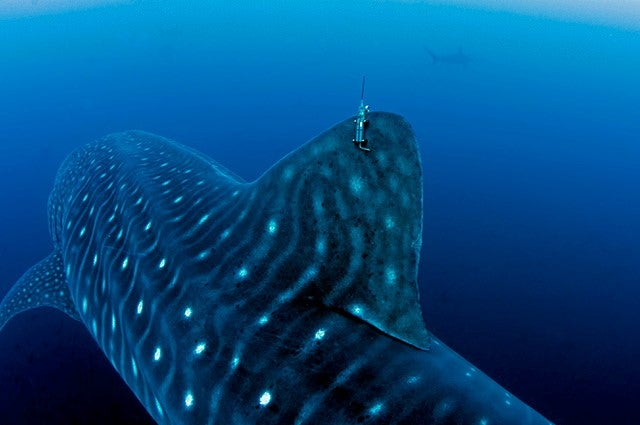
Meanwhile, the animal-bourne video cameras allow a visual insight of their movements underwater and any possible interactions with other individuals both inter- and intra-specific in areas not easily observed by the human eye, while also avoiding any change in behaviour that may occur from human presence. The camera’s also have inbuilt accelerometers which allow fine scale resolution data collection of their movements in different planes during various activities such as foraging, navigating, diving, and more.
The microbiome samples serve for innovative research which is looking at the role of body-associated microbiomes in determining elasmobranch health and how the unique microbiome might be involved in host immunity, nutrition, disease and waste- processing.
This year the Galapagos Whale Shark Project team reports a low frequency of whale shark sightings which are probably influenced by the fluctuation of sea surface temperatures (SSTs) due to climatic patterns such as the warming of waters with El Niño Southern Oscillation (ENSO) and the cooling counter event of La Niña. Specifically in 2021 NOAA reports a neutral climate state with “near to below average” SST’s with a 70-80% chance of La Niña during the northern hemisphere winter 2021-22.
Jonathan R Green states “The lower SSTs in April and May brought early sightings of whale sharks but in June and July temperatures again rose with a corresponding decrease in numbers and frequency of sightings from reports from the dive Masters, visiting divers, [and our team].” With climate change it is predicted that the Oceanic phenomena’s such as El Niño and la Niña will occur with higher frequencies and thus it is probable that this will affect the regularity with which whale sharks are sighted in their known aggregation locations. The shift in seasonal sightings and possibly also location of sightings make it more complicated to apply proper measures of management for the conservation of this species. The impact of climate change on this species is uncertain and is being considered in current and future studies.
The GWSP would like to thank the Galapagos National Park Directorate (DPNG), the Georgia Aquarium (GA), the Galapagos Science Center (GSC), the Galapagos Conservation Trust (GCT), the World Wildlife Fund (WWF), Save Our Seas Foundation (SOSF) and Galapagos Shark Diving (GSD) for their funding and/or support in this project.
For further information:
galapagoswhalesharkproject@gmail.com
This article was published on: September 23, 2021
Georgia Aquarium to Reduce Emissions Footprint with Greener Life ® For Business from Georgia Natural Gas
Georgia Natural Gas (GNG), Georgia’s leading natural gas provider, and Georgia Aquarium today announced that the Aquarium is the first organization to take advantage of Greener Life® for Business, a new service from GNG that purchases carbon offsets on behalf of GNG’s commercial customers to make emissions from their natural gas use carbon neutral.
Greener Life for Business demonstrates how GNG can play an important role in helping commercial and industrial customers offset emissions while still maintaining day-to-day operations. Through the program, businesses can reduce their emissions footprint significantly without the complications associated with building new infrastructure or replacing appliances.
“We are thrilled to be partnering with Georgia Aquarium, enabling them to continue relying on natural gas for their operations while also making strides toward their environmental goals,” said Mike Braswell, GNG president and CEO. “GNG is proud to offer this program to support the work of local businesses and contribute to reduced emissions with the use of natural gas.”

Georgia Aquarium is always looking for innovative ways to reduce our environmental impact. Our partnership with Georgia Natural Gas and the Greener Life for Business program provides us the opportunity to reduce our emissions and promote a cleaner, healthier planet.
“GNG’s Greener Life for Business program is the latest initiative from the Southern Company Gas family that supports our mission to fuel a cleaner future,” said David Weaver, senior vice president of external strategy and environmental affairs at Southern Company Gas. “Many commercial and industrial processes rely on the unique, high-heat properties that natural gas provides. It’s often not easy – nor affordable – for these businesses to find alternatives. Our goal is to support the continued use of clean, safe, reliable and affordable natural gas across multiple industries while helping businesses both large and small reduce their environmental footprint.”
The Greener Life program also makes it easy for consumers to reduce their emissions footprint at an affordable rate of only $4.99/month. For a limited time, residential customers who sign up for Greener Life will receive their first six months free.
For all those participating, GNG uses Environmental Protection Agency standards to calculate the amount of greenhouse gases released into the atmosphere from customers’ use of natural gas. GNG then purchases and retires carbon offsets to balance the impact of those customers’ emissions.
GNG has purchased carbon offsets from the Wolf Creek Landfill Project in Georgia and the Doe Mountain Forest Improvement Project in Tennessee. Each quarter, GNG will retire enough carbon offsets on behalf of residential and commercial participants to completely offset the greenhouse gases released by their natural gas use the prior quarter.
Residential consumers looking to lessen their environmental impact can visit gng.com/greenerlife.
Additional information on Greener Life for Business can be found at gng.com/business/green.
###
About Georgia Natural Gas
Georgia Natural Gas is part of SouthStar Energy Services. SouthStar is owned by Southern Company Gas, a wholly-owned subsidiary of Southern Company (NYSE: SO). SouthStar also operates as Ohio Natural Gas, Florida Natural Gas, Maryland Energy, Pennsylvania Energy, Grand Rapids Energy (in Michigan), and in other parts of the Southeast as SouthStar Energy Services. SouthStar’s subsidiaries in Illinois operate as Illinois Energy and Illinois Energy Solutions.
About Southern Company Gas
Southern Company Gas is a wholly-owned subsidiary of Atlanta-based Southern Company (NYSE:SO), America’s premier energy company. Southern Company Gas serves approximately 4.3 million natural gas customers through its regulated distribution companies in four states with approximately 666,000 retail customers through its companies that market natural gas. Other businesses include investments in interstate pipelines and ownership and operation of natural gas storage facilities. For more information, visit southerncompanygas.com.
This article was published on: September 9, 2021
Georgia Aquarium Shares Results of Largest-ever Cetacean Welfare Study
ATLANTA – Georgia Aquarium is announcing the peer-reviewed journal PLOS ONE published findings from the Cetacean Welfare Study, the largest-ever groundbreaking, multi-institutional study of how physical habitat, environmental enrichment, and animal training impact the welfare of cetaceans in zoos and aquariums worldwide. The collection of nine manuscripts highlights tools and findings that can be utilized for the continuous improvement of the care and welfare of cetaceans in professional care.
From Chicago to Singapore, data was collected across 46 cetacean habitats at 43 accredited facilities in seven countries. Over the course of the data collection phase of the study, which took place in 2018 and 2019, scientists gathered information regarding 216 common and Indo-Pacific bottlenose dolphins, 13 beluga whales, and eight Pacific white-sided dolphins.
Georgia Aquarium contributed physiological data from its common bottlenose dolphins and beluga whales. Specifically, the dolphins at the Aquarium wore special packs that collected data on their behavior, swimming, spatial use, and videos were collected to gain insight into their behavior and social interactions. This data from the dolphins and beluga whales ultimately added to the robust set of information that would inform these findings on cetacean health and welfare.
Using cutting-edge technology, the study explored cetacean welfare through various lenses, including habitat characteristics, training programs, environmental factors, and demographics like age and sex. An important outcome of the work was a whole new set of research tools, including the creation of an iOS app, ZooPhysioTrak—a comprehensive database of health and welfare biomarkers from all the participating institutions that provides veterinarians and cetacean care managers with standard health reference intervals and welfare indicators to compare their animals’ test results (from blood and fecal samples). This resource places important health and welfare information directly into the hands of cetacean caregivers and managers like never before.
“Thirty-four Alliance of Marine Mammal Parks and Aquariums member facilities from all over the world eagerly participated in this groundbreaking study in order to contribute to an increased understanding of cetacean welfare,” said Kathleen Dezio, AMMPA president and CEO. “We commend Dr. Lance Miller and his colleagues on this cutting-edge research that will empower zoo and aquarium professionals with important new tools and insights to help them continue to enhance the welfare of the inspiring animals in their care.”
Additionally, findings suggest the environmental enrichment programs and social management of bottlenose dolphins are more closely related to behaviors likely indicative of positive welfare than habitat characteristics. This suggests that welfare is less related to the size of the animals’ habitat, and more related to how the mammals are cognitively challenged through their environment enrichment and appropriate social management. Coming out of the study, institutions implemented additional protocols to their already existing and robust enrichment programs to continually grow and enhance them based on findings from this study.
“Association of Zoos and Aquariums members are known for providing the best care and welfare possible for their animals. This groundbreaking study provides new insights into how our members can better care for cetaceans. The important science-backed findings will also help enhance our rigorous accreditation standards related to cetaceans,” said Dan Ashe, president and CEO of the Association of Zoos and Aquariums.
These findings, and others from the study, will be used to enhance cetacean care and welfare best practices, and will advise future animal welfare research, which advances the goal of zoos and aquariums everywhere to continuously improve knowledge and welfare assessment tools for species under professional care.
This article was published on: August 31, 2021